Crystal Palace Triumphs 3–1 Over 10-Man Tottenham in Premier League Clash
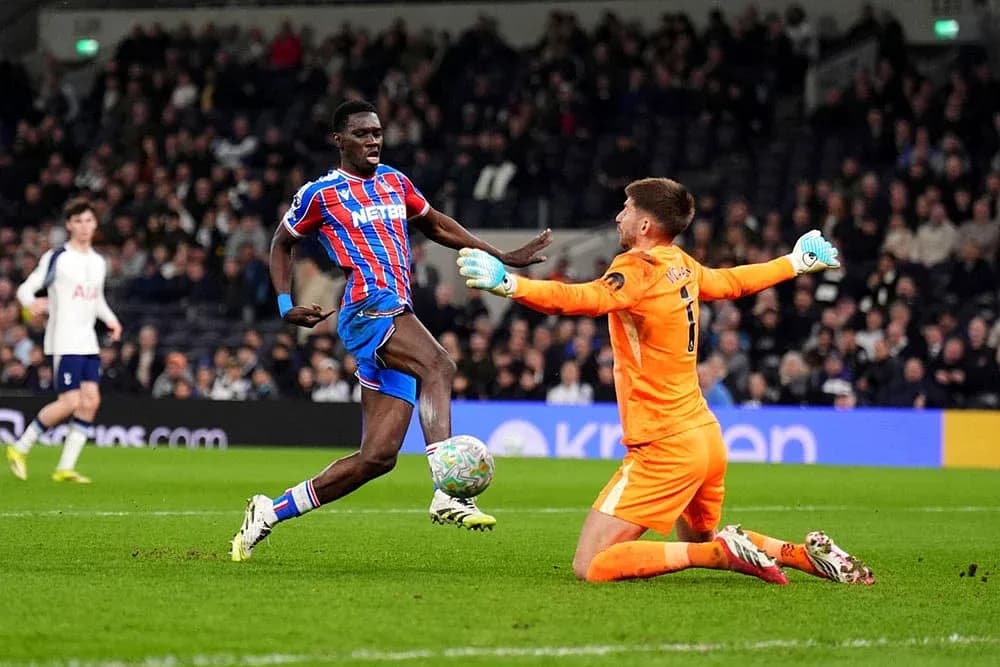
Under the lights at the Tottenham Hotspur Stadium, Crystal Palace produced a ruthless 3–1 win over a beleaguered Tottenham side whose night unraveled after a first-half red card. In this Premier League Round 29 clash, Spurs, starting the evening 16th with 29 points, briefly led through Dominic Solanke but collapsed defensively once reduced to 10 men. Palace, 13th with 38 points, showed far greater control and composure, with Ismaïla Sarr’s brace and Jørgen Strand Larsen’s strike turning the game decisively before the interval.
First Half Analysis
The tone was set early for Tottenham’s chaotic evening. Souza went into the book on 7' for a foul, a sign of the home side’s frantic edge out of possession. Palace then made a proactive change on 14', with Nathaniel Clyne replacing Daniel Muñoz, a like-for-like switch that maintained their wing-back structure.
Palace initially thought they had struck first when Sarr found the net on 32', only for VAR to rule the effort out. That reprieve seemed to galvanise Spurs. On 34', Archie Gray slipped a clever pass into the final third and Solanke finished clinically for a goal from open play, giving Tottenham a 1–0 lead against the run of possession.
The match pivoted six minutes later. On 38', Micky van de Ven was sent off for a professional foul as the last man, leaving Spurs to defend their lead with 10 men and forcing a tactical rethink. Palace capitalised almost immediately: on 40', Sarr converted from the penalty spot to level the game.
Tottenham’s discipline continued to fray. Pape Matar Sarr was booked for dissent on 25', and with their structure crumbling after the red, Ange Postecoglou reacted on 43' with a double change: Yves Bissouma replaced Randal Kolo Muani, and Conor Gallagher came on for Souza, shifting Spurs towards a more compact, midfield-heavy shape. It did not stem the tide. In first-half stoppage time, Palace struck twice from open play: Strand Larsen made it 2–1 on 45' from an Adam Wharton assist, before Sarr, again supplied by Wharton, swept home a third, giving Palace a 3–1 half-time lead and leaving Spurs shell-shocked.
Second Half & Tactical Shifts
With a two-goal cushion and a man advantage, Palace emerged after the break intent on structural control rather than all-out attack. They circulated possession patiently, using their back three and double pivot to stretch a Tottenham side now in a 3-4-1 or 4-4-1 hybrid, depending on the phase.
On 67', Oliver Glasner freshened his front line, sending on Brennan Johnson for Evann Guessand. This kept Palace’s press energetic without sacrificing width. Tottenham, chasing the game, made an attacking gamble on 74': Xavi Simons replaced right wing-back Pedro Porro, and Richarlison came on for Solanke. Removing a defender for an advanced playmaker was a clear signal Spurs were prepared to risk transition moments to find a route back.
Palace responded with further control-oriented changes on 81'. Christantus Uche replaced Strand Larsen, adding fresh legs between the lines, while Will Hughes came on for Wharton, swapping one composed passer for another to manage the tempo and protect the lead.
The closing stages were scrappy. Bissouma, already central to Spurs’ reconfigured midfield, was booked for dissent on 82', encapsulating the frustration of a side staring at a fifth straight league defeat. Clyne collected a yellow card for a foul on 90+2', one of several niggly challenges as Palace protected their advantage. Despite Tottenham’s late forward surges, Palace’s back line, led by Chris Richards and Chadi Riad, held firm, limiting clear chances and preserving a comfortable 3–1 scoreline.
Statistical Deep Dive
Palace’s 60% share of the ball underlined how they conceded possession only selectively, preferring to dictate rhythm once ahead. They completed 402 of 463 passes (87% accuracy), compared to Tottenham’s 242 of 311 (78%), reflecting more measured and precise build-up from the visitors.
The shot profile was relatively balanced but context matters. Spurs had 12 total shots to Palace’s 9, with both sides registering 4 shots on target. However, Palace’s xG of 1.78 outstripped Tottenham’s 1.09, indicating that the visitors carved out the better quality chances, particularly around the penalty and Sarr’s close-range finishes.
Defensively, Palace made 5 blocks against Tottenham’s 3, illustrating how often Spurs were forced into crowded shooting lanes. Both teams committed 14 fouls, but the disciplinary ledger was far harsher on the hosts: three yellow cards and a crucial red for van de Ven, versus two yellows for Palace. That numerical disadvantage, combined with Palace’s superior pass accuracy and shot quality, defined the contest.
Standings & Implications
For Tottenham, stuck on 29 points in 16th place, this defeat deepens an alarming slide, their form line of “LLLLL” now backed by another damaging home loss. Relegation anxiety will only intensify given their fragile home record and defensive frailty. Crystal Palace, by contrast, consolidate 13th spot on 38 points, with a “WLWLW” pattern suggesting a side trending upwards. This controlled away performance, built on structure, efficiency and Sarr’s cutting edge, strengthens their mid-table security and offers a platform to look up the table rather than over their shoulder.