England's World Cup Chances and Phil Neville's Role
World Cup on the horizon, England under the microscope, Manchester United plotting another grand redesign of the midfield. And somehow, in the middle of it all, Phil Neville is the supposed “shock” story.
He isn’t. The real intrigue lies elsewhere.
England, a ‘warning’ and a supercomputer with common sense
England’s World Cup chances have already been fed into The Sun’s so‑called supercomputer, which has spat out a “miserable verdict”: Gareth Southgate’s side are only the third favourites.
Only.
Behind Spain and France, England are given an 11.3% chance of winning the tournament. That’s not doom. That’s exactly where bookmakers broadly have them – in the pack, dangerous, but not nailed on.
Yet the headline message is that “ENGLAND fans have been warned that the nation’s wait for an international trophy may not end this summer.” As if supporters needed a computer to tell them that not every one of the 48 teams in an expanded World Cup gets to lift the trophy.
Reality check: England are well placed, but football still refuses to guarantee anything.
Phil Neville’s ‘shock role’ that wasn’t
So to Neville, presented as the headline twist in England’s build‑up.
“Phil Neville’s shock role for England at World Cup revealed just TWO WEEKS after ex-Man Utd star sacked by MLS team,” screamed one Sun headline, implying some clandestine late recruitment, a desperate lunge for help.
Strip away the drama and the story is straightforward. Neville, along with fellow coach John Herdman, was asked by Thomas Tuchel to discuss the practical challenges of playing a World Cup in the United States – climate, time zones, travel, even traffic. England tapped into their experience. Sensible, basic due diligence.
It is not a secret, and it is certainly not new.
Neville himself laid out the entire process in a column for The Times last week. He described how, while managing Portland Timbers, he took a call from FA technical director John McDermott last year. McDermott wanted to “pick his brain” about what England might face at a US‑based World Cup.
This is a former England international, part of the national coaching setup in the past, and a manager who took a women’s team to two tournaments in the States. He has spent five years working in American football. Of course the FA asked him about acclimatisation and logistics. Of course they did it long before this month.
So the “shock role” turns out to be a 90‑minute Zoom chat about travel plans and conditions, arranged last year, fully explained by Neville in print days ago.
The only surprise is that anyone tried to dress it up as a revelation.
World Cup fever, New York style
While England quietly lean on expertise, The Sun sent Martin Lipton to Manhattan and came back with a different kind of verdict: New York, he wrote, has “NO appetite for World Cup fever”.
His evidence? A Monday morning scan of three New York newspapers. No Harry Kane. No Lionel Messi. No Cristiano Ronaldo. Instead, coverage of the NBA playoffs, the Yankees, the Mets and the MLB season in full swing.
In other words, American sports pages are currently dominated by the sports actually being played.
The World Cup hasn’t started. The NBA playoffs have. Baseball is rolling through its marathon schedule. That’s not apathy; that’s a news agenda.
England’s base and a ‘notorious’ sideshow
Back on England duty, there is always room for another angle. This time, it’s the location of the national team’s training base, which The Sun reports is next to a “notorious dogging spot loved by randy couples”.
Cue a deep dive into Swope Park, described as so popular for dogging and cruising that it appears on adult websites and social media apps. One Facebook post is quoted asking, “Anyone know what goes on at Swope Park at night?” The answer, apparently, involves frisky adults parking near a golf course and meeting by the Grecian‑style Thomas H. Swope Memorial, not far from the pitches England will use.
It is the kind of story only a foreign editor with an incognito browser and a strong stomach for local folklore tends to unearth. Essential to England’s tactical plan? No. But irresistible tabloid colour all the same.
United, PSG and a midfield dream
While England pore over logistics and locations, Manchester United are once again sketching out a new midfield blueprint.
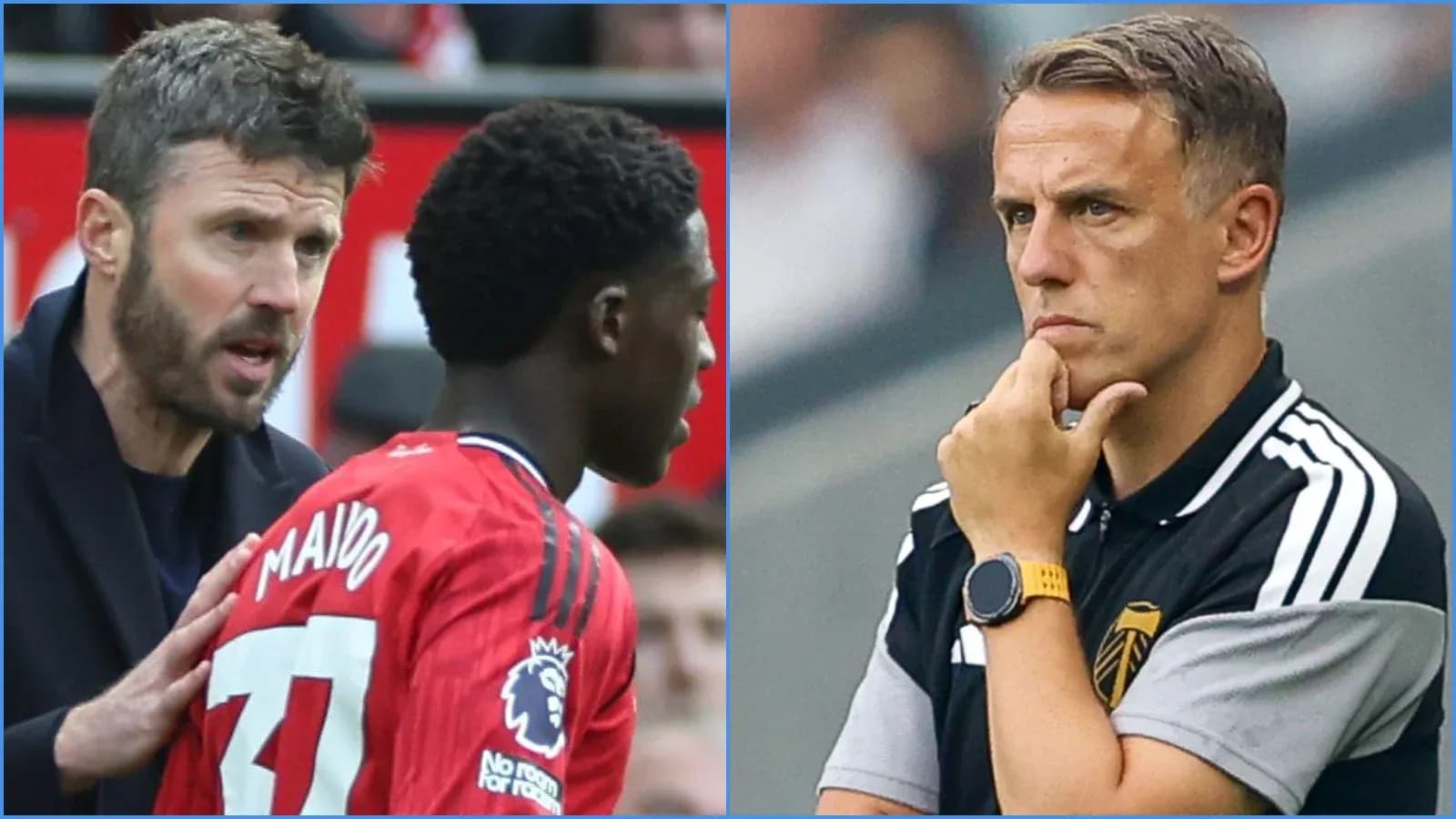
“Man Utd set to create PSG-style midfield with £35m transfer and new role for Kobbie Mainoo,” runs one headline, selling the notion that Old Trafford’s hierarchy intend to mirror the engine room of back‑to‑back European champions and, right now, the best team in the world.
The reported plan is simple enough: move Bruno Fernandes deeper, give Kobbie Mainoo licence to roam further forward, and sign Ederson for £35m. That, we’re told, is the “new role” for Mainoo – playing as a midfielder.
The comparison is clear. United want a trio that echoes the balance and control of PSG’s Vitinha, Fabian Ruiz and Joao Neves. Michael Carrick, now on the outside looking in, is said to view that Iberian core as the benchmark for United’s overhaul.
But there is a gulf between admiration and imitation. PSG’s midfield is not just three names on a teamsheet. It is a unit honed at the highest level, three intelligent, technically immaculate players who understand space, tempo and pressure as a collective.
United’s “PSG-style” vision leans heavily on shuffling one player back, nudging another forward and dropping in a Brazilian who did not make his country’s World Cup squad ahead of a 32‑year‑old Fabinho and is replacing a 34‑year‑old at club level.
The ambition is clear: copy the best. The method feels like a shortcut.
A headline twist that isn’t one
The appetite for a clever line does not stop with United.
“Trent Alexander-Arnold Liverpool reunion to be announced as four-year deal is signed,” teased the Liverpool Echo. It sounds like the right‑back is heading back to Anfield on some dramatic new contract.
He isn’t. The story is that Ibrahima Konate is joining Real Madrid. A “reunion” with Alexander-Arnold, then, only in the sense that they might face each other in Europe.
Wordplay wins, clarity loses.
Arteta’s ‘shock’ and a doctor’s exit
At Arsenal, the same trick appears again.
“Mikel Arteta rocked as key staff member leaves Arsenal just weeks after stunning Premier League title win,” declares The Sun. It suggests an aftershock, a destabilising departure in the glow of success.
The reality is starker and simpler. Arsenal have dismissed their head doctor after a review into this season’s injury problems – a review led by Arteta himself.
The man who commissioned the investigation is unlikely to be “rocked” by one of its consequences. This is not a betrayal. It is a decision.
England are leaning on experience to navigate America. United are trying to reverse‑engineer Europe’s best midfield. Arsenal are cutting into their own backroom to stay ahead of the curve. The headlines shout about shocks and drama, but the real story is more interesting: the game’s biggest institutions are quietly reshaping themselves for what comes next.