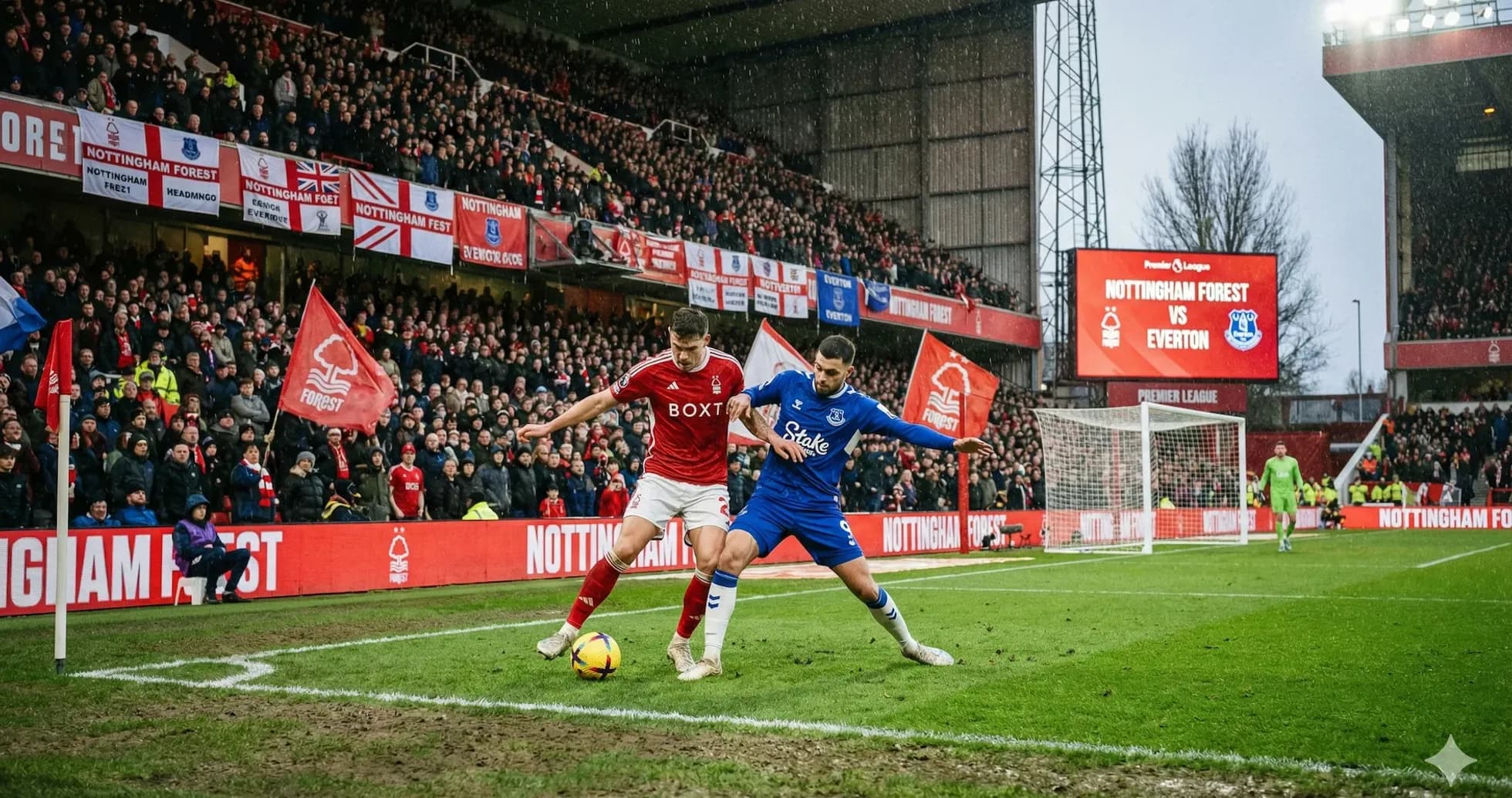
Everton's 2-0 Victory Over Nottingham Forest: Match Analysis
In a tense encounter at the City Ground, Everton claimed a disciplined 2–0 win over Nottingham Forest, reinforcing their status as a difficult side to break down away from home. Officiated by Michael Oliver, the match followed a familiar pattern: Forest monopolised the ball and territory, but Everton were sharper in the moments that mattered and managed the game expertly once ahead. The win lifts Everton into eighth place on 28 points, while Forest remain 17th on 18 points, precariously positioned just above the relegation places.
First Half Analysis
Nottingham Forest began with urgency, trying to impose themselves through sustained possession and repeated deliveries into the box. Everton, however, looked comfortable defending in a compact shape, prioritising structure over risk and waiting for counter-attacking opportunities to appear. That approach paid off in the 19th minute when Everton struck with their first major moment of quality. Dwight McNeil slipped a clever pass into the path of James Garner, who worked half a yard of space and finished clinically into the far corner. Crucially, it was Everton’s first shot on target — a sign of their efficiency rather than volume.
Forest responded by turning the screw. They enjoyed long spells of possession and pushed numbers forward, probing down the flanks and looking to overload Everton’s defensive line. Yet for all their control, clear chances were limited early on. Forest’s first meaningful effort on target did not arrive until late in the half, when a whipped set-piece forced Jordan Pickford into an awkward save. Everton were content to absorb pressure, defend crosses aggressively, and slow the tempo whenever possible, ensuring Forest’s dominance rarely translated into clean looks at goal.
By halftime, the hosts were behind despite controlling the game territorially. The underlying story was already emerging: Forest had plenty of the ball and a stream of attempts, but Everton were comfortable conceding low-percentage shots, trusting their defensive organisation and Pickford’s command of his area.
Second Half Narrative
Forest sought to change the rhythm immediately after the break, making a midfield adjustment designed to add thrust and a more direct threat between the lines. Douglas Luiz was introduced to inject energy and urgency, and the hosts tried to increase the pace of circulation to pull Everton out of shape. The pattern, however, remained frustratingly similar for Forest: they could get into advanced areas, but Everton defended the penalty area with discipline and cleared their lines effectively.
As Forest continued to press, Everton’s defensive performance became the defining feature. The visitors dealt with a heavy volume of crosses and second balls, while Pickford remained reliable when called upon. Forest also made changes to chase the game, bringing on additional attacking options as they searched for a moment of clarity in the final third. Everton, by contrast, focused on game management — protecting central zones, preventing transitions, and picking their moments to break.
The decisive second goal arrived in the 79th minute and perfectly captured Everton’s approach. Garner, already the scorer, turned provider with a well-timed pass that sent Thierno Barry through into space. Barry kept his composure and finished to double the lead, effectively killing the contest. It was a ruthless blow for Forest: after so much territorial dominance, they found themselves two goals down to a side that had spent long periods without the ball but maximised its best opportunities.
Forest continued to push in the closing stages, but the urgency began to look more frantic than coherent. Everton, meanwhile, stayed compact, controlled the clock, and protected the clean sheet without needing to overextend themselves.
Statistical Deep Dive
The match statistics underline the theme of contrasting efficiency. Nottingham Forest finished with 70% possession, 21 shots, and six on target, alongside nine corners, reflecting sustained pressure and repeated entries into the final third. Everton, despite having only 30% possession, were more clinical: 11 shots and three on target, yet two goals — the clearest indicator of how effectively they converted their best moments.
The key point is not that Forest lacked effort or territory, but that their shot selection and finishing did not match the scale of their dominance. Everton’s defensive organisation consistently forced Forest into crowded areas or rushed attempts, and when chances did arrive, Pickford and the back line handled them. In contrast, Everton’s attacking moments were fewer but cleaner, and both goals came from well-executed actions in transition.
Individual Performances
James Garner was the standout performer, combining composure in front of goal with the intelligence to deliver the decisive pass for Everton’s second. His contribution — a goal and an assist — gave Everton the edge in a game where fine margins mattered. Jordan Pickford also played a pivotal role, commanding his area and making important interventions that prevented Forest from building momentum through an equaliser.
For Nottingham Forest, there were flashes of creativity in advanced areas, and their attacking players worked hard to generate pressure, but too many actions broke down at the moment of execution. The substitutions were aimed at increasing urgency and directness, yet Everton’s defensive structure held firm, and Forest never found the consistent final pass or finish required to turn dominance into goals.
Match Significance & Conclusion
This was a significant away win for Everton — not because they dominated proceedings, but because they executed their plan with discipline and maturity. The result moves them into eighth place on 28 points, keeping them firmly in the top-half conversation and highlighting their ability to win even when the flow of the game is against them.
For Nottingham Forest, the defeat leaves them 17th with 18 points, still outside the relegation zone but with little margin for error. Their broader issue remains the same: possession and pressure are not translating into goals consistently enough. Unless they can improve their cutting edge in the final third, matches like this — where the stats look favourable but the scoreboard does not — will continue to drag them toward a relegation battle.