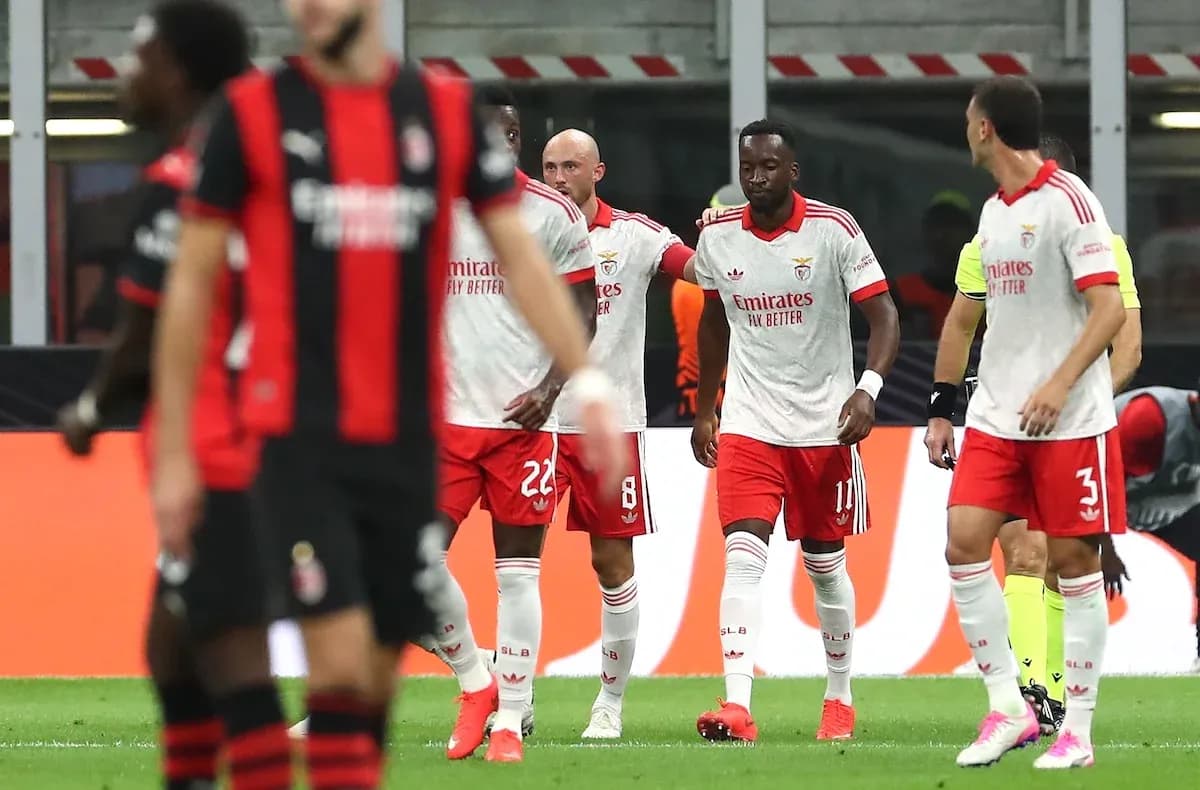
FC St. Gallen Triumphs Over Benfica in Europa League Qualifying
FC ST. Gallen’s 2-1 win over Benfica at Kybunpark was a classic Europa League qualifying tie where structure and mentality outweighed pure control of the ball. Benfica owned possession (62% to 38%) and completed far more passes (479 to 284), but St. Gallen’s 3-5-2 was built to suffer without the ball and explode when spaces opened, especially in and around the box. With 14 of their 17 shots coming from inside the area, the Swiss side turned territorial inferiority into territorial efficiency, repeatedly attacking the weak points of Benfica’s 4-2-3-1.
Out of possession, Enrico Maassen’s 3-5-2 was compact and vertically disciplined. The back three of T. Gaal, Jozo Stanić and Cédric Okoroji held a relatively narrow line, inviting Benfica to circulate across the back four and double pivot rather than play directly through the centre. The wing‑midfielders M. Stevanovic and H. Vandermersch dropped to form a situational back five, while Lukas Görtler and L. Daschner worked as hybrid eights: screening passes into Rafa Silva and G. Sudakov, then jumping out to press when the trigger came (usually a backwards or square pass in Benfica’s half).
This scheme conceded territory but protected the most dangerous zones. Benfica did manage 14 total shots, yet only 10 came from inside the box and just 4 tested the goalkeeper. That balance hints at St. Gallen’s success in forcing Benfica to shoot under pressure or from imperfect angles. When the press was broken, the central trio collapsed quickly, accepting fouls as a pressure valve — St. Gallen finished with 15 fouls and 3 yellow cards, all explicitly for “Foul”, underlining a calculated, physical edge to their defending.
In transition, St. Gallen’s plan was clear: win the first or second ball and immediately look for A. Balde and C. Witzig attacking the channels. The opening goal at 37’ captured this dynamic perfectly. Winning possession and breaking Benfica’s rest‑defence, Görtler surged forward from midfield to assist Balde, who exploited the space behind the full‑back. That move reflected the structural weakness of Benfica’s 4-2-3-1 on the day: with full‑backs high and the double pivot stretched, the first vertical pass after a turnover often found St. Gallen runners facing an exposed back line.
The second St. Gallen goal at 80’ – T. Gaal arriving to score from a Daschner assist – showed how the home side grew bolder as Benfica chased the game. With Benfica committing more bodies forward, St. Gallen’s wide centre‑backs were encouraged to step into midfield, creating overloads on the flanks and surprising Benfica’s block. Gaal’s late yellow card at 90+4’ for “Foul” was almost symbolic of his dual role: aggressive in stepping out to defend, aggressive in stepping in to attack.
Benfica’s 4-2-3-1 had the ball but not the same clarity between the lines. Manu and J. Kaminski as the double pivot ensured clean build‑up and helped produce 394 accurate passes, but too often the circulation was horizontal. Rafa Silva and Sudakov sought pockets between St. Gallen’s midfield and defence, yet the Swiss back three’s narrowness and the work rate of Görtler and Daschner squeezed those spaces. Benfica’s best moments came when V. Pavlidis could combine with Rafa Silva on the half‑turn, as in the 44’ equaliser: Pavlidis dropping to link and Rafa attacking the gap. But those sequences were too rare.
As Benfica pushed in the second half, Marco Silva turned to his bench to alter the attacking structure. At 66’, T. Gouveia (IN) came on for J. Kaminski (OUT), and E. Barrenechea (IN) replaced M. Figueiredo (OUT), signalling a shift towards more vertical, risk‑taking profiles in advanced areas. Later, F. Ivanovic (IN) came on for Pavlidis (OUT) at 76’, adding fresh movement up front, and J. Rego (IN) replaced Manu (OUT) at 84’ to inject extra attacking intent from midfield. The pattern, however, remained: more Benfica possession, but St. Gallen’s low‑to‑mid block continued to funnel them into crowded central lanes or wide crosses that the back three could manage.
Maassen’s substitutions were more about energy management and preserving the structure than changing it. At 72’, A. Hunziker (IN) came on for C. Witzig (OUT), L. Frokaj (IN) replaced C. Boukhalfa (OUT), and D. Besio (IN) entered for Balde (OUT). The front line was refreshed, but the 3-5-2 framework stayed intact: two mobile forwards ready to counter, five across midfield to close lanes. At 90+3’, J. Ruiz (IN) came on for J. Stanić (OUT), a defensive substitution to protect the lead in the closing moments.
Between the posts, L. Ati Zigi (FC ST. Gallen) and A. Trubin (Benfica) both had to live with the game’s tactical narrative. St. Gallen allowed more of the ball but fewer clean looks, and Ati Zigi (FC ST. Gallen) was required to make 3 saves. Trubin (Benfica), despite his side’s territorial dominance, faced 6 shots on target and made 4 saves, underlining just how incisive St. Gallen were when they did reach the final third.
Set‑pieces and rest‑defence were another subtle but decisive battleground. St. Gallen earned 6 corners to Benfica’s 5 and 13 free kicks in their favour, often using dead‑ball situations to push their centre‑backs high and pin Benfica deep. Conversely, Benfica’s 15 free kicks and 13 fouls conceded show that they were regularly forced into recovery challenges against transitions rather than controlled tactical fouling high up the pitch.
Discipline further reflected the tactical tone. St. Gallen’s three yellow cards – Lukas Görtler (Foul at 30’), Jozo Stanić (Foul at 62’), and Tom Gaal (Foul at 90+4’) – mapped directly onto moments where their aggressive block had to be reset. Benfica’s lone booking, Vangelis Pavlidis (Foul at 65’), came as he tried to press and recover the ball in a phase where his team were chasing the game.
In statistical terms, Benfica’s profile – more possession, more passes, slightly fewer shots (14 to 17) but a marginal edge in blocked efforts (4 to 3) – is typical of a dominant favourite. Yet St. Gallen’s 14 shots inside the box to Benfica’s 10, and their higher volume of shots on goal (6 to 4), reveal a tactical plan that prioritised quality of chance over quantity of possession. The 2-1 scoreline mirrored that balance: Benfica controlled the ball, but St. Gallen controlled the spaces that mattered.