Hradec Králové vs Beşiktaş: Tactical Analysis of Europa League Qualifier
Hradec Králové’s 3-4-2-1 and Beşiktaş’s 4-1-4-1 produced a tight, territorially balanced Europa League qualifier at Malsovicka arena, ultimately decided by Beşiktaş’s superior use of transitions and wide overloads. The visitors edged possession 52–48, but the shot profile tells the real story: Hradec Králové generated 9 shots on goal to Beşiktaş’s 5, yet the Turkish side left with a 1-0 win, underlining a difference in efficiency and game management once ahead and down to ten men.
David Horejs set Hradec Králové up in a back three with A. Zadrazil protected by F. Cech, F. Cihak and J. Uhrincat. The wing‑line of J. Kucera, V. Darida, S. Dancak and D. Horak was tasked with stretching Beşiktaş’s 4-1-4-1 horizontally, while the front trio of M. van Buren, T. Sloncik and O. Mihalik tried to occupy both centre-backs and the spaces between full-backs and central defenders. The structure worked in terms of territorial pressure and chance volume: 8 corner kicks to Beşiktaş’s 5 and more shots on goal show that Hradec Králové consistently forced the visitors back, especially down the flanks.
However, without a recorded total shots or xG figure, the qualitative impression from the numbers is of a side that reached finishing zones but struggled with shot quality. Zero blocked shots suggests Beşiktaş’s back line, led by T. Djalo and E. Topcu, did an excellent job of forcing efforts through rather than allowing clear, close-range blocks, which usually come from high‑danger situations. Hradec Králové’s 10 fouls, versus Beşiktaş’s 6, also hint at a home side that increasingly had to break up counters after losing the ball high.
Vincenzo Italiano’s 4-1-4-1 for Beşiktaş was built on a single pivot in S. Ozcan screening the defence, with a flexible line of four (V. Cerny, J. Olaitan, O. Kokcu, I. Fakili) rotating around the lone striker Oh Hyeon-Gyu. The visitors’ offensive pattern leaned on quick progression and width: 6 blocked shots and 11 shots off goal, from a total of 5 shots on target, show that they were able to reach shooting positions regularly, even if accuracy was inconsistent. The blocked‑shot count in particular underlines that Hradec Králové’s back three had to defend their box under pressure, throwing bodies in front of attempts.
The key structural turning point came with the dismissal of Kassoum Ouattara. Beşiktaş’s left‑back was booked on 65 minutes and then again on 71 minutes, immediately followed by a red card at the same time stamp. Up to that point, Beşiktaş had been using Ouattara’s lane aggressively to step high and support the front five, pinning Hradec Králové’s right side. His expulsion forced Italiano to re-balance the back line and flatten the midfield, sacrificing some attacking ambition for compactness.
The substitutions around the 76th minute show how Beşiktaş re‑tooled their shape. O. Kokcu (OUT) for W. Ndidi (IN) and I. Fakili (OUT) for R. Yilmaz (IN), along with V. Cerny (OUT) for S. Kilicsoy (IN), collectively signalled a shift: more defensive security in central areas with Ndidi and a more traditional full-back in R. Yilmaz, while Kilicsoy offered fresh legs and direct threat in transition. This adjustment was classic ten‑man management: stabilise the block, then rely on one or two high‑energy forwards to exploit the spaces left by a home team chasing the game.
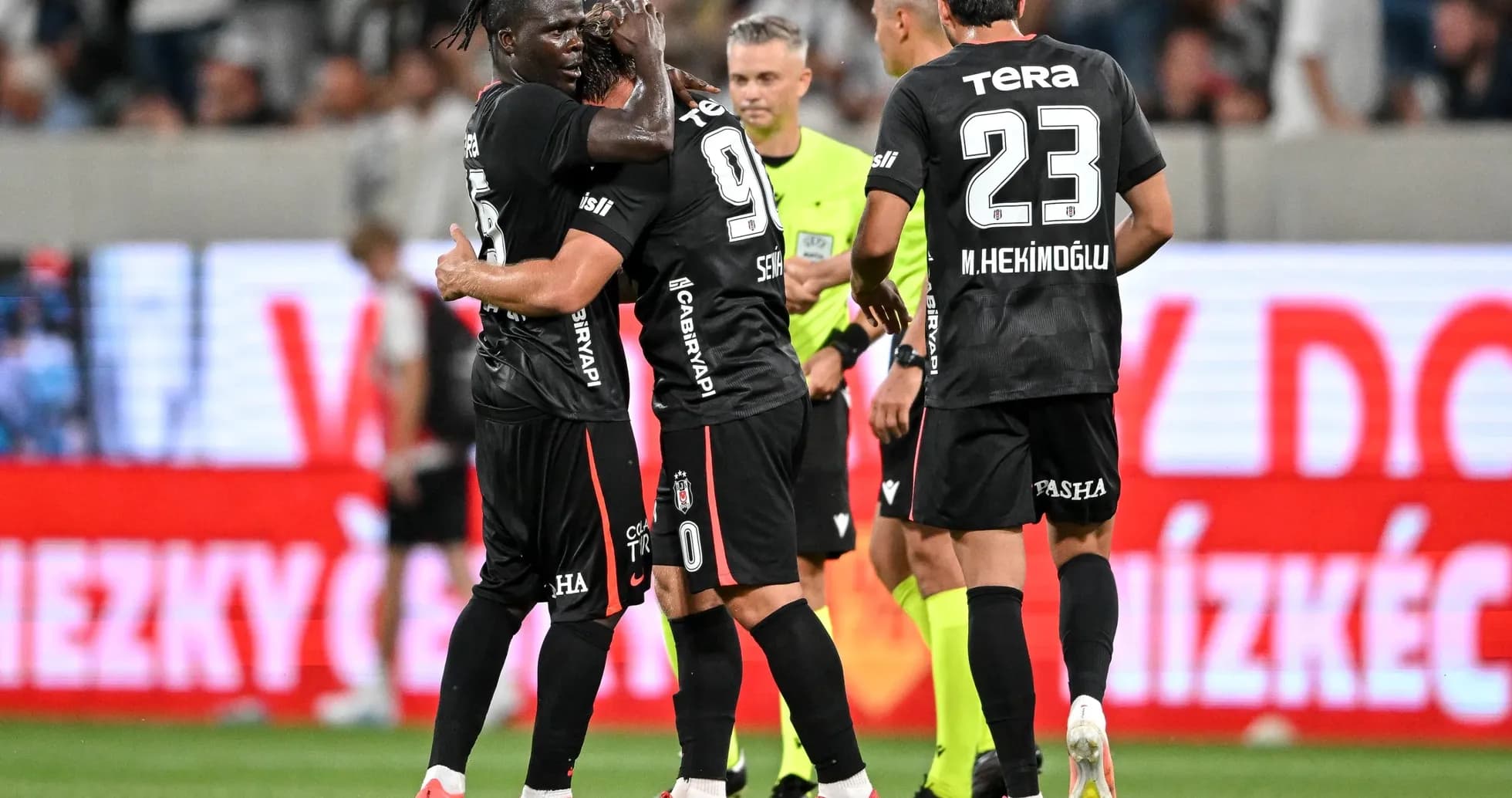
It was precisely this pattern that produced the decisive moment. In the 80th minute, S. Kilicsoy scored for Beşiktaş to make it 0-1, a goal that fits the tactical context: Hradec Králové had just committed to further attacking changes, with earlier substitutions of J. Kucera (OUT) for D. Ludvicek (IN) at 42', S. Dancak (OUT) for M. Valenta (IN) and M. van Buren (OUT) for A. Umar (IN) at 59', and then T. Sloncik (OUT) for D. Trubac (IN) at 81'. Horejs was clearly rotating his attacking and wide pieces to maintain intensity, but every extra body pushed forward increased the risk of being hit on the break by Beşiktaş’s remaining forwards.
From a defensive-structure perspective, Hradec Králové’s 3-4-2-1 had to cope with Beşiktaş’s full-backs and wide midfielders pinning their wing-backs. With Beşiktaş registering 5 shots on goal and 6 blocked shots, Hradec Králové’s back three were often forced to defend in their own box without the wing-backs being fully recovered, especially before Ouattara’s red card. The lack of recorded goalkeeper saves for either side means we cannot quantify A. Zadrazil’s or A. Nubel’s shot-stopping, but the distribution of shots on goal (9 vs 5) indicates that the Beşiktaş keeper [A. Nubel (Beşiktaş)] had more direct work than his opposite number [A. Zadrazil (Hradec Králové)], even if the final outcome favoured the visitors.
Discipline also shaped the game’s rhythm. Hradec Králové picked up two yellow cards, both early and on attacking players: Mick van Buren at 2' and Jakub Uhrinčať at 29'. This likely constrained their pressing and counter-pressing aggression in the forward line and right side. Beşiktaş, by contrast, accumulated three yellow cards and one red: V. Cerny at 37', Ouattara’s two yellows and subsequent red at 65' and 71', and Oh Hyeon-Gyu at 83'. The Turkish side thus had to navigate the final 20 minutes plus added time with a numerical deficit and several players on bookings, further justifying their more conservative, compact block and reliance on counters.
Statistically, the match reads as a classic case of control versus punch. Hradec Králové had more shots on goal (9 to 5) and more corners (8 to 5), pointing to sustained pressure and territorial control, especially in wide areas. Yet Beşiktaş, with slightly more possession (52%) and a significantly higher number of blocked shots (6), managed the key defensive zones better and turned one of their fewer on‑target efforts into the decisive goal. The foul count (10 for Hradec Králové, 6 for Beşiktaş) underlines how the home side increasingly resorted to halting transitions, while Beşiktaş, even with a red card, stayed relatively disciplined in their challenges.
Without xG or passing data, the clearest tactical verdict comes from the combination of formations, shot distribution and discipline: Hradec Králové’s structure created volume but not enough clear, converted chances; Beşiktaş’s 4-1-4-1, reconfigured after the red card, prioritised compactness and transition efficiency. In a finely balanced qualifier, that trade-off proved decisive.