Ibrahim Mbaye: Youngest African Goalscorer in World Cup History
There is a version of 16 June 2026 that lives only in the shadows of MetLife Stadium.
France are three goals up on Senegal, 85 minutes gone, the kind of World Cup group game that usually dissolves into formality. Then a teenager steps off the bench, shoulders loose, eyes cold. Ibrahim Mbaye does not look like a late substitution. He looks like an interruption.
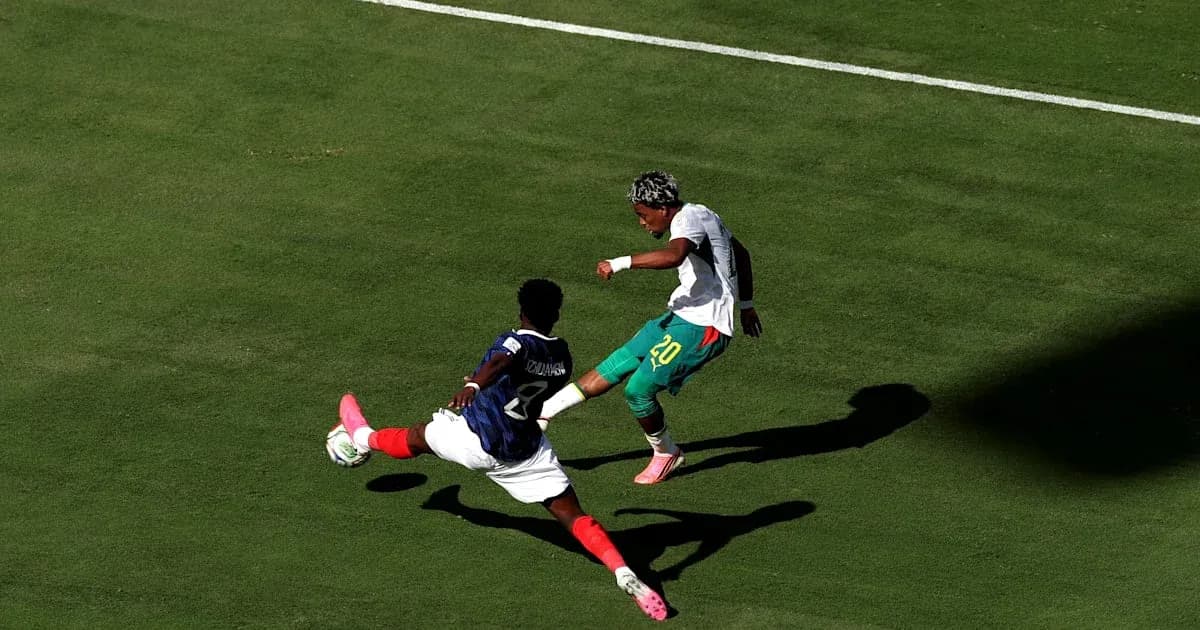
Deep into stoppage time, out on the right, he finally gets the ball where he wants it. One touch to square up Théo Hernandez, another to sell him the wrong way with a feint and a roll of the foot. Space opens for a heartbeat. Mbaye doesn’t blink. He lashes a low shot past Mike Maignan and into the far corner.
Minute 95. France 3, Senegal 1.
The scoreboard calls it a consolation. History calls it something else. At 18 years and 143 days, Mbaye becomes the youngest African ever to score at a FIFA World Cup, taking a record from fellow Senegalese Moussa Wagué. Only Pelé, Manuel Rosas, Gavi and Lamine Yamal have done it younger.
C’est du sérieux. And for Mbaye, it has been serious for a long time.
Books, then Ballon d’Or dreams
Rewind ten months. Paris Saint-Germain are heading to Marseille for a Ligue 1 match. The squad boards the flight. Mbaye, then 17, is nowhere near the gate.
He is sitting his baccalauréat.
While his teammates run through set pieces, he is working through equations. PSG arrange a separate journey; exam first, football later. By 8pm, he is in Marseille, boots laced, having swapped the silence of an exam hall for the noise of the Vélodrome in a matter of hours.
For most players, that story would be the defining quirk of a career. For Mbaye, it is just another day that started with a pen and ended with a ball.
PSG’s academy has long prided itself on that balance. The same machine that produced Warren Zaïre-Emery and Senny Mayulu treats classrooms with the same gravity as training pitches. Director Yohan Cabaye can point to a 95 per cent baccalauréat pass rate as proof that discipline is non-negotiable.
In Mbaye, that philosophy has found its most striking case study. The nutmeg on Hernandez and the ruthless finish against France were not tricks tossed up in panic. They were a problem solved in real time, by a player who seems to process a 95th-minute World Cup chance the way he handles a final exam question: calmly, methodically, with no rush in his body.
A Paris kid, a Senegal shirt, and a choice from the heart
Mbaye’s story begins in Trappes, a Paris suburb whose footballing fame previously rested on the rise of Nicolas Anelka. His father is Senegalese, his mother Moroccan, his football education entirely French. He moved through the youth ranks of Les Bleus, a talent so polished that few inside the French system imagined he would wear any other colours.
Then came November 2025.
Mbaye chose Senegal. No tug of war, no public row. His call, his timing.
“I will never regret choosing to play for Senegal because it was a decision from the heart,” he told Senegalese broadcaster RTS after lifting the Africa Cup of Nations trophy in January, a teenager standing on the same podium as veterans twice his age. Months later, he doubled down: “If only you knew… it’s the best decision I’ve ever made in my life. The Senegalese have such huge hearts; it’s incredible.”
That is why the goal against France hit so hard. A boy raised in the Paris banlieues, shaped by the country’s most prestigious academy, scoring his first World Cup goal against the nation that schooled him — but doing it in the green of Senegal.
Quelle histoire. Any script editor would have thrown it out as too perfect.
Numbers that belong to someone older
Strip away the romance and the numbers still look unreal.
Mbaye made his Ligue 1 debut at 16 years, 6 months and 23 days, becoming PSG’s youngest-ever league starter, taking a record from Zaïre-Emery. He signed his first professional contract in February 2025, scored his first senior goal within weeks, and by August had become the youngest Frenchman to appear in a UEFA Super Cup, eclipsing a mark set by Ryan Giggs back in 1987.
In May 2026, with PSG grinding towards yet another title, it was Mbaye who settled it. A stoppage-time strike away at Lens locked in the club’s 14th Ligue 1 crown. No fanfare, just the same clean, decisive touch.
The Senegal chapter has moved just as fast. Debut against Brazil in November 2025. A goal three days later on his second cap. Youngest player ever to feature at an Africa Cup of Nations that December. By January, he had already broken his own mark as Senegal’s youngest AFCON goalscorer, on the way to lifting the trophy before CAF later ruled to award the victory to Morocco.
The paperwork and controversy do not change the scoreboard in his favour: four goals in twelve caps before turning 19. It is no wonder the comparisons with Kylian Mbappé have started to sound less like hype and more like projection.
Ask his coaches, though, and they rarely begin with pace or finishing. They talk about his choices. When to carry. When to pass. When to slow a move that is racing away from his teammates. His game feels edited, with all the waste cut out.
Mbaye does not need twenty touches to change a match. Often, he needs one.
“Mbaye is world class, and he is ours, he did not choose France – he chose Gaindeyi,” Senegalese journalist Wahany Johnson Sambou told Olympics.com in January, using the Wolof nickname for the national team. “He’ll do great things, just watch.”
Dakar, then LA: a new Olympic chapter
Senegal’s Olympic football story is still in its opening pages. The men’s team have only appeared once, at London 2012, but that single tournament lit the fuse on careers: Sadio Mané, Idrissa Gueye, Cheikhou Kouyaté all passed through that gateway.
They have not been back since.
Now the stage is coming to them. Dakar will host the Youth Olympic Games this October, a moment that will drag the Olympic movement into Senegalese stadiums and streets. The feeling around the federation is clear: this is not just a festival. It is a statement that the country’s time in this arena has arrived.
Mbaye, born in January 2008, will be 20 when Los Angeles 2028 kicks off. Prime age for an Under-23 tournament that has already carried Lionel Messi, Neymar and Mohamed Salah into the global spotlight. Olympics.com has already highlighted him among Africa’s brightest prospects for LA 2028, and the logic is obvious.
What makes the prospect so compelling is not the medals or the records he has stacked up before adulthood. It is the temperament behind them. The same unflustered clarity that allowed him to glide from a baccalauréat exam to a Ligue 1 fixture, and from a 3-0 World Cup deficit to a sliver of immortality in the 95th minute.
For now, Mbaye keeps moving as he always has — quietly, efficiently, ahead of schedule. He is arriving early to moments the rest of the football world assumed were still years away.
The real question is not whether he will define a tournament. It is which one he decides to take first.