Jagiellonia Defeats Rangers 2-1: Tactical Analysis
Jagiellonia’s 2-1 win over Rangers at Chorten Arena was defined less by territorial dominance and more by how efficiently Adrian Siemieniec’s side exploited their 4-3-3 structure in key phases. With 52% possession and a 7–3 advantage in shots on goal, the hosts translated a marginal control of the ball into far clearer attacking output, while Rangers’ 4-2-3-1 never consistently connected its midfield shield to the front line.
Out of possession, Jagiellonia’s 4-3-3 compacted into a narrow 4-1-4-1, with T. Romanczuk anchoring in front of the back four. The two number eights, S. Lozano and K. Szmyt, stepped out aggressively onto Rangers’ double pivot of D. Neil and T. Chukwuani, making Rangers’ first phase build-up predictable and funnelled toward the flanks. This pressing scheme helped limit Rangers to just three shots on goal despite their 48% share of the ball and five corners. When Rangers tried to circulate through the back line, Jagiellonia’s front three, led centrally by N. Prelec, curved their pressing runs to screen passes into midfield, forcing longer balls that the centre-backs A. Konstantopoulos and Y. Kobayashi could attack.
With the ball, Jagiellonia’s structure was fluid. The nominal 4-3-3 often resembled a 2-3-5 in settled possession: full-backs N. Wojtuszek and G. Montoia advanced to pin Rangers’ wide players, while Romanczuk dropped closer to the centre-backs to form the first line of circulation. Szmyt and J. Imaz occupied the half-spaces, constantly looking to receive between Rangers’ midfield and defensive lines. This occupation of interior zones was crucial in turning their possession advantage into a 7–3 edge in shots on goal and in generating the pressure that led to both first-half goals.
The own goals on each side underlined the territorial pattern. G. Montoia’s early own goal under Rangers’ name came from pressure inside Jagiellonia’s box, but it was an isolated moment rather than a sign of sustained Scottish dominance. By contrast, E. Fernandez’s own goal for Jagiellonia and then Szmyt’s normal goal at 21' emerged from sequences where Jagiellonia had compressed Rangers deep, forcing hurried defensive actions. Jagiellonia’s only corner (to Rangers’ five) shows they did not rely on set-piece volume; instead, they created danger in open play through structured positional attacks and quick combinations around the box.
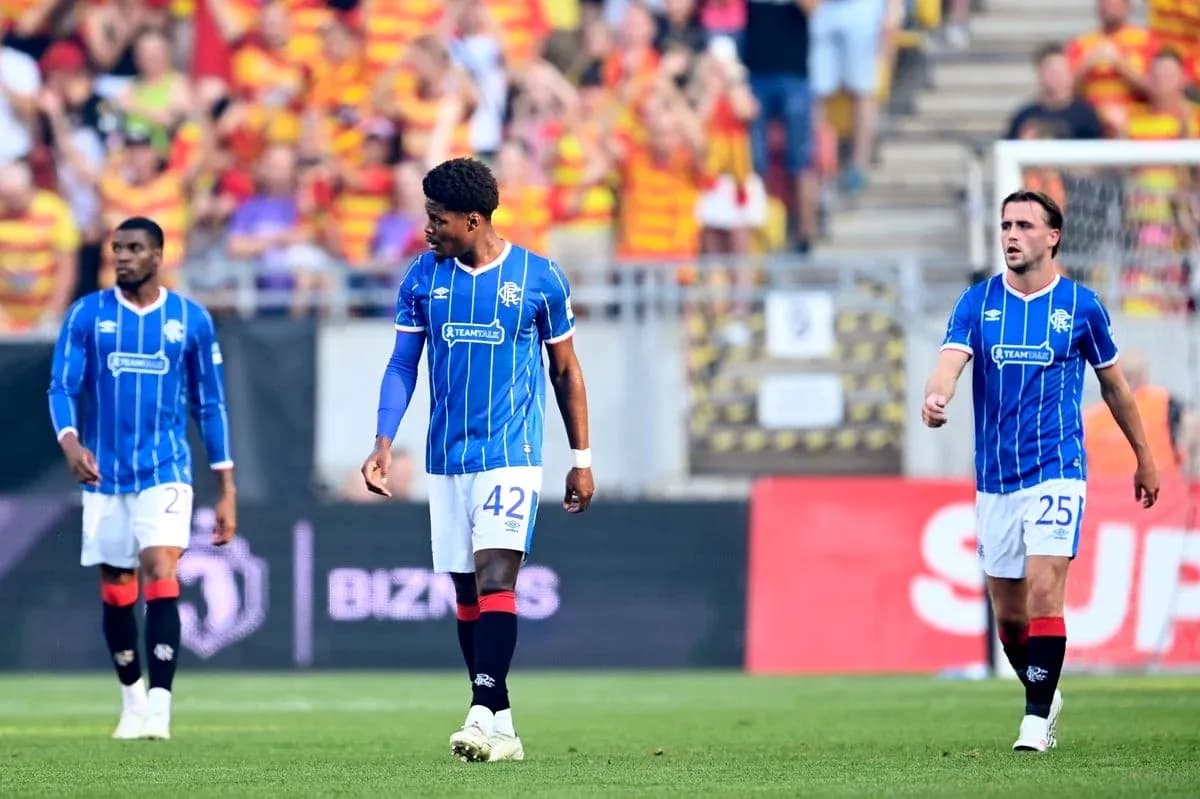
Rangers’ 4-2-3-1 never fully stabilized. The double pivot of Neil and Chukwuani struggled under Jagiellonia’s interior pressure, which is reflected in Rangers committing 15 fouls to Jagiellonia’s 11 and picking up three yellow cards (Tuur Rommens, Tochi Chukwuani, Nicolas Raskin) as they increasingly resorted to stopping transitions and breaking up counters. Their five corners and four shots off goal indicate that when they did reach the final third, it was often via wide play and second balls rather than controlled central progression. The lack of offsides (0) further suggests Rangers rarely threatened with depth runs behind Jagiellonia’s back line; their attacks were more about static possession around the box than vertical penetration.
The second-half substitution wave from Rangers at 46' — C. Devlin (IN) for T. Chukwuani (OUT), N. Raskin (IN) for D. Neil (OUT), and F. Curtis (IN) for D. Yokota (OUT) — was a clear attempt to refresh the midfield and add more energy between the lines. Functionally, this shifted the emphasis toward more dynamic pressing from the second line and slightly more risk in possession. However, the underlying pattern did not change: Jagiellonia continued to manage space well, and Rangers still found it difficult to generate high-quality chances, as the shots-on-goal tally remained in the hosts’ favour.
Jagiellonia’s substitutions were more about game management than structural change. At 65', J. Agbonifo (IN) for R. Conceicao (OUT) and A. Klynge (IN) for S. Lozano (OUT) freshened the midfield and right side without altering the 4-3-3 template. Later, D. Drachal (IN) for J. Imaz (OUT) and Y. Sylla (IN) for N. Prelec (OUT) at 80' further reinforced legs in the middle and up front to maintain pressing intensity and protect the 2-1 lead. The late yellow card for Yuki Kobayashi at 88' fits this narrative of a side defending assertively and occasionally on the edge to close out the result.
Discipline and duels became increasingly important as Rangers chased the game. Their 15 fouls and three yellows contrasted with Jagiellonia’s 11 fouls and single booking, underlining how the visitors were more often reacting to Jagiellonia’s possession and transitions rather than dictating tempo. The fact that Rangers still managed five corners shows they forced pressure moments, but Jagiellonia’s defensive structure in and around their box — compact lines, clear roles for Romanczuk screening and the centre-backs attacking crosses — ensured those set pieces did not translate into a volume of shots on goal.
Overall, this was a match where slight possession superiority and a well-drilled 4-3-3 allowed Jagiellonia to control where the game was played. They created more and better shooting opportunities, absorbed Rangers’ wide-oriented pressure, and used targeted substitutions to preserve compactness and intensity. Rangers’ 4-2-3-1 offered moments of threat, particularly via corners and wide attacks, but the lack of central penetration and reliance on reactive fouling left them chasing a scoreline that Jagiellonia managed with maturity.