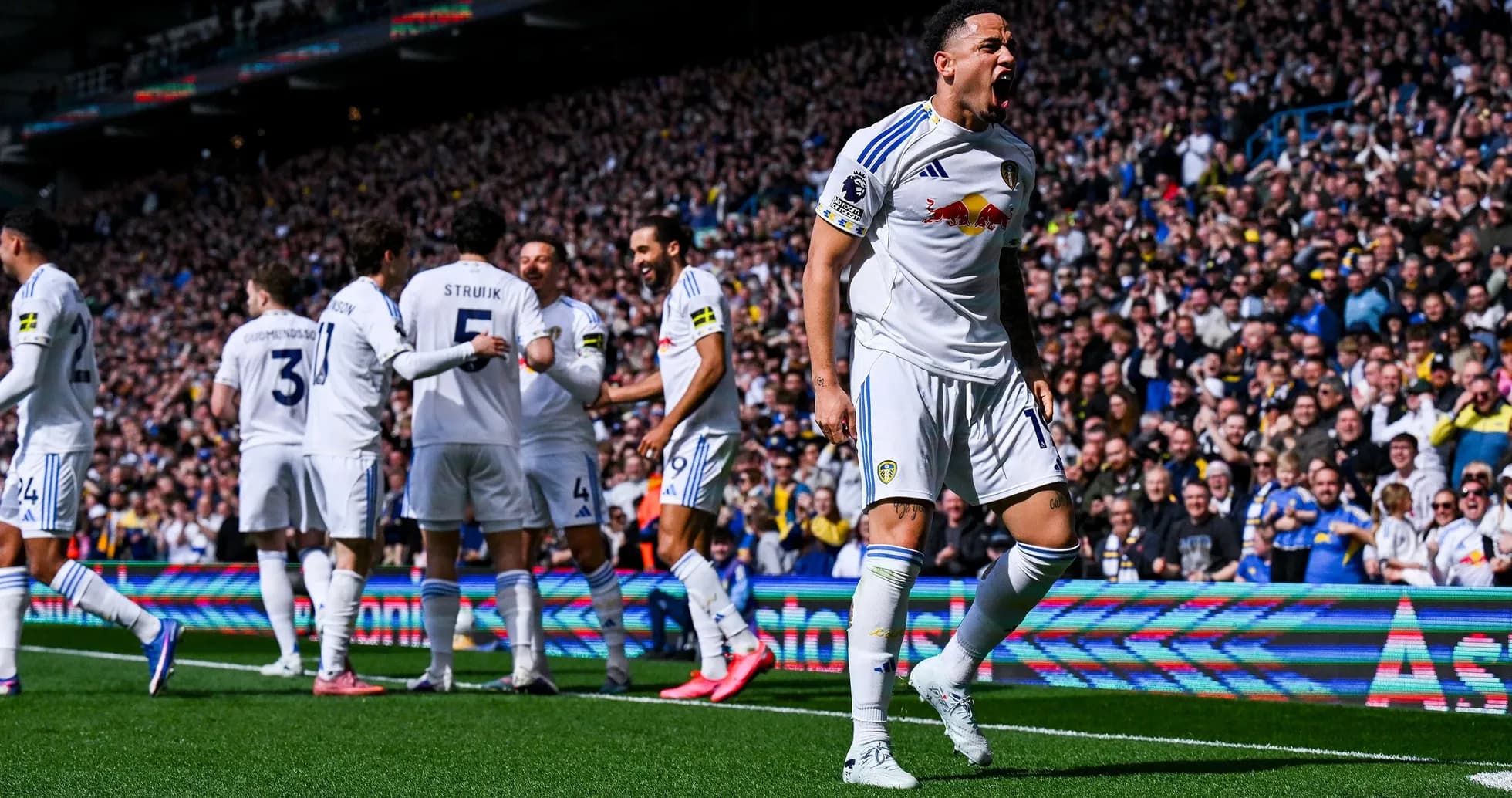
Leeds Overpower Wolves 3–0 in Premier League Clash
Elland Road had the feel of a crossroads rather than a routine league date. Round 33 of the Premier League, a relegation-haunted Wolves side arriving bottom of the table with 17 points, and a Leeds team still glancing nervously over their shoulder in 15th on 39 points. By full time, the story was emphatic: Leeds 3–0 Wolves, a scoreline that mirrored the gulf in cohesion, confidence and structure between the two sides.
Heading into this game, the season’s statistical DNA already hinted at the direction of travel. Leeds had been awkward rather than exhilarating overall: 9 wins, 12 draws and 12 defeats in 33 matches, with a goal difference of -7 (42 scored, 49 conceded). At Elland Road, though, they had been a different proposition, scoring 25 and conceding 20 across 17 home fixtures, an average of 1.5 goals for and 1.2 against. Wolves arrived with the league’s most fragile profile: only 3 wins in 33, 61 goals conceded and just 24 scored, giving them a brutal goal difference of -37. On their travels they had yet to win, with 7 away goals all season at an average of 0.4 per game, against 30 conceded at 1.8.
I. The Big Picture – Mirrored Shapes, Different Intent
Both coaches rolled out a 3-4-2-1, but the symmetry was purely on paper. Daniel Farke built Leeds’ structure on a secure back three of J. Justin, J. Bijol and P. Struijk ahead of K. Darlow, with width provided by J. Bogle and G. Gudmundsson. E. Ampadu and A. Tanaka formed the double pivot, tasked with both screening and initiating play, while B. Aaronson and N. Okafor floated behind D. Calvert-Lewin.
Rob Edwards matched the shape but not the authority. Wolves’ back three of S. Bueno, Toti and L. Krejci sat in front of D. Bentley, flanked by wing-backs J. Tchatchoua and H. Bueno. In central midfield, Andre and Joao Gomes were asked to be both enforcers and progressors, with J. Bellegarde and A. Gomes supporting A. Armstrong up front. The idea was to compress the middle and spring forward quickly; in practice, they were mostly pinned back, their 3-4-2-1 collapsing into a 5-4-1.
Leeds’ season-long flexibility with shapes – they had used eight different formations, with 4-3-3 and 3-5-2 their most common – showed in how naturally they flowed within this 3-4-2-1. Wolves, who had also frequently toggled between back-three variants and 4-3-3, looked far less rehearsed in their rotations.
II. Tactical Voids – Absences and Discipline
The absentees told their own tactical stories. Leeds were again without D. James and A. Stach, both listed as missing through muscle and ankle injuries respectively. James’ absence removed a vertical, high-pace wide threat, nudging Farke further towards a central, combination-heavy attack through Aaronson and Okafor. Stach’s absence meant even more responsibility on Ampadu as the single most reliable defensive midfielder.
For Wolves, the list was longer and more structurally damaging. L. Chiwome and E. Gonzalez were out with knee injuries, while S. Johnstone missed out with a knock, but the most telling absentee was Y. Mosquera, suspended through yellow cards. Mosquera’s season had been defined by aggression – 11 yellows – but also by defensive production: 52 tackles, 13 blocked shots and 19 interceptions. Without him, Wolves lost their most combative presence in the back line and a defender who routinely stepped out to engage. That vacuum forced Toti and L. Krejci to defend deeper, inviting Leeds onto them.
Disciplinary trends across the season also framed the contest. Leeds’ yellow-card profile peaked between 61-75 minutes, where 23.64% of their cautions arrived, hinting at a side that can become stretched as legs tire. Wolves, by contrast, showed a volatile middle third: 26.39% of their yellows came between 46-60 minutes, with another 20.83% in each of the 61-75 and 76-90 windows. Combined with three red cards spread across 31-75 minutes, this is a team that often loses control just when games open up. In a match where they would likely be chasing, that was a strategic liability.
III. Key Matchups – Hunter vs Shield, Engine Room vs Enforcers
The headline duel was always going to be D. Calvert-Lewin against the Wolves defence. With 11 league goals and 1 assist in 30 appearances, Calvert-Lewin has been Leeds’ clearest cutting edge. His shot volume – 60 efforts, 30 on target – speaks to a centre-forward who constantly occupies central zones. Crucially, he is not just a finisher but a physical reference point: 401 duels contested, 157 won, and 35 fouls drawn. Against a Wolves side conceding 1.8 goals per game overall and 1.8 on their travels, his presence was a structural problem.
Without Mosquera, Wolves’ “shield” became a collective rather than an individual. Toti’s profile – 18 tackles, 11 blocked shots, 10 interceptions – shows a defender who reads danger and can block, but not necessarily one who thrives in repeated aerial and physical contests. With Leeds able to swing crosses from Bogle and Gudmundsson and feed early deliveries from Aaronson’s pockets, Calvert-Lewin was always likely to pin the central defender and force mismatches on second balls.
The engine room battle was more nuanced. For Leeds, Ampadu has been one of the division’s most complete holding midfielders this season: 1485 passes at 85% accuracy, 71 tackles, 15 blocked shots and 43 interceptions. He is both screen and starter, the pivot around which Farke’s possession game turns. Alongside him, Tanaka offered mobility and short-link passing, allowing Aaronson to float higher between the lines.
Wolves countered with a double pivot of Andre and Joao Gomes. Andre’s numbers – 1126 passes at 90% accuracy, 73 tackles, 10 blocked shots and 26 interceptions – paint him as the metronome and first presser. Joao Gomes brings edge: 89 tackles, 5 blocked shots, 32 interceptions and a league-high 60 fouls committed, alongside 9 yellow cards. Together they form a combative core, but one that can be dragged into fouls when overloaded.
Leeds’ plan was clear: use Aaronson’s intelligence between the lines to force Andre and Joao Gomes into decisions. Aaronson’s 29 key passes and 5 assists underline his status as the creative conduit, and his 47 fouls drawn show how often he tempts contact. Each time he received behind Wolves’ midfield, the away side had to choose between stepping out – and leaving space for Calvert-Lewin and Okafor – or sitting off and allowing Leeds to dictate.
IV. Statistical Prognosis – Why 3–0 Felt Inevitable
Even before a ball was kicked, the underlying numbers tilted heavily towards a Leeds win. Heading into this game, Leeds averaged 1.3 goals per match overall and conceded 1.5, but that defensive figure was softened at home where they allowed just 1.2 per game. Wolves, by contrast, scored only 0.7 per match overall and 0.4 away, while conceding 1.8 both overall and on their travels.
Leeds’ clean-sheet record – 7 in total, 5 at home – suggested they had enough defensive solidity to shut down a goal-shy Wolves side that had failed to score in 17 matches, including 11 times away. With Darlow protected by a back three and Ampadu screening, the probability of Wolves creating sustained pressure was always low.
In Expected Goals terms, the matchup profile pointed towards a Leeds advantage: a home side that regularly reaches decent shot volumes, led by a high-usage striker in Calvert-Lewin, against an away defence that concedes both territory and chances. Wolves’ inability to transition their way up the pitch, especially without Mosquera’s aggressive stepping out, meant Leeds could keep the game in the Wolves half for long stretches, inflating their xG while suppressing the visitors’.
Following this result, the 3–0 scoreline felt less like an outlier and more like the logical endpoint of the season’s trends. Leeds’ structured aggression, anchored by Ampadu and animated by Aaronson and Calvert-Lewin, overwhelmed a Wolves side whose statistical and tactical frailties converged on a single afternoon at Elland Road.