Levski Sofia vs AEK Athens: Tactical Insights from a Goalless Draw
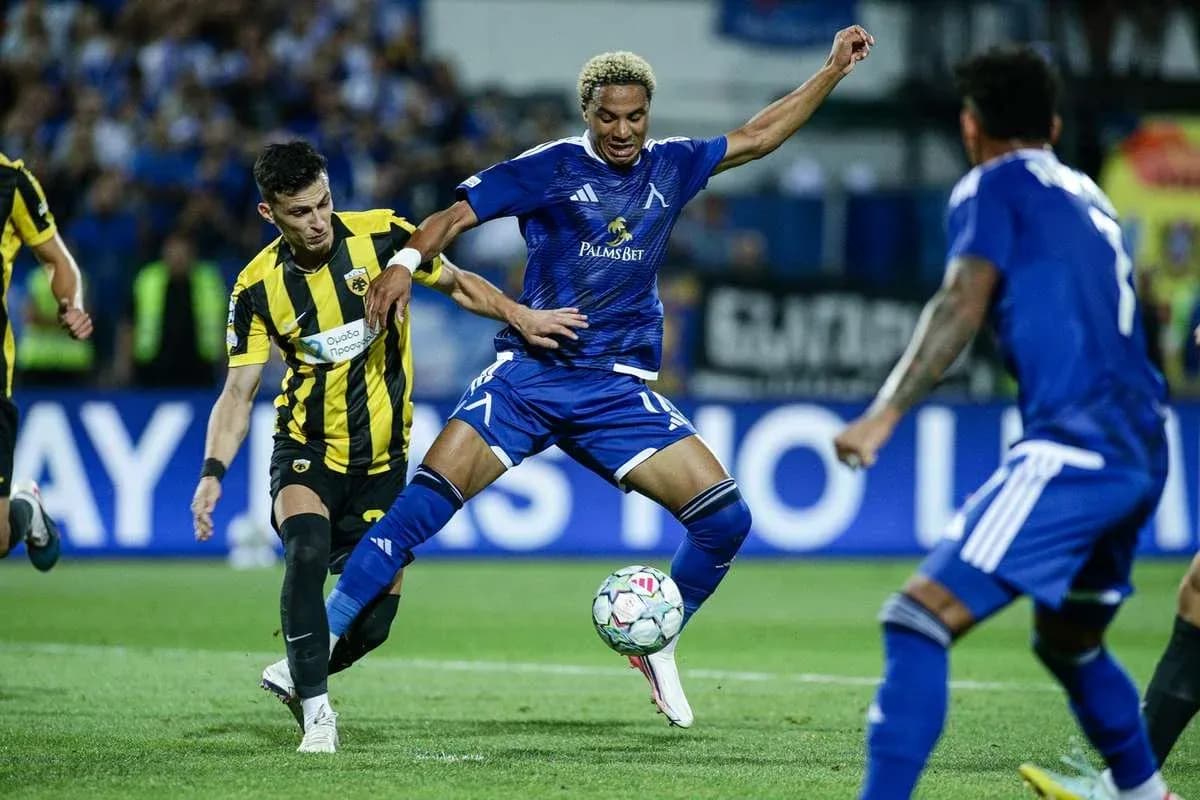
Levski Sofia and AEK Athens FC produced a goalless but tactically rich first leg at Georgi Asparuhov Stadium, a match defined more by structure and risk management than penalty-box chaos. Across 90 minutes, Levski’s 4-2-3-1 sought to control rhythm and territory, while AEK’s 4-4-2 prioritised compactness, duels and counter-attacking channels. The statistical profile – Levski leading on total shots (15–12), shots on goal (3–1) and possession (52–48), but with both sides registering only a single save from S. Vutsov (Levski Sofia) and three from T. Strakosha (AEK Athens FC) – underlines a game where defensive organisation consistently smothered final-third clarity.
Levski’s structure in possession was clear from the outset. The back four of A. Centelles, N. Serafimov, K. Dimitrov and A. Neves built from deep, with the double pivot of M. Moubarik and Maicon providing a stable base. Their 485 passes, 428 accurate (88%), show a side comfortable circulating under moderate pressure. Maicon often dropped alongside the centre-backs to create a three-man first line, allowing full-backs – particularly Centelles on the left – to step higher and pin AEK’s wide midfielders. Ahead of them, the trio of A. Oko-Flex, Serginho and Everton Bala operated between the lines, trying to overload AEK’s central midfield pairing.
AEK’s 4-4-2, with Zini and L. Jovic leading the line, was more about horizontal and vertical compactness than pressing high. The midfield band of A. Koita, K. Kairinen, R. Marin and L. Majer stayed narrow, inviting Levski to play wide and then closing aggressively once the ball entered the half-spaces. Their 453 passes (394 accurate, 87%) and slightly lower possession suggest a willingness to concede some control in exchange for maintaining a tight block and preserving counter-attacking threat.
Levski’s shot profile – 15 total, 3 on goal, 4 blocked, with 6 from inside the box and 9 from outside – tells the story of a team repeatedly forced into lower-quality attempts. AEK’s back four, anchored by H. Moukoudi and F. Relvas, defended their area assertively, stepping out to block shooting lanes and preventing Reinaldo from receiving freely between lines. When Levski did find pockets, AEK’s midfield recovered well, turning promising central positions into long-range efforts.
AEK’s 12 shots (1 on goal, 2 blocked, 5 inside the box, 7 from outside) reflect a more selective attacking approach. Their forwards looked to exploit transitions, with early balls into channels towards Zini and Jovic. However, Levski’s centre-backs, Serafimov and Dimitrov, managed depth intelligently, rarely allowing space in behind. Moubarik screened effectively in front, breaking up several nascent counters and forcing AEK to shoot from distance.
The physical and psychological tone of the game is underlined by the foul count: AEK committed 17 fouls to Levski’s 8. This disparity fits the tactical pattern. AEK’s midfield and back line were repeatedly asked to disrupt Levski’s rhythm, accepting contact and tactical infringements to prevent clean combinations around the box. The absence of recorded yellow or red cards suggests that these interventions, while frequent, were mostly controlled and within acceptable limits, but they also contributed to breaking up Levski’s tempo in advanced zones.
Goalkeeper usage further highlights the nature of the contest. S. Vutsov (Levski Sofia) was called upon for only 1 save, reflecting how effectively Levski limited AEK’s clear chances despite conceding 12 shots. The defensive line’s ability to block (2 AEK shots blocked by Levski) and push attempts outside the box meant Vutsov’s evening was more about sweeping and distribution than shot-stopping. In contrast, T. Strakosha (AEK Athens FC) made 3 saves, facing Levski’s 3 shots on goal. His interventions, combined with 4 blocked efforts by his defenders, were decisive in preserving the clean sheet, especially as Levski pushed with more numbers in the second half.
The substitution pattern from the 57th minute onward marks the tactical “second phase” of the match. At 57', Marko Nikolic adjusted AEK’s midfield and front line: L. Majer (OUT) for P. Mantalos (IN), and L. Jovic (OUT) for B. Varga (IN). This shifted AEK towards a slightly more creative profile between the lines with Mantalos, and a more direct, physical reference up front with Varga. The idea was to hold the ball better in advanced areas and offer a stronger target against Levski’s centre-backs, while maintaining the 4-4-2 shape.
Julio Velazquez responded on 67', with J. Perea (IN) for A. Oko-Flex (OUT), injecting fresh energy and more vertical movement on the flank. Late in the game, at 79', he doubled down on attacking adjustments: M. Soula (IN) for Everton Bala (OUT) and A. Mitkov (IN) for Reinaldo (OUT), essentially refreshing the front line to sustain pressure and running against a tiring AEK defence. At 88' and 89', further changes – S. Hevertton (IN) for A. Neves (OUT) and S. Stoyanchov (IN) for Maicon (OUT) – subtly rebalanced the side, adding legs in the back line and midfield while keeping the structure intact.
AEK mirrored this freshening of wide and forward areas at 81', when M. Gacinovic (IN) replaced A. Koita (OUT) and O. Zubkov (IN) came on for Zini (OUT). These changes shifted AEK’s emphasis further towards counter-attacking with technical quality and ball-carrying from deeper positions, but Levski’s rest defence remained disciplined, preventing late breaks from turning into high-value chances.
Set pieces offered only limited divergence from open play patterns. Levski earned 1 corner to AEK’s 2, numbers that align with the overall balance: Levski slightly more territorially dominant, AEK more opportunistic. Offside figures – 0 for Levski, 1 for AEK – reinforce that both teams were cautious with runs in behind, prioritising ball retention and structure over constant depth runs.
In the aggregate, the statistical verdict supports the eye-test of a finely poised tactical battle. Levski’s marginal edge in possession, passing accuracy and shot volume did not translate into a decisive advantage in chance quality, as indicated by the low number of shots on goal and the minimal workload for S. Vutsov (Levski Sofia). AEK’s higher foul count and lower shot volume, combined with T. Strakosha’s (AEK Athens FC) 3 saves, reflect a strategy built on containment and selective strikes rather than sustained pressure.
With the tie goalless after the first leg, both coaches will see confirmation of their defensive frameworks, but the second leg will likely demand more attacking risk. Levski may need to convert their territorial control into more box entries and higher-quality shots, while AEK must find ways to turn their compact 4-4-2 into more consistent threat without compromising the solidity that earned them this clean sheet.