Liverpool and Brentford Battle to 1-1 Draw at Anfield
Liverpool’s 1-1 draw with Brentford at Anfield unfolded as a territorial siege that never quite translated into the decisive second goal their dominance merited. Both sides lined up in a 4-2-3-1, but the same structure produced very different behaviours: Liverpool used it to suffocate territory and create volume, Brentford to compress space and counter selectively.
Liverpool’s shape was aggressive from the back. With 60% possession and 503 passes (434 accurate, 86%), Arne Slot’s side built through Virgil van Dijk and Ibrahima Konaté, who held a high line and squeezed the game into Brentford’s half. The full-backs, C. Jones on the right and A. Robertson on the left, pushed on early, effectively turning the structure into a 2-3-5 in sustained attacks, with R. Gravenberch and Alexis Mac Allister forming the double pivot.
In the first phase, Mac Allister dropped deepest to connect centre-backs to the advanced line of M. Salah, D. Szoboszlai, R. Ngumoha and C. Gakpo. With 14 corner kicks and 24 total shots (17 inside the box), Liverpool repeatedly reached the final third, but Brentford’s compact 4-4-1-1 block made central penetration difficult. Much of Liverpool’s threat came from wide overloads and second balls around the box, reflected in their 8 blocked shots and the high xG of 2.9.
The breakthrough on 58 minutes encapsulated Liverpool’s positional play. C. Jones, nominally a defender, had been stepping into midfield and even the half-space. His goal at 58' for Liverpool, assisted by M. Salah, came from that fluidity: Salah’s involvement on the right pulled Brentford’s block across, and Jones arrived from a deeper starting position to exploit the gap. It was a reward for Liverpool’s insistence on circulating the ball until a lane opened, rather than forcing low-percentage crosses.
Brentford’s response was instructive. Keith Andrews kept the 4-2-3-1 compact, accepting Liverpool’s territorial control but trusting the front four to attack quickly once possession was turned over. With only 331 passes (262 accurate, 79%) and 40% of the ball, Brentford prioritised verticality and direct progression through J. Henderson and Vitaly Janelt at the base, with M. Jensen linking to K. Schade and I. Thiago.
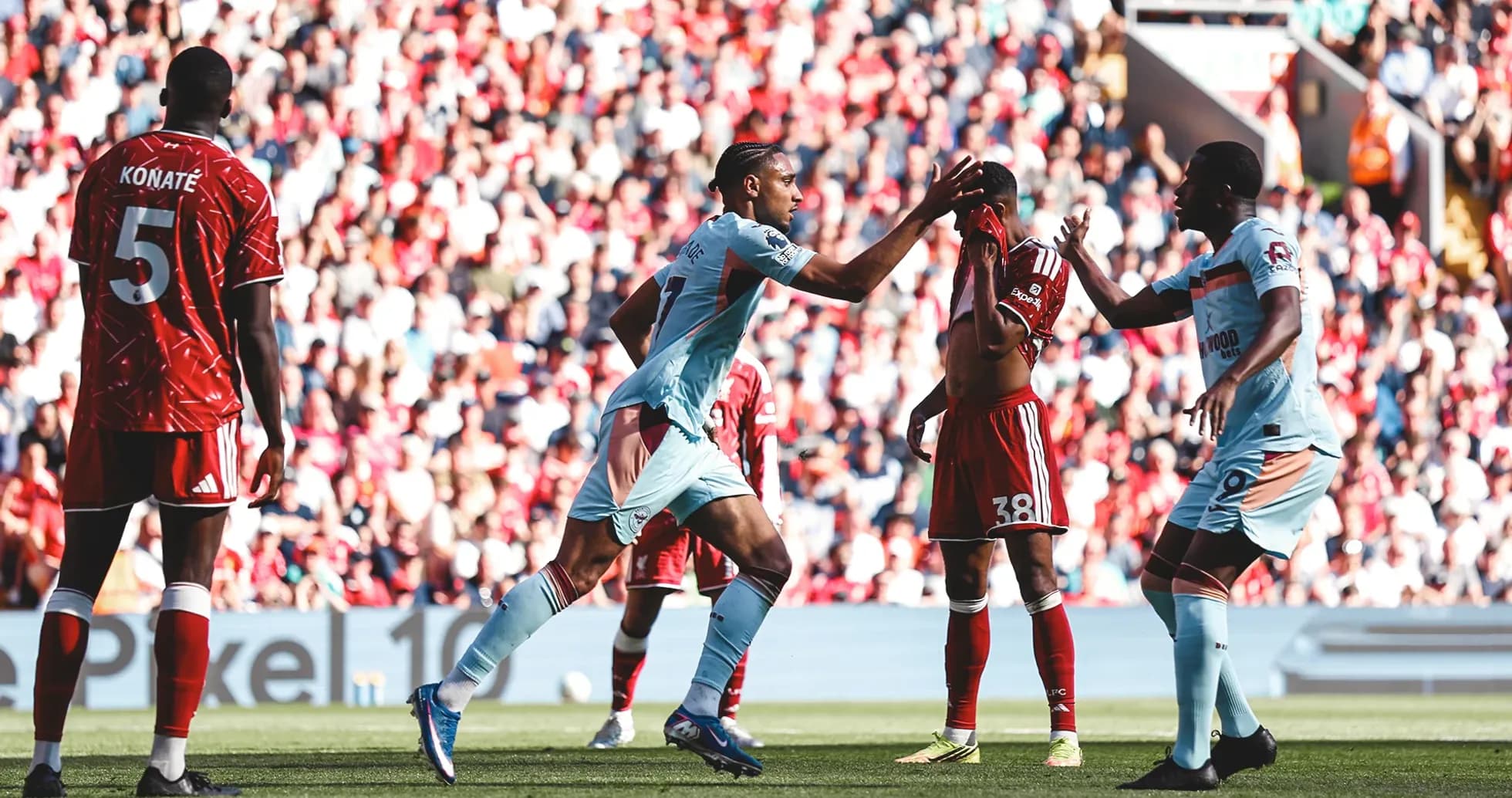
The equaliser at 64' for Brentford, scored by K. Schade with no assist, reflected that plan. After weathering pressure, Brentford found space in transition, exploiting Liverpool’s advanced full-backs and the high line. Schade’s goal came in a phase where Liverpool’s rest defence—two centre-backs and one pivot screening—was briefly exposed, underlining the risk built into their territorial dominance.
From there, both coaches turned to the bench to adjust the game state. For Brentford, the first key change was structural stability: at 60', A. Hickey (IN) came on for J. Henderson (OUT), moving a natural defender into the back line and allowing tweaks in how the full-backs engaged Liverpool’s wingers. Later, at 83', M. Damsgaard (IN) for M. Jensen (OUT) freshened the central band with more energy for counters and pressing, and at 89', R. Nelson (IN) replaced K. Lewis-Potter (OUT), giving Brentford a more direct outlet late on.
Liverpool’s substitutions were aimed at re-energising the attack and maintaining pressure. At 73', F. Wirtz (IN) came on for R. Ngumoha (OUT), adding a creative, between-the-lines presence in the left half-space. A minute later, at 74', J. Frimpong (IN) replaced M. Salah (OUT), changing the right flank profile from a classic wide playmaker to a more vertical, line-breaking runner. This was a clear attempt to attack tired legs in Brentford’s defensive line with pace and depth runs.
On 83', Liverpool doubled down on freshness and attacking thrust: M. Kerkez (IN) for A. Robertson (OUT) kept the left flank aggressive, while T. Nyoni (IN) for R. Gravenberch (OUT) rebalanced the midfield with new legs to sustain counter-pressing and recycling. At 89', J. Gomez (IN) for I. Konaté (OUT) was a late defensive rotation, ensuring physical and aerial security as Brentford chased set-piece opportunities.
Out of possession, Liverpool’s defensive scheme was front-footed. The front four pressed Brentford’s build-up, forcing longer passes that van Dijk and Konaté were generally well-placed to contest. The foul count—9 for Liverpool, 9 for Brentford—speaks to a game of frequent duels but not chronic disruption. The late yellow cards for Liverpool’s Ibrahima Konaté at 79' (Foul) and Alexis Mac Allister at 90+2' (Foul) reflected moments where Liverpool had to halt potential transitions after being stretched in search of a winner.
Brentford’s discipline issues were more about emotional management under pressure. Jordan Henderson’s yellow card at -5' (Argument) set an early tone of confrontation, and in second-half added time both Nathan Collins at 90+5' (Argument) and Vitaly Janelt at 90+4' (Argument) were booked, indicating the strain of defending deep for long spells as Liverpool pushed for a decisive goal.
In goal, Alisson (Liverpool) had a relatively quiet but high-stakes afternoon, officially making 1 save. That low number underscores how well Liverpool limited Brentford’s clear looks despite conceding 2 shots on goal and 11 total shots; the visitors’ xG of 1.22 shows their few chances were of reasonable quality, with Alisson’s positioning and the back line’s shot suppression doing much of the work before the ball reached him. His goals prevented figure of 1.4 underlines that the chances Brentford did fashion were dangerous, and his interventions materially preserved the draw.
At the other end, C. Kelleher (Brentford) was central to the away side’s resilience, credited with 7 saves. Under a barrage of 8 shots on goal and 24 total attempts, his shot-stopping, combined with Brentford’s 3 blocked shots and dense penalty-area defending, kept Liverpool from turning pressure into a multi-goal lead. The goals prevented metric of 1.4 for Brentford’s goalkeeper unit highlights how often Liverpool’s shot quality should, on average, have produced more than a single goal.
Statistically, the draw looks like an underperformance for Liverpool in the box and an overperformance for Brentford in resilience. Liverpool’s xG of 2.9 versus a single goal, alongside 17 shots inside the area and 14 corners, indicates they consistently reached high-value zones but lacked either finishing precision or the final decisive touch in crowded situations. Brentford, with xG of 1.22 and only 2 shots on target, maximised their limited attacking phases, turning one of their few clean looks into the Schade equaliser.
Tactically, Liverpool’s 4-2-3-1 delivered dominance in territory, possession, and chance creation, but left them periodically vulnerable to the very transitions Brentford were set up to exploit. Brentford’s mirror formation, more conservative and reactive, sacrificed control for compactness and efficiency. The 1-1 scoreline, in the end, reflects Liverpool’s inability to convert structural superiority into a second goal and Brentford’s disciplined, if at times emotionally frayed, defensive execution anchored by Kelleher’s goalkeeping.