Liverpool and Chelsea Share Points in 1–1 Draw at Anfield
Liverpool 1–1 Chelsea at Anfield, a result that keeps Liverpool’s push for a top-four finish on track but stalls their momentum, while Chelsea arrest a run of defeats with a hard-earned point that stabilises their position in mid-table.
The Lead: Result & Significance
Liverpool were unable to turn an early lead into a decisive home win, dropping points that slightly weakens their grip on a Champions League place. Chelsea, coming in on a poor run, showed resilience to respond before half-time and then manage the game, ensuring they remain safely inside the top half and within touching distance of the European spots.
Key Match Moments (Chronological)
Liverpool struck first inside six minutes. Ryan Gravenberch arrived from midfield to finish after Rio Ngumoha created the opening with the early supply, giving the hosts a 1–0 lead and immediate control of the tempo.
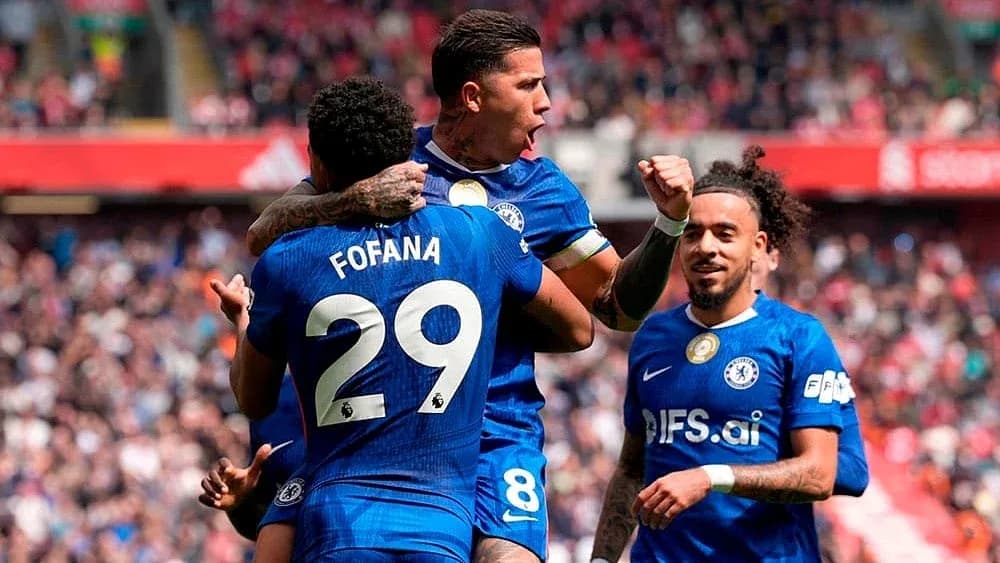
Chelsea grew into the contest and were rewarded on 35 minutes. Enzo Fernández produced a solo effort, driving forward and finding the net without an assist to level the game at 1–1 and puncture Liverpool’s early dominance.
Early in the second half, at 49 minutes, Chelsea thought they had turned the game around when Cole Palmer found the net, but VAR intervened and the goal was disallowed for offside, a key turning point that kept the contest level.
The first substitution arrived on 63 minutes for Chelsea, as Reece James replaced Andrey Santos to add fresh energy and attacking thrust from right-back.
Liverpool responded with a change of their own on 67 minutes, when Alexander Isak replaced Rio Ngumoha, shifting the focus to a more orthodox centre-forward presence after Ngumoha’s earlier creative impact.
Also in the 67th minute, Jorrel Hato was booked for holding, reflecting Chelsea’s need to disrupt Liverpool’s transitions. Four minutes later, in the 71st minute, Chelsea coach Calum McFarlane received a yellow card from the touchline, underlining the tension on the visitors’ bench.
On 73 minutes, Enzo Fernández went into the book for tripping, as Chelsea’s midfield became increasingly stretched in trying to contain Liverpool’s rotations between the lines.
Liverpool made a double defensive and attacking adjustment on 77 minutes. Joe Gomez replaced Ibrahima Konaté at the back, while Federico Chiesa replaced Cody Gakpo in the forward line, signalling Arne Slot’s attempt to inject more dynamism in the final third while maintaining defensive security.
Marc Cucurella received a yellow card for holding in the 83rd minute, another sign of Chelsea resorting to tactical fouls to slow Liverpool’s attacks.
As the clock ticked towards full time, Liverpool’s substitutes were also drawn into the disciplinary action. Joe Gomez was booked for delay of game in the 88th minute, and in added time at 90+4 minutes Alexis Mac Allister received a yellow card for tripping, the final notable act of a tense but ultimately balanced contest.
Fixture Statistics & Tactical Audit
- xG (Expected Goals): Liverpool 0.51 vs Chelsea 0.47
- Possession: Liverpool 49% vs Chelsea 51%
- Shots on Target: Liverpool 3 vs Chelsea 3
- Goalkeeper Saves: Liverpool 2 vs Chelsea 3
- Blocked Shots: Liverpool 1 vs Chelsea 1
The numbers point to a finely balanced match, and the 1–1 scoreline broadly reflects that equilibrium. Liverpool generated slightly higher xG (0.51 vs 0.47) but only marginally, suggesting neither side carved out a volume of clear chances. Chelsea’s slight edge in possession (51% vs 49%) aligned with periods of controlled build-up, yet they were unable to turn that into a sustained shots advantage. With both teams limited to three shots on target and a single blocked effort each, this was more of a tactical stalemate than an open contest, with compact defensive structures restricting space in and around the box. The near-identical xG and shot profiles indicate the draw was a fair outcome based on chance quality and territorial control.
Standings Update & Seasonal Impact
For Liverpool, the draw adds one point to their pre-match tally of 59, moving them to 60 points. Their goals for increase from 60 to 61, while goals against rise from 48 to 49, leaving them with a goal difference of +12, unchanged despite the 1–1 scoreline. They remain in 4th place, still in the Champions League positions, but the dropped home points narrow their margin for error in the run-in as they look over their shoulder at chasing rivals in the top-four race.
Chelsea move from 49 to 50 points with this draw. Their goals for climb from 55 to 56, and goals against from 49 to 50, maintaining a goal difference of +6. They stay 9th in the table, but crucially halt a sequence of defeats, keeping themselves within range of the European spots above them. The point slightly trims the gap to the teams in the European race, giving McFarlane’s side a platform to build from in the final matches.
Lineups & Personnel
Liverpool Actual XI
- GK: Giorgi Mamardashvili
- DF: Curtis Jones, Ibrahima Konaté, Virgil van Dijk, Miloš Kerkez
- MF: Ryan Gravenberch, Alexis Mac Allister, Jeremie Frimpong, Dominik Szoboszlai, Rio Ngumoha
- FW: Cody Gakpo
Chelsea Actual XI
- GK: Filip Jørgensen
- DF: Malo Gusto, Wesley Fofana, Levi Colwill, Jorrel Hato
- MF: Andrey Santos, Moisés Caicedo, Cole Palmer, Enzo Fernández, Marc Cucurella
- FW: João Pedro
Expert's Post-Match Verdict
This was a tactically cautious encounter in which both managers prioritised structure over risk. Arne Slot’s Liverpool started aggressively, using Gravenberch’s forward runs and Ngumoha’s creativity to exploit early spaces, but their inability to translate territory into chances (only 3 shots on target and xG of 0.51) underlined a lack of cutting edge in the final third (limited chance creation). The second-half introductions of Alexander Isak and Federico Chiesa added variety but did not significantly alter the underlying shot profile, suggesting Chelsea’s defensive block and midfield screen were largely effective.
Calum McFarlane’s Chelsea were compact and disciplined without the ball, and while they conceded early, they adjusted well, with Enzo Fernández’s equaliser reflecting their capacity to threaten from deeper midfield positions. Their slight possession advantage (51%) and matched shots on target (3) point to a controlled, if unspectacular, away display. However, the cluster of yellow cards, particularly for Hato, Fernández, Cucurella and Caicedo (4 bookings, 17 fouls), shows that their game management relied heavily on tactical fouling to disrupt Liverpool’s rhythm. Overall, the match was defined more by defensive organisation and risk management than by attacking ambition, and the draw feels proportionate to what either side created.