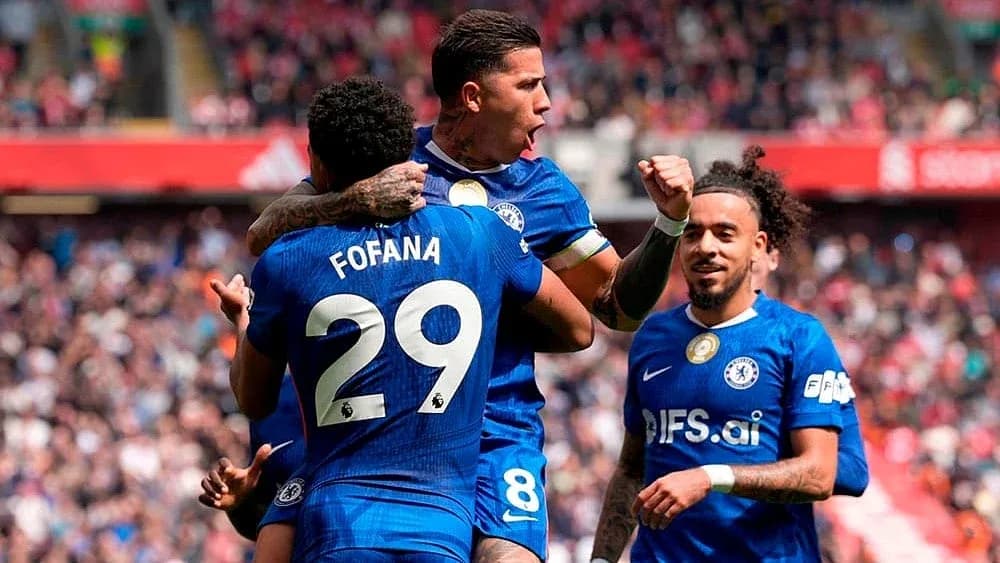
Liverpool and Chelsea Share Points in Tactical Stalemate
Anfield under grey Merseyside skies staged a meeting of two reshaped heavyweights, and the 1-1 draw between Liverpool and Chelsea felt less like a conclusion and more like a tactical prologue for where these squads are heading.
I. The Big Picture – Two Projects in Mid-Transition
Following this result, Liverpool remain a top-four side with Champions League ambitions, sitting 4th with 59 points and a goal difference of 12, built on 60 goals scored and 48 conceded overall. At Anfield they have been strong: 18 home matches, 10 wins, 5 draws, only 3 defeats, with 33 goals for and 19 against. The statistical profile is clear: at home they average 1.8 goals for and 1.1 against, a team that usually imposes itself but can be opened up in moments.
Chelsea, 9th with 49 points and a goal difference of 6 (55 for, 49 against overall), arrive as an erratic but dangerous side. On their travels they have quietly been solid: 18 away games, 7 wins, 5 draws, 6 defeats, scoring 31 and conceding 25. An away average of 1.7 goals for and 1.4 against suggests they rarely die wondering; they carry threat but leave the door ajar.
The match itself – level at 1-1 at half-time and 1-1 at full-time – mirrored those season arcs: Liverpool’s home authority blunted by Chelsea’s capacity to trade blows away from Stamford Bridge.
II. Tactical Voids – Who Was Missing, and What It Meant
The teamsheets told their own story of absences. For Liverpool, Alisson’s muscle injury handed the gloves to Giorgi Mamardashvili, a very different stylistic presence: taller, more of a penalty-box anchor than a sweeping playmaker. That subtly changed Liverpool’s build-up, with Virgil van Dijk and Ibrahima Konaté more often asked to progress the ball themselves rather than lean on the goalkeeper as an extra passer.
Ahead of them, the injury list was brutal. Stefan Bajcetic, Conor Bradley, Hugo Ekitike, Wataru Endo, Giacomo Leoni, and, crucially, Mohamed Salah and Florian Wirtz were all unavailable. The absence of Salah – 7 goals and 6 assists in total this league campaign – removed Liverpool’s most proven end-product wide threat and their primary penalty-taker. Wirtz’s illness stripped away another line-breaking technician. In their place, Arne Slot leaned into youth and versatility: Rio Ngumoha from the start, with Trey Nyoni and Kieran Morrison among the substitutes, and a front line headed by Cody Gakpo without a classic right-sided scorer.
Chelsea’s own list was long, but structurally different. J. Derry and Robert Sánchez (both with concussion issues), an unnamed hamstring absentee, J. Gittens, A. Garnacho, and Pedro Neto were all out, while Mykhailo Mudryk was suspended. That forced Calum McFarlane toward a more stable, less explosive attacking setup. Filip Jørgensen started in goal, and the front half of the team leaned heavily on João Pedro and Cole Palmer for invention, with Marc Cucurella pushed into a midfield role from the left to offer balance.
Disciplinary trends also framed the contest. Across the season, Liverpool’s yellow-card peak comes late: 31.48% of their cautions arrive between 76-90', and they even carry a rare red in extra time (one dismissal between 91-105'). Chelsea are similarly combustible late on, with 23.60% of their yellows between 76-90' and a red-card distribution that spans almost every phase of the match. This fixture, with its tight scoreline and high stakes, always threatened to tilt into a card-heavy finale.
III. Key Matchups – Hunter vs Shield, and the Engine Room
The “Hunter vs Shield” duel revolved around João Pedro. In total this campaign he has 15 league goals and 5 assists, plus 50 shots (28 on target) and 29 key passes. He arrived at Anfield as Chelsea’s reference point, a forward who not only finishes but also connects play. His task: test a Liverpool defence that, overall, concedes 1.3 goals per match and has shipped 48 in 36 league games.
Van Dijk and Konaté, with Curtis Jones and Miloš Kerkez flanking them, had to manage João Pedro’s constant drifting into half-spaces, especially with Cole Palmer and Enzo Fernández feeding him. Enzo’s season numbers – 9 goals, 3 assists, 65 key passes and 50 shots in total – underline how much he has become Chelsea’s second-wave finisher from midfield. Every time Joao Pedro dropped off, Enzo threatened to burst beyond him.
In the “Engine Room” battle, Liverpool leaned on Dominik Szoboszlai and Alexis Mac Allister against Moisés Caicedo and Enzo. Szoboszlai’s profile is that of a complete midfielder: in total this league season he has 6 goals, 5 assists, 2,090 passes with 68 key passes and an 87% accuracy, plus 52 tackles, 8 successful blocks and 29 interceptions. He is both creator and destroyer, and his presence was essential in compensating for the absence of Salah’s creativity.
Mac Allister and Ryan Gravenberch formed the connective tissue, but they were constantly harassed by Caicedo, who has quietly put together an elite defensive campaign: 1,940 passes at 91% accuracy, 87 tackles, 14 successful blocks, 56 interceptions, and a remarkable disciplinary ledger of 11 yellow cards and 1 red. Caicedo’s aggression is a double-edged sword – he commits 51 fouls in total – but it is also Chelsea’s primary shield in front of a young back line featuring Levi Colwill and Jorrel Hato.
IV. Statistical Prognosis – What This Draw Says About Both Sides
Even without explicit xG data, the season-long numbers sketch the underlying story. Liverpool at home average 1.8 goals for and 1.1 against; Chelsea away average 1.7 for and 1.4 against. A 1-1 draw sits almost exactly where those curves intersect – Liverpool failing to fully impose their usual attacking edge, Chelsea again finding a way to score on their travels.
Liverpool’s 10 clean sheets overall and Chelsea’s 9 suggest both sides can be compact when the game script demands it, but neither is yet an airtight unit. The late-card surges for both clubs hint at why: intensity is high, control is fragile, and in tight matches the final quarter-hour becomes chaotic rather than controlled.
From a squad-building lens, this match underlined Liverpool’s growing reliance on multi-functional midfielders like Szoboszlai and Mac Allister, and the need for depth behind Salah and Wirtz. Chelsea, meanwhile, are structurally built around Caicedo’s destructive work and Joao Pedro’s dual role as scorer and creator, with Enzo as the third pillar.
Following this result, both projects look incomplete but promising. Liverpool have the points and platform of a Champions League side; Chelsea have the away numbers and individual profiles of a team that should be higher than 9th. The 1-1 at Anfield felt like a snapshot of two squads still being written – and a reminder that when these pieces fully click, this fixture could once again decide far more than just a single regular-season afternoon.