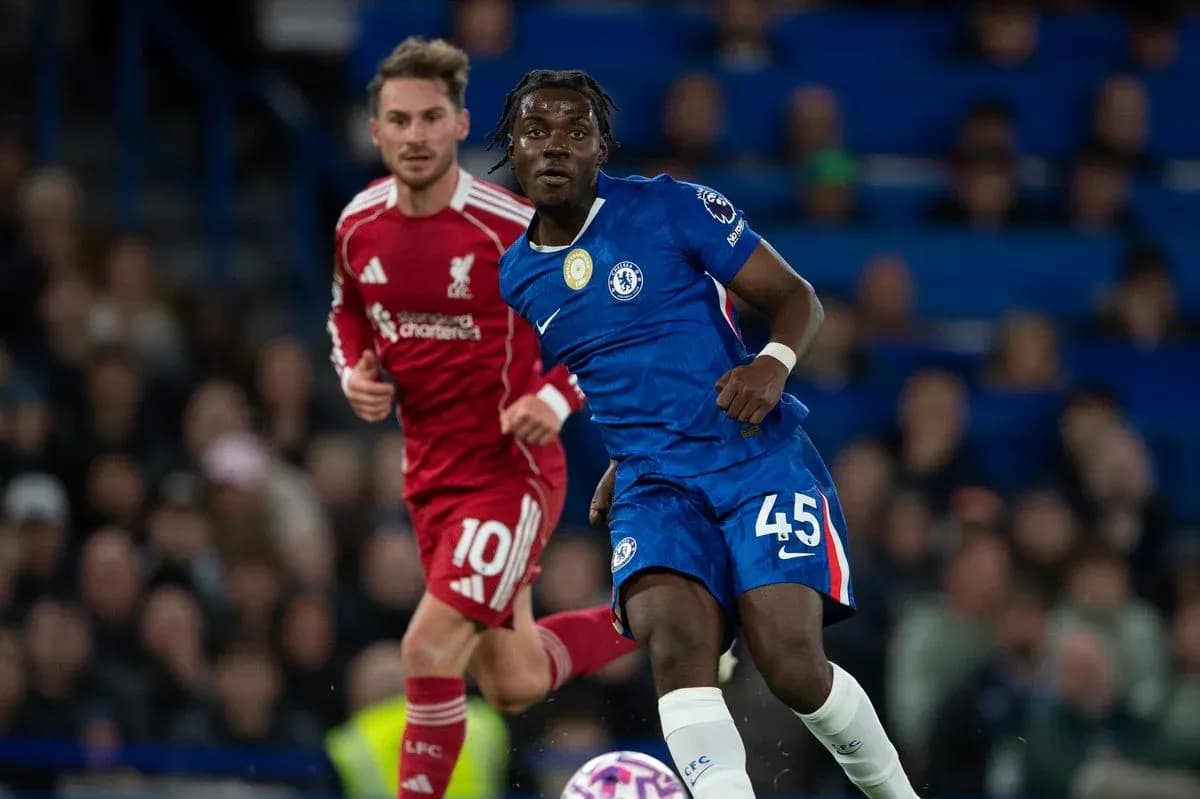
Liverpool and Chelsea Share Points in Tactical Stalemate
Liverpool and Chelsea shared a 1–1 draw at Anfield in Premier League Round 36, a match where the tactical story was one of control without incision. Liverpool started faster and struck early, but Chelsea gradually asserted territorial and possession dominance. Yet, with both sides finishing with xG under 0.6 (0.56 for Liverpool, 0.5 for Chelsea), the game became a study in defensive organisation and risk management rather than attacking fluency, with neither coach willing to over-commit in a finely balanced contest.
Scoring Summary
The scoring opened on 6' when Ryan Gravenberch arrived from midfield to finish a Liverpool move, assisted by Rio Ngumoha. The early goal reflected Liverpool’s initial verticality and willingness to attack Chelsea’s rest defence before it was fully set. Chelsea equalised on 35' through Enzo Fernández, whose strike levelled the game at 1–1 and shifted the dynamic, allowing Chelsea to lean into a more patient, possession-heavy approach.
Key Moments
The only major VAR intervention came at 50', when a Cole Palmer goal for Chelsea was cancelled after review, a critical moment that underlined how fine the margins were; structurally, though, it confirmed Liverpool’s high line had been breached even if the scoreboard was reset.
Substitutions then reshaped the tactical chessboard. At 63', Andrey Santos (OUT) made way for Reece James (IN), pushing Chelsea into a more aggressive right-sided structure, with James offering width and crossing threat while Malo Gusto could adjust his height and positioning. Liverpool responded at 67' with Alexander Isak (IN) coming on for Rio Ngumoha (OUT), a clear shift towards a more conventional central reference point up front and a move away from the fluid, roaming presence Ngumoha had offered between the lines.
On 77', Arne Slot doubled down on defensive security: Federico Chiesa (IN) came on for Cody Gakpo (OUT), and Joe Gomez (IN) replaced Ibrahima Konaté (OUT). Chiesa’s introduction added transitional threat, but the dual substitution also hinted at managing physical load and maintaining defensive intensity against Chelsea’s increasing possession.
Disciplinary Events
Disciplinary events were clustered in the final third of the match and must be logged exactly:
- 67' Jorrel Hato (Chelsea) — Foul
- 73' Enzo Fernández (Chelsea) — Foul
- 83' Marc Cucurella (Chelsea) — Foul
- 88' Joe Gomez (Liverpool) — Argument
- 89' Moisés Caicedo (Chelsea) — Handball
- 90+4' Alexis Mac Allister (Liverpool) — Persistent fouling
Card totals, locked: Liverpool: 2, Chelsea: 4, Total: 6.
These bookings underline a pattern: Chelsea’s defensive unit and double pivot repeatedly had to halt Liverpool transitions (Hato, Fernández, Cucurella), while Liverpool’s late cards (Gomez, Mac Allister) reflected frustration and cumulative infringements as they tried to disrupt Chelsea’s late-phase circulation. Caicedo’s handball at 89' was an isolated technical infringement rather than part of a wider disciplinary trend.
Tactical Overview
Tactically, Liverpool’s structure revolved around a back four of Curtis Jones, Ibrahima Konaté, Virgil van Dijk and Miloš Kerkez in front of Giorgi Mamardashvili. With no explicit formation in the data, the roles point towards Jones tucking inside from full-back, allowing Jeremie Frimpong to push high on the right, with Kerkez offering more orthodox width on the left. Van Dijk and Konaté anchored a compact central block that limited Chelsea to just six total shots and four inside the box.
In midfield, Ryan Gravenberch, Alexis Mac Allister and Dominik Szoboszlai formed a technically secure core. Gravenberch’s goal underlined his licence to arrive late in the box, while Mac Allister’s late booking for “Persistent fouling” captures how often he was tasked with breaking Chelsea’s rhythm. Szoboszlai operated as the connective piece, linking to Frimpong and Ngumoha between the lines. Rio Ngumoha, starting as a midfielder but effectively a hybrid 10/winger, provided the assist and early creativity before being replaced by Alexander Isak, who offered more penalty-box presence but less link play.
Liverpool’s statistical profile supports this: 48% possession, 473 total passes at 84% accuracy, and 8 total shots (3 on target). The relatively low xG of 0.56 despite early scoring suggests their attacks were sporadic and often from sub-optimal locations, with Chelsea’s structure limiting clear-cut chances. Mamardashvili made 2 saves, mirroring Filip Jørgensen’s 2 saves at the other end, indicating that while both teams reached the final third, the keepers were not consistently exposed.
Chelsea’s setup, under Calum McFarlane, leaned on a technically strong back line of Malo Gusto, Wesley Fofana, Levi Colwill and Jorrel Hato, with Marc Cucurella nominally listed as a midfielder but functionally part of the left-sided chain. In front, Moisés Caicedo and Andrey Santos (later Reece James) supported a creative trio of Cole Palmer, Enzo Fernández and Cucurella behind João Pedro. Fernández’s goal and later yellow card show his dual role: advancing into scoring zones but also engaging in defensive duels.
Chelsea’s 52% possession and 515 passes at 87% accuracy reflect a side comfortable circulating the ball, especially after the equaliser. Yet their xG of 0.5 and only 6 shots (3 on target) reveal how Liverpool’s compact mid-block forced them into lower-quality attempts. The disallowed Palmer goal is the main tactical red flag for Liverpool: Chelsea’s capacity to time runs in behind and exploit the high line nearly turned the match.
Both teams committed 17 fouls, but Chelsea’s 4 yellow cards versus Liverpool’s 2 show that Chelsea’s defensive interventions were more often judged caution-worthy, especially from their back line and pivot. This aligns with the flow: Liverpool were more dangerous in transition, compelling Chelsea to break play with riskier challenges.
Statistically, the verdict is of a balanced, low-margin contest. Liverpool’s Overall Form in this match shows a side capable of striking early but not of sustaining chance creation against a well-organised block. Defensively, their index is strong: limiting Chelsea’s volume and keeping xG low, with Mamardashvili’s negative “goals prevented” value (-0.49) matching Jørgensen’s, suggesting both keepers conceded roughly what the chances warranted.
Chelsea’s Overall Form here is that of a possession-dominant but low-risk side, controlling territory without overloading the box. Their Defensive Index is slightly undermined by the early concession and the volume of cards, yet structurally they restricted Liverpool to modest xG and shot counts.
In the end, 1–1, xG almost level, and identical goalkeeper saves encapsulate a match where tactical discipline and structure trumped attacking chaos, leaving both sides with a point that feels justified by the underlying numbers.