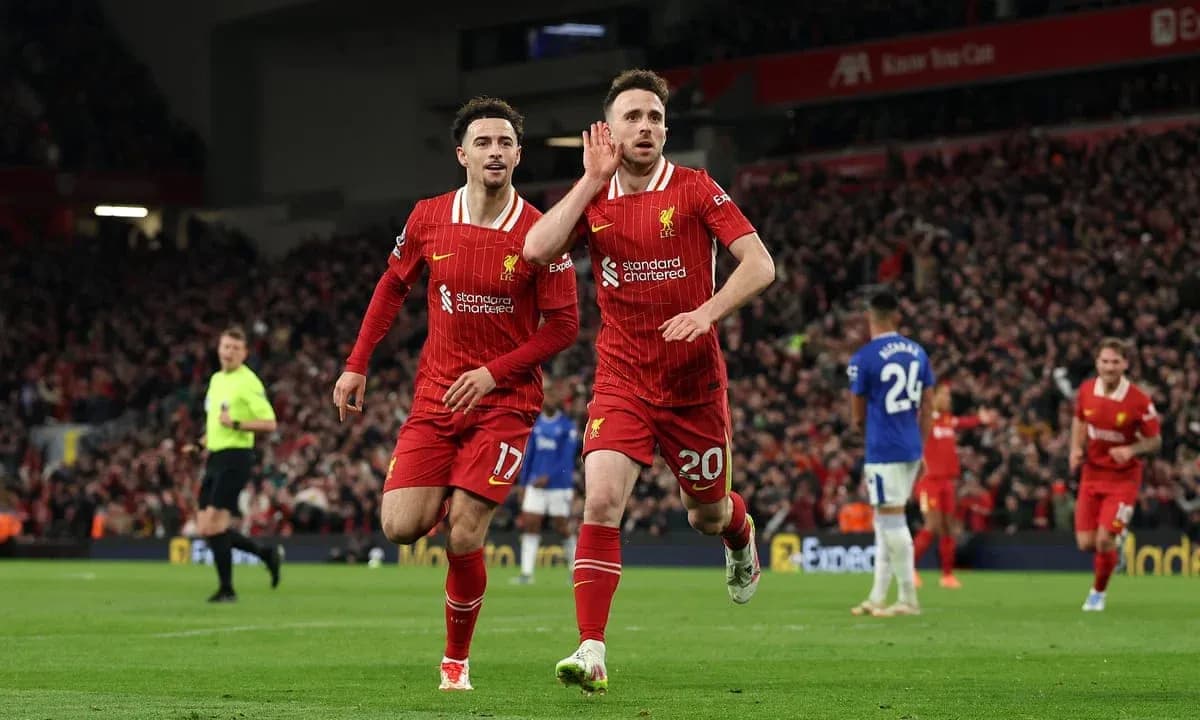
Liverpool Edges Everton in Tactical Derby Victory
Everton and Liverpool produced a controlled but finely poised derby at Hill Dickinson Stadium, with Liverpool’s 2–1 away win in Premier League Round 33 built on superior control between the lines and more efficient chance creation, rather than overwhelming volume. The visitors led 1–0 at half-time and ultimately edged a tight xG battle (1.45 vs 0.8), reflecting a performance that was more about territorial and structural dominance than relentless attacking. Everton, in a looser shape without a declared formation, relied on direct play into Beto and second balls around K. Dewsbury-Hall and I. Ndiaye, threatening in moments but never quite sustaining pressure against a disciplined Liverpool 4-2-3-1.
Liverpool’s structure was clear from the outset. G. Mamardashvili, behind a back four of C. Jones, I. Konate, V. van Dijk and A. Robertson, gave Slot a stable platform in build-up. The double pivot of D. Szoboszlai and R. Gravenberch controlled central zones, allowing the advanced trio of M. Salah (right), F. Wirtz (central) and C. Gakpo (left) to occupy half-spaces around Everton’s midfield line, with A. Isak as the single forward. This created a recurring pattern: Liverpool circulating through their centre-backs and pivots, then punching vertical passes into the feet of Wirtz or Gakpo, who then combined with Salah or Isak.
Everton, by contrast, defended deeper and more reactively. With J. Pickford in goal and a back line of J. O’Brien, J. Tarkowski, J. Branthwaite and V. Mykolenko, they tried to keep distances compact, but the lack of a clearly defined midfield structure left gaps between the lines. I. Gueye and James Garner were often dragged horizontally to deal with Liverpool’s rotations, leaving D. McNeil and Dewsbury-Hall to shuttle back in support. This strain was visible in the early disciplinary moment: Pickford’s yellow card for argument at 22' underlined a side feeling pressure from Liverpool’s territorial control rather than outright shot volume.
The disallowed Everton goal at 28', cancelled by VAR against Jake O’Brien, actually exposed their primary attacking route: set-piece and aerial threat. O’Brien and Tarkowski pushed high on dead balls, with Beto as the focal point. Even though the goal was wiped out, the incident showed that Liverpool’s dominance in open play did not fully translate into aerial security.
Liverpool’s opener at 29' encapsulated their positional superiority. A. Isak’s presence pinned Everton’s centre-backs, while Gakpo dropped into the left half-space to receive and then feed M. Salah. Salah’s finish for 0–1 came from Liverpool’s ability to create a free man between Everton’s lines: Gakpo (shirt 18) drifted inside, drawing a defender and opening the lane for Salah (11) to attack the box from the right. The 56% possession and higher pass accuracy (84% vs Everton’s 76%) were not sterile; they were the product of a structure that constantly moved Everton’s block.
Everton’s attacking adjustment after the break was subtle but effective for a spell. Dewsbury-Hall (22) began to push higher from midfield, looking to combine with Ndiaye (10) in the right half-space, while McNeil (7) continued to provide width on the opposite flank. The equaliser at 54' came from precisely this more assertive posture: K. Dewsbury-Hall assisted Beto (9) for 1–1, a move that reflected Everton’s best pattern—quick progression into the final third, early service into their striker, and aggressive occupation of the box. Their seven shots inside the box (matching Liverpool’s seven) show that when they did reach advanced areas, they were able to generate decent-quality looks.
Substitutions then reshaped the tactical battle. At 58', F. Woodman (IN) came on for G. Mamardashvili (OUT) for Liverpool. With both keepers recording three saves each across the match, this was not about shot-stopping disparity, but possibly game management or fitness; structurally, Liverpool’s build-up remained similar, with centre-backs initiating and the double pivot offering close support.
At 72', R. Ngumoha (IN) came on for A. Isak (OUT). This altered Liverpool’s attacking reference: instead of a traditional central forward pinning centre-backs, Ngumoha (73) offered more mobility and depth runs, encouraging Salah and Gakpo to attack the box more aggressively from wide starting positions. Everton responded at 73' with T. Barry (IN) for Beto (OUT), losing their primary aerial reference but gaining more mobility in transition. That shift slightly reduced Everton’s capacity to hold long clearances and build from second balls, making them more reliant on quick counters rather than sustained pressure.
At 80', T. George (IN) replaced D. McNeil (OUT), freshening Everton’s left side but also removing one of their better crossers, further diminishing the direct supply line to the box. Liverpool’s triple late change at 84' and 86' tightened their control. At 84', A. Mac Allister (IN) came on for F. Wirtz (OUT), and J. Frimpong (IN) replaced C. Gakpo (OUT). Mac Allister (10) added more composure and press-resistance in central zones, turning Liverpool’s 4-2-3-1 into something closer to a 4-3-3 in possession, with Szoboszlai pushing higher. Frimpong (30) provided explosive width and recovery on the right, allowing Salah to stay closer to goal. At 86', M. Kerkez (IN) came on for A. Robertson (OUT), giving fresh legs at left-back to handle Everton’s late counters and overlaps.
Everton’s last defensive reshuffle came at 87', with M. Keane (IN) for J. Branthwaite (OUT), a like-for-like centre-back change aimed at managing fatigue and set-piece defence. Yet the key late moments went Liverpool’s way. At 90+12', James Garner received a yellow card for a foul, a product of Everton’s increasingly stretched attempts to disrupt Liverpool’s circulation as they pushed for a winner.
The decisive tactical moment arrived with V. van Dijk’s goal at 90', assisted by D. Szoboszlai. This was emblematic of Liverpool’s superiority in structured situations: Szoboszlai (8), operating from the right half-space, delivered into a zone where van Dijk (4) could attack the ball aggressively. Everton’s earlier removal of Beto and McNeil had reduced their capacity to counter from deep, forcing them to defend more waves of pressure and more set-pieces. Liverpool’s six corners to Everton’s one and their four blocked shots underline how consistently they forced play into Everton’s box.
Statistically, Liverpool’s 14 total shots to Everton’s 10, combined with the xG split (1.45 vs 0.8), confirm that the visitors created the better chances overall, even if the raw shots inside the box were level. Their superior passing volume (491 vs 370) and accuracy allowed them to control tempo and field position, while committing more fouls (12 vs 8) in exchange for counter-pressing aggression—yet they avoided any cards, highlighting disciplined execution. Everton’s two yellow cards (Pickford for argument at 22', Garner for a foul at 90+12') framed a defensive effort that was combative but often reactive.
Overall form and defensive index both tilt towards Liverpool: they limited Everton to relatively low-quality chances, matched their shots inside the area, and leveraged their structural superiority and bench depth to secure a late, but tactically coherent, 2–1 victory.