Maccabi Tel Aviv’s Tactical Control in 1–0 Win Over Sheriff Tiraspol
Maccabi Tel Aviv’s 1–0 win over Sheriff Tiraspol at Batumi Arena in the UEFA Europa League 2nd Qualifying Round was a controlled, structurally disciplined performance built on a clear 4-3-3 blueprint. With both sides splitting possession at 50–50 and the Israelis edging the shot quality and territorial pressure, the match evolved into a story of one team using its shape to generate repeatable attacking situations and the other struggling to convert territorial moments into real threat.
Kenny Miller’s Maccabi Tel Aviv lined up in a 4-3-3 with O. Melika in goal behind a back four of R. Revivo, R. Shlomo, M. Camara and N. Ben Harush. In front, the midfield trio of I. Shahar, I. Sissokho and D. Peretz gave the structure its balance: Shahar as the more advanced connector, Sissokho as the shuttler, and Peretz anchoring and recycling. The front line of H. Varela, S. Abu Farkhi and S. Jehezkel was tasked with stretching Sheriff’s back four horizontally, opening half-spaces for underlapping full-backs and late midfield runs.
The statistical profile underlines how Maccabi’s structure translated into pressure. They produced 3 shots on goal and 5 shots off goal, with a further 3 attempts blocked. While total shots and shots inside the box are not specified, the volume of corner kicks (12) tells the tactical story: sustained occupation of the final third, repeated wide entries, and an insistence on forcing Sheriff to defend facing their own goal. Offensively, this came from the wings: Jehezkel and Abu Farkhi held high, wide positions, pinning Sheriff’s full-backs and allowing Revivo and Ben Harush to advance into crossing zones.
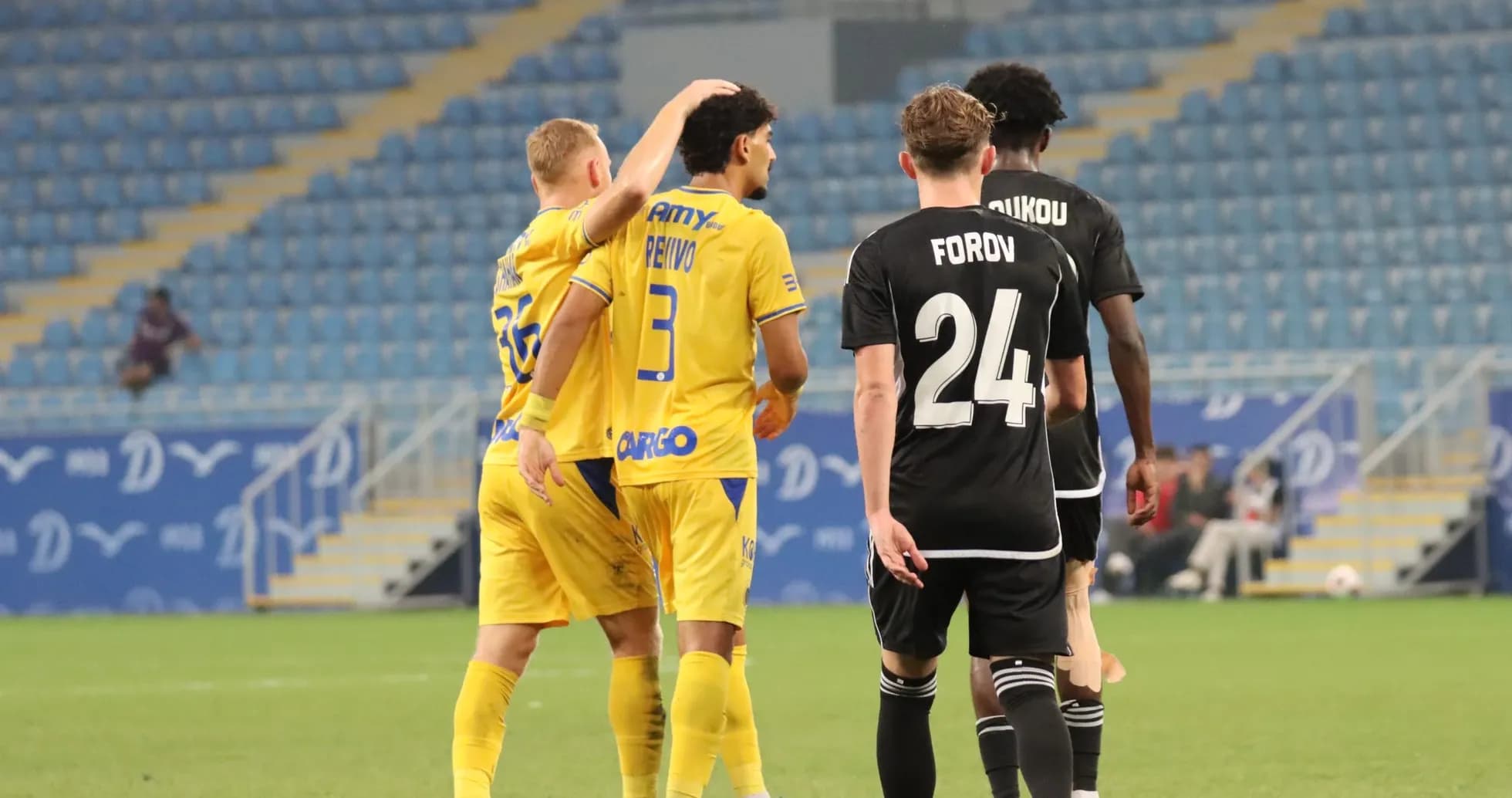
The decisive moment came on 29 minutes, when S. Kone diverted the ball into his own net under pressure, giving Maccabi Tel Aviv the 1–0 lead they would never relinquish. That phase typified Maccabi’s approach: wide service, aggressive occupation of central zones, and forcing Sheriff’s back line to make decisions while running towards their own goal. Even though the goal is recorded as an own goal, the structural origin lies in Maccabi’s ability to overload the box and attack second balls.
Out of possession, Maccabi’s 4-3-3 compacted into a narrow 4-1-4-1, with Peretz screening the centre-backs and the two advanced midfielders stepping to Sheriff’s pivots. The foul count (9) indicates a controlled aggression level: enough to disrupt Sheriff’s rhythm without tipping into indiscipline. Their offside tally (4) is also tactically relevant: the front three repeatedly tried to threaten in behind, accepting occasional offsides as the cost of stretching Sheriff’s defensive line vertically.
Sheriff Tiraspol also nominally started in a 4-3-3, with E. Timbur in goal, a back line of Rai, B. Fomba, B. Ciss and M. Ouedraogo, and a midfield of Mota, D. Klas and A. Pergjoni. Ahead of them, L. Jaures-Ulrich, S. Kone and D. Forov were listed as midfielders but functioned in advanced roles, giving Sheriff a fluid, sometimes asymmetrical front. However, the attacking output was blunt: 0 shots on goal, 4 shots off goal and 2 blocked. Despite equal possession and 7 corners, they failed to convert their phases of build-up into clear chances.
Tactically, Sheriff’s main issue was their spacing in the final third. With Kone and Forov often dropping into the half-spaces to receive, the penalty area was frequently under-occupied. Crosses and set pieces found too few targets, and Maccabi’s centre-backs were rarely forced into emergency defending. The 11 fouls they committed, compared to Maccabi’s 9, reflect a team more often chasing transitions and having to halt counters rather than dictating the tempo.
Victor Mihailov’s substitutions after the break were an attempt to rebalance that structure. At 57', Sapata (IN) came on for Mota (OUT), adding more attacking intent from midfield. Two minutes later, at 59', V. Nihaev (IN) replaced S. Kone (OUT), a move that removed the player who had scored the own goal but, more importantly, sought fresher legs and different movement in the front line. The triple change at 77' — N. Swen (IN) for A. Pergjoni (OUT), V. Cozma (IN) for L. Jaures-Ulrich (OUT), and J. Modelo (IN) for D. Forov (OUT) — was a structural reset: more direct, more vertical, and with fresher wide options to attack late.
Yet the numbers show that these changes did not fundamentally alter the threat profile. Sheriff still ended with 0 shots on goal. Their 2 yellow cards — V. Nihaev for “Tripping” at 71' and B. Ciss for “Tripping” at 90+3' — underline a reactive posture, with late challenges as Maccabi managed the lead into stoppage time.
Maccabi’s own substitutions were tailored to game management. At 63', I. Ben Simon (IN) came on for I. Shahar (OUT), refreshing the midfield line while preserving the three-man structure. In the same minute, O. Davida (IN) replaced S. Jehezkel (OUT), adding fresh legs on the flank to maintain pressing intensity and transition threat. At 79', I. Noy (IN) came in for H. Varela (OUT), and I. Ben Hamo (IN) for N. Ben Harush (OUT), tweaks that shored up the left side and added defensive solidity for the closing phase. The unchanged foul count (no cards for Maccabi, 0 yellow and 0 red) shows that these changes helped close the game without losing composure.
Defensively, the clean sheet is explained less by heroic goalkeeping numbers — goalkeeper saves are not specified for either side — and more by collective control of shot quality. Sheriff’s inability to register a single shot on goal speaks to Maccabi’s compactness between the lines and their dominance of first and second balls around the box. The 12–7 corner advantage further reflects how often Maccabi forced play into Sheriff’s defensive third, while limiting counters through good rest defence from Peretz and the two centre-backs.
With xG and goals prevented values not specified, the statistical verdict must rest on the available metrics. Equal possession but a clear edge in shots on goal (3–0), blocked shots (3–2) and corners (12–7) points to Maccabi Tel Aviv as the side with the more coherent attacking plan and better territorial control. Sheriff’s higher foul count (11–9) and two late yellow cards for “Tripping” reinforce the impression of a team chasing the game and resorting to corrective defending rather than proactive structure.
In sum, Maccabi Tel Aviv’s 4-3-3 delivered a professional, low-risk European performance: secure at the back, assertive in wide areas, and structurally sound enough to convert pressure into the decisive own goal. Sheriff Tiraspol matched them in possession but not in penetration, leaving the 1–0 scoreline a fair reflection of the tactical balance at Batumi Arena.