Manchester City vs Aston Villa: Tactical Analysis of a 1-2 Defeat
Manchester City’s 1-2 defeat to Aston Villa at Etihad Stadium unfolded as a clear tactical contrast between sterile control and vertical efficiency. City, in a 4-2-2-2 under Pep Guardiola, dominated territory and possession (52%, 458 passes) but were repeatedly punished in transition by Unai Emery’s compact 4-2-3-1, which produced fewer shots overall (12 to 16) but more on target (5 to 3) and a higher xG (1.58 to 1.25). The match hinged on Villa’s ability to break through City’s stretched double pivot and attack the space behind the advanced full-backs, with Ollie Watkins’ brace the logical outcome of the visitors’ game plan rather than an upset against the run of play.
City’s structure with J. Trafford in goal, a back four of R. Lewis, J. Stones, R. Dias and N. Ake, and the Nico–B. Silva double pivot was designed to secure central control and feed an attacking box of A. Semenyo, Savinho, P. Foden and T. Reijnders. Early on, that blueprint worked: City generated 10 shots inside the box and 6 blocked efforts, a sign of sustained pressure and Villa’s deep defensive density. The 23rd-minute opener from A. Semenyo, finishing a Manchester City move, came from precisely this territorial dominance, with the front four rotating between the lines and full-backs stepping high to pin Villa’s wide players.
However, that same aggressive rest-defense left structural vulnerabilities. With both full-backs involved high and Nico pushed on to connect play, City often defended transitions with only Stones and Dias against Watkins plus the second-line runners. Villa’s 4-2-3-1, anchored by Douglas Luiz and L. Bogarde, was conservative without the ball but very direct once possession was regained. Their 9 shots inside the box from only 12 total attempts underline how Emery’s side avoided low-quality efforts, preferring to play through or beyond City’s first line and attack the heart of the defence.
Second Half
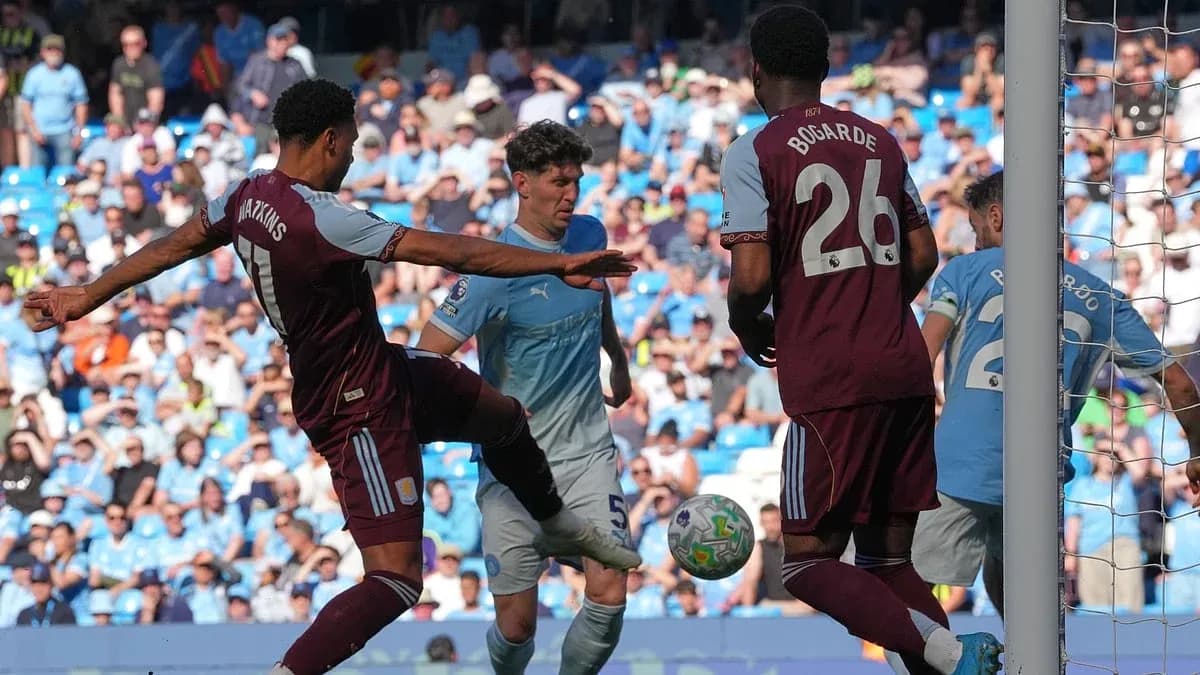
The turning point came immediately after half-time. At 46', M. Cash (IN) came on for A. Garcia (OUT), giving Villa a more natural attacking right-back profile and extra thrust down that flank. Within a minute, O. Watkins levelled at 47', capitalising on City’s slow defensive reset as their high line was exposed. The pattern repeated at 61', when Watkins struck again, this time assisted by R. Barkley, finishing a move that saw Villa break through City’s midfield line and combine centrally before releasing their striker. VAR confirmed this second Watkins goal at 63', cementing Villa’s control of the scoreline and validating their focus on quick, vertical attacks into the channels around Dias and the left half-space.
Guardiola’s response was to refresh the attacking structure. At 58', R. Cherki (IN) came on for A. Semenyo (OUT), adding a more creative, ball-to-feet profile between the lines. One minute later, at 59', M. Kovacic (IN) replaced B. Silva (OUT), shifting the double pivot towards more progressive ball-carrying from deeper zones. Later, at 77', J. Doku (IN) for T. Reijnders (OUT) and R. Ait-Nouri (IN) for N. Ake (OUT) aimed to increase one-v-one threat on the flanks and maintain width against a Villa block that was dropping ever deeper. J. Gvardiol (IN) for J. Stones (OUT) at 78' slightly rebalanced the back line, but the underlying issue remained: City could circulate possession and reach the final third, yet struggled to disorganise Villa’s compact 4-5-1 block.
Villa’s in-game management was equally decisive. Beyond the Cash change, Emery rotated his midfield engine at 73', bringing on Y. Tielemans (IN) for Douglas Luiz (OUT), P. Torres (IN) for V. Lindelof (OUT), and A. Onana (IN) for L. Bogarde (OUT). These moves refreshed legs in central areas and subtly shifted Villa towards a more protective posture, with Torres’ introduction reinforcing aerial security and box defending. At 86', J. McGinn (IN) for R. Barkley (OUT) added pressing intensity and ball retention to help close the game out, turning Villa’s shape into a robust, compact unit protecting the central lane and forcing City wide.
Individually, the goalkeepers underlined the tactical story. J. Trafford (Manchester City) faced 5 shots on target and made 3 saves, with Villa’s xG at 1.58 and his goals prevented figure at 0.28, suggesting he performed roughly to expectation but was left exposed by the quality of chances conceded. M. Bizot (Aston Villa), by contrast, made 2 saves from City’s 3 shots on target. With City generating an xG of 1.25 and Bizot also credited with 0.28 goals prevented, Villa’s keeper (Aston Villa) was well-protected by the structure in front of him; most of City’s 16 shots were either blocked (6) or taken from less threatening situations, a testament to Villa’s compactness and timing in closing shooters.
Discipline and duels also reflected the tactical balance. City committed 8 fouls to Villa’s 4, and their only booking came at 82': Rico Lewis (Manchester City) — Foul, a late sign of frustration as he tried to halt another Villa transition. Villa, despite defending more without the ball, avoided bookings entirely, maintaining composure in their challenges and benefiting from a clear, zonal defensive scheme that reduced the need for emergency fouls.
Statistically, the match reinforces the idea that control of the ball is not the same as control of the game. City’s 52% possession and 458 passes, with 405 accurate (88%), gave them a marginal edge in volume but not in penetration. Villa’s 436 passes, with 394 accurate (90%), reveal a side that was nearly as secure in circulation but far more purposeful once they crossed halfway. Both teams produced similar passing volumes, yet Villa turned their phases into higher-quality chances, as shown by the xG split (Manchester City 1.25, Aston Villa 1.58) and the shots on target count (3 vs 5).
The late drama at 90+2', when a potential goal by Phil Foden was disallowed by VAR, encapsulated City’s afternoon: territory, pressure and half-chances, but ultimately denied by Villa’s structure and a tight off-ball discipline. In tactical terms, Emery’s Aston Villa executed a classic away blueprint—compact block, ruthless transitions, efficient finishing—while City’s 4-2-2-2 offered control without sufficient defensive protection against counters, turning a 1-0 lead into a 1-2 home defeat on the final day.