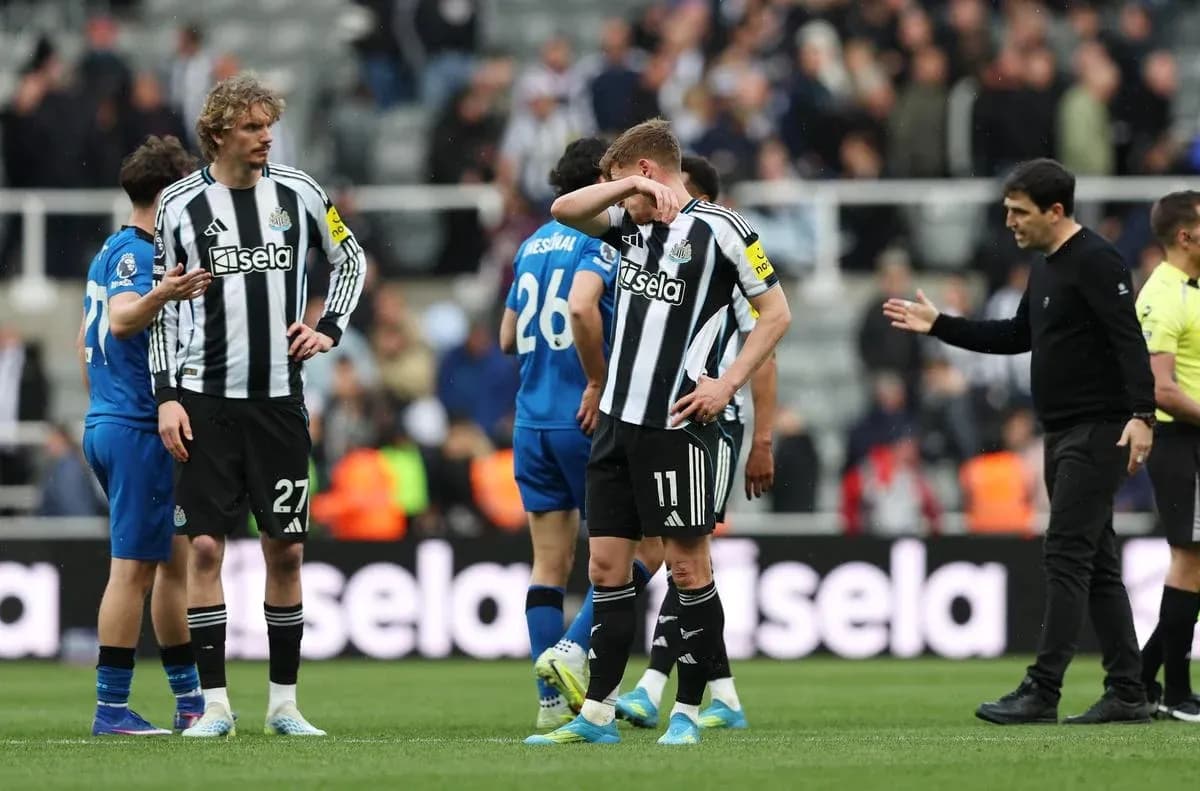
Newcastle vs Bournemouth: Tactical Analysis of the 2–1 Defeat
Newcastle’s 2–1 home defeat to Bournemouth at St. James’ Park unfolded as a clash between structured possession and ruthless transition. In a Premier League Round 33 fixture, Eddie Howe’s 4‑3‑3 delivered territorial control and a marginal edge in the ball (54% to 46%), but Andoni Iraola’s 4‑2‑3‑1 carried the sharper threat, reflected in a 3.03 xG to 1.65 advantage and a decisive late winner. Bournemouth’s compact mid-block, vertical running from the three behind Evanilson and full-back aggression, especially from Adrien Truffert, repeatedly exposed Newcastle’s defensive line and turned a statistically balanced shot count (12–12) into a more dangerous visiting performance.
The scoring opened on 32 minutes when Bournemouth translated their first clear attacking pattern into a goal. From the 4‑2‑3‑1 base, Alex Scott and Ryan Christie acted as a double pivot in build-up, but the real incision came higher: Rayan drifting inside from the right half-space, Eli Junior Kroupi between lines, and Marcus Tavernier attacking the left channel. The goal itself – Tavernier finishing from a Rayan assist – captured Iraola’s plan: draw Newcastle’s midfield three narrow, then hit quickly into the vacated wide zones. With Newcastle’s full-backs, Valentino Livramento and Lewis Hall, both pushing high in the 4‑3‑3, Malick Thiaw and Sven Botman were repeatedly left to manage large lateral spaces. Bournemouth’s first goal came when that back four became stretched, with the visitors exploiting the gap between Hall and Botman and then finishing clinically.
At that stage, Bournemouth’s Defensive Index – in terms of compactness and duel management – was superior. They allowed Newcastle plenty of sterile possession but protected central areas, with Scott screening passes into William Osula’s feet and Christie tracking Lewis Miley’s attempts to step into advanced pockets. Newcastle’s Overall Form in possession was neat but too horizontal: Sandro Tonali dropped to the right of Thiaw to start moves, Miley received under pressure facing his own goal, and Jacob Ramsey struggled to arrive in the box early enough to support the front three. Harvey Barnes and Anthony Elanga held wide starting positions but were often isolated against full-backs, forcing Newcastle to rely on individual 1v1s rather than collective overloads.
Second Half Adjustments
Howe’s tactical response came immediately after the interval. At 46', Kieran Trippier (IN) came on for Lewis Hall (OUT), reshaping the right side and subtly altering the build-up structure. Trippier’s presence gave Newcastle a more stable rest-defence and a higher technical level in wide circulation. Newcastle began to pin Bournemouth deeper, and the 4‑3‑3 tilted into a 2‑3‑5 in possession, with Trippier high, Livramento tucking slightly, and Tonali plus Miley forming a double pivot behind a line of five attackers.
The key attacking shift arrived on 62 minutes with a double substitution: Bruno Guimarães (IN) came on for Jacob Ramsey (OUT), and Jacob Murphy (IN) came on for Anthony Elanga (OUT). Bruno’s introduction fundamentally changed Newcastle’s midfield geometry. Instead of flat, predictable passes, he played between Bournemouth’s first and second lines, breaking their cover shadow and finding Barnes and Osula in more advantageous positions. Murphy’s more direct, vertical profile on the right also forced Truffert deeper, reducing Bournemouth’s early-outlet threat down that flank.
Newcastle’s equaliser on 68 minutes came as the logical product of this improved central occupation and more aggressive final-third presence. William Osula scored from close range after Newcastle finally managed to combine centrally and arrive with numbers in the box. The goal was then confirmed by VAR at 71', underlining how fine the margins were in Newcastle’s comeback. The sequence reflected a brief spell in which Newcastle’s Overall Form peaked: the ball circulation was faster, second balls were recovered higher, and Osula’s movement between centre-backs exploited a temporary disorganisation in Bournemouth’s back line.
Defensively, however, Newcastle never fully stabilised. Aaron Ramsdale faced only three shots on target and made one save, a low workload that belied the quality of Bournemouth’s chances. The visitors’ 3.03 xG versus just three shots on goal indicates that their best opportunities were from extremely high-value positions – either very close to goal or with Ramsdale exposed. Bournemouth’s ability to attack the half-spaces behind Newcastle’s advanced full-backs remained a structural issue throughout, and it was never fully solved, even after Dan Burn (IN) came on for Valentino Livramento (OUT) at 74', adding aerial presence but not significantly reducing the space behind the line.
Impactful Substitutions
Bournemouth’s substitutions were equally significant in maintaining their threat. Tyler Adams (IN) for Ryan Christie (OUT) at 65' and David Brooks (IN) for Eli Junior Kroupi (OUT) at 66' refreshed the midfield legs and preserved the intensity of the press. Later, Ben Gannon-Doak (IN) for Rayan (OUT) at 78' injected direct running against a tiring Newcastle back line. These changes allowed Bournemouth to keep transitioning with speed even as Newcastle pushed for a winner.
The decisive moment came on 85 minutes, when Adrien Truffert scored Bournemouth’s second. The left-back’s winner was emblematic of Iraola’s full-back usage: Truffert did not simply hold the touchline; he underlapped into the half-space as Newcastle’s block narrowed to protect the centre. With Newcastle’s defensive line pinned by Evanilson and the substitute runners, Truffert arrived from deep, untracked, to finish. This was less an isolated error and more the culmination of a structural problem: Newcastle’s wide midfielders and full-backs were repeatedly overloaded by Bournemouth’s rotations on the left.
In goal, Đorđe Petrović made two saves from three shots on target, and while his raw shot-stopping volume was low, his command of the area and late-game management were notable, culminating in a yellow card for time wasting at 90+4'. Newcastle’s keeper, Ramsdale, recorded one save from three shots on target, with no goals prevented above expectation, aligning with Bournemouth’s clinical finishing.
Disciplinary Control
Disciplinary control also told a tactical story. Bournemouth collected four yellow cards: Ryan Christie (52', foul), Marcus Tavernier (55', argument), Alex Scott (82', foul), and Petrović (90+4', time wasting). Newcastle’s two bookings – Sven Botman (77', foul) and Jacob Murphy (80', foul) – reflected increasing desperation as they tried to halt transitions and recover the ball quickly after turnovers. The card distribution mirrors the match’s flow: Bournemouth breaking with speed and occasionally overstepping in duels, Newcastle forced into tactical fouls as their rest-defence was stretched.
Statistically, Newcastle’s 54% possession, 433 passes at 79% accuracy and 1.65 xG describe a side that controlled territory but struggled to translate it into truly dangerous chances. Bournemouth, with 380 passes at 75% accuracy, 12 shots (matching Newcastle) but a far higher xG of 3.03, demonstrated a superior chance-creation profile. Their Defensive Index – four yellow cards but no red, three blocked shots, and a compact mid-block – held firm under pressure, while their Overall Form in attack, especially through dynamic wide and half-space rotations, ultimately decided a finely poised contest.