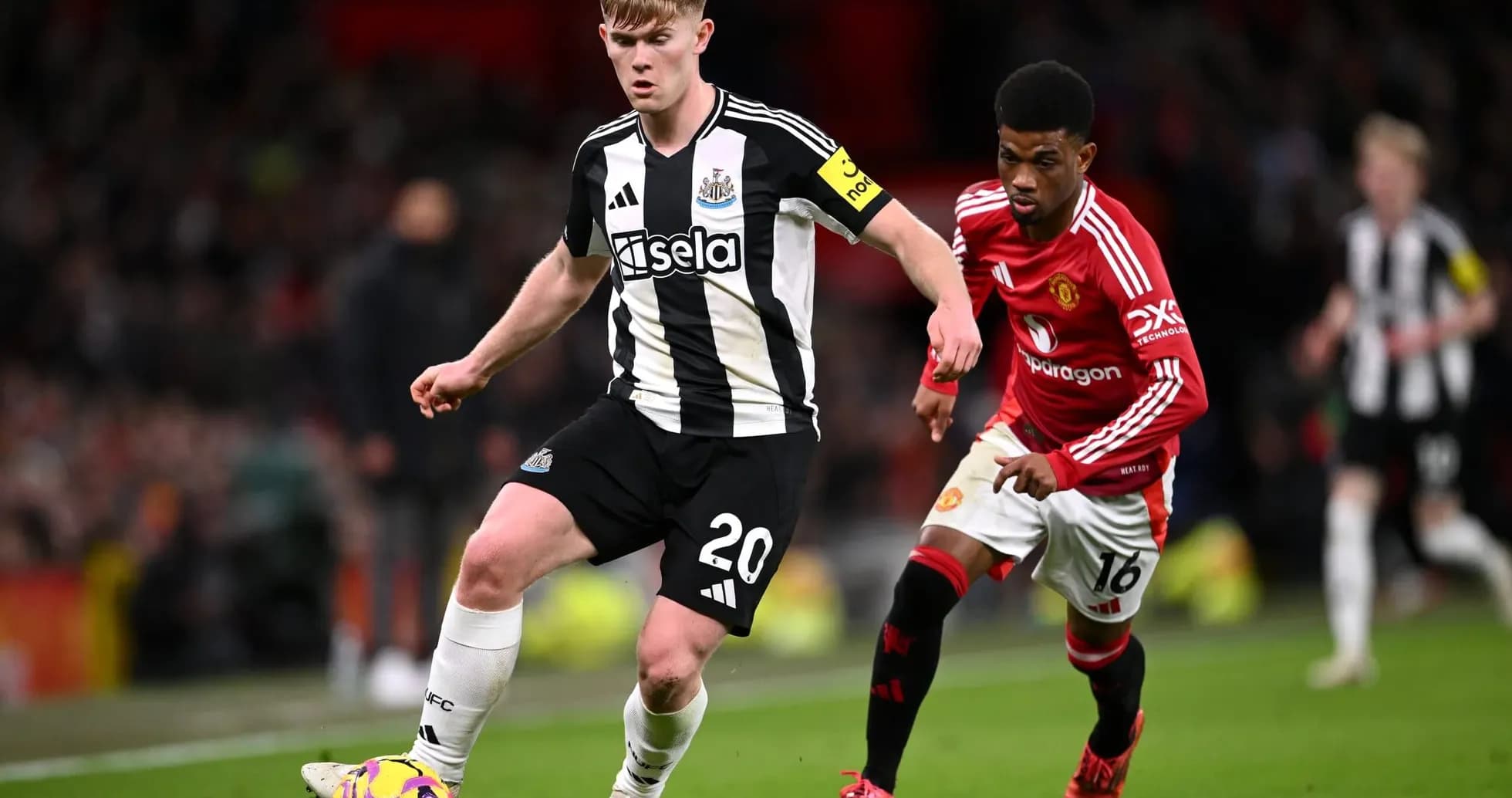
Newcastle Stuns Manchester United 2–1 Despite Red Card
Down to 10 men from first-half stoppage time and facing a Manchester United side sitting 3rd on 51 points, Newcastle – 12th with 39 points – produced a fiercely disciplined and emotionally charged 2–1 win. Anthony Gordon’s penalty and a late goal from substitute William Osula overturned Casemiro’s equaliser, as Peter Bankes oversaw a night of high controversy, a red card, and a tactical arm-wrestle that exposed United’s lack of incision against a compact, resilient home side.
First Half Analysis
The opening phase reflected the formations on paper: Newcastle’s 4-3-3 sought direct running from Anthony Gordon and Harvey Barnes, while Manchester United’s 4-2-3-1 relied on Kobbie Mainoo and Casemiro to control rhythm. Newcastle, despite conceding possession, focused on structural control, happy to spring forward through Joelinton’s ball-carrying and Gordon’s movement.
Tension escalated on 26' when Jacob Ramsey went into the book for a foul, the first of several physical duels in midfield. Bryan Mbeumo responded with a yellow card of his own on 37' for a late challenge, and Joelinton followed on 38' as the contest grew increasingly scrappy. Luke Shaw’s booking on 39' underlined United’s struggles to contain Newcastle’s wide players one-on-one.
The half turned chaotic around the interval. At 45', Gordon calmly converted a penalty to put Newcastle 1–0 up, a reward for their more purposeful attacking in the final third. Yet the hosts’ momentum was shattered moments later. In first-half stoppage time (45+1'), Ramsey received a second yellow for simulation, immediately followed by a red card for the same offence, leaving Newcastle to play the entire second half with 10 men. United capitalised almost instantly: Casemiro arrived to score a goal from open play at 45', finishing after Bruno Fernandes’ assist, to send the sides into the break level at 1–1 but with the visitors holding a significant numerical advantage.
Second Half & Tactical Shifts
Newcastle reacted immediately at the restart. On 46', Joe Willock replaced Harvey Barnes, a like-for-like shift that effectively converted the 4-3-3 into a more conservative, hard-running midfield line to plug the Ramsey gap and protect the full-backs. The plan was clear: concede territory, compress the central lanes, and look for counters through Gordon and Anthony Elanga.
Erik ten Hag’s side tried to tilt the pitch after the hour. At 61', Diogo Dalot came in for Casemiro, an attacking gamble that pushed United’s full-backs higher and reduced their double-pivot security. Simultaneously, Manuel Ugarte replaced Luke Shaw, with Ugarte stepping into midfield and United reshuffling their back line. The intent was to add progression and verticality, but it also left spaces that Newcastle’s remaining midfielders could exploit on transition.
The pattern didn’t immediately change: United probed, but Newcastle’s back four, marshalled by Dan Burn and Malick Thiaw, held firm. Noussair Mazraoui’s yellow card on 64' for a foul reflected United’s frustration as attacks broke down against a disciplined block.
Ten Hag doubled down on attacking options late on. At 76', Amad Diallo replaced Mainoo, adding another forward runner between the lines, and a minute later (77') Joshua Zirkzee came on for Mbeumo, turning United’s shape into something closer to a 4-2-4 in possession. Yet the volume of attackers did not translate into clarity of chances.
Eddie Howe (inferred from Newcastle’s structure, though not named in the data) managed his tired 10 men astutely. On 80', Kieran Trippier was booked for a foul, but he remained a key outlet. Four minutes later, Jacob Murphy replaced Anthony Elanga on 84', adding fresh legs on the flank. On 85', Osula came in for Gordon, a bold call given Gordon’s threat, but one that would prove decisive. At the same moment, Tyrell Malacia replaced Mazraoui for United, a more conservative tweak on the left.
The decisive moment came on 90'. Osula, the substitute, struck a goal from open play, finishing a move supplied by Trippier’s assist to make it 2–1. It was a classic late sucker punch: United’s advanced structure left them vulnerable, and Newcastle’s efficiency in a rare attack punished them. Deep into stoppage time (90+7'), Sven Botman replaced Sandro Tonali, a defensive substitution to see out the win, as Newcastle dropped even deeper to protect their lead.
Statistical Deep Dive
The numbers underline Newcastle’s strategic discipline. United held 55% possession to Newcastle’s 45%, and completed 384 of 469 passes (82% accuracy) compared to Newcastle’s 291 of 381 (76%). Yet that territorial edge did not translate into dominance of quality.
United recorded 14 total shots to Newcastle’s 12, but both sides managed 5 shots on target. Newcastle’s xG of 2.48 dwarfed United’s 1.48, reflecting that the hosts created the clearer chances despite their numerical disadvantage and lower possession. United’s 5 blocked shots show how often Newcastle’s defenders threw themselves in the way, while Newcastle’s single blocked effort highlights United’s less desperate defending.
Discipline was a major storyline. Newcastle committed 15 fouls and collected 4 yellow cards plus Ramsey’s red, illustrating the physical toll of playing with 10 men. United’s 16 fouls and 3 yellows, however, point to their own struggles to control transitions and counter-press effectively. Goalkeeper saves were close – 4 for Aaron Ramsdale, 3 for Senne Lammens – underlining that while United had more of the ball, the game state remained precarious at both ends.
Standings & Implications
Within the existing table snapshot, Newcastle remain 12th on 39 points with a goal difference of -1, but this result feels far bigger than their mid-table label suggests, especially after a recent run of mixed form (WLLWL). Beating a Manchester United side ranked 3rd on 51 points and chasing Champions League qualification reinforces Newcastle’s capacity to bloody the nose of the elite at St. James’ Park. For United, still 3rd with a +11 goal difference, this defeat stalls momentum and raises familiar questions about their ability to break down compact, organised opposition when the pressure is on.