Newcastle United's Future: Sell to Compete or Risk Decline
Newcastle United’s hierarchy has delivered the bluntest message yet of this new era on Tyneside: if the club miss out on the Champions League, big names will almost certainly have to go.
Chief executive David Hopkinson did not dress it up. In a candid briefing, he made clear that the days of Newcastle simply hoarding talent without thinking about the balance sheet are over – even under the vast wealth of Saudi Arabia’s Public Investment Fund.
The club, he stressed, must become a trader as well as a collector.
Isak sale sets the template
The sale of Alexander Isak to Liverpool last summer remains a raw wound for many supporters and a public point of friction with Eddie Howe. The head coach made no secret of his unhappiness at losing his leading striker; the fanbase saw it as a step backwards just as Newcastle were trying to cement themselves among the elite.
Hopkinson, who was not in post when that deal was done, views it very differently.
“To me, Isak was a good sale,” he said, pointing to the £125 million fee as a benchmark of what Newcastle want to do in the market. That move, deeply unpopular in the stands, is now being held up inside the club as a model of how to operate under tight financial rules.
“Going forward our strategy is to buy well and sell well,” he explained. Buying well, in his eyes, is not about outspending rivals but about extracting maximum value from every deal – both incoming and outgoing. The focus is shifting from transfer fees paid to long-term value generated.
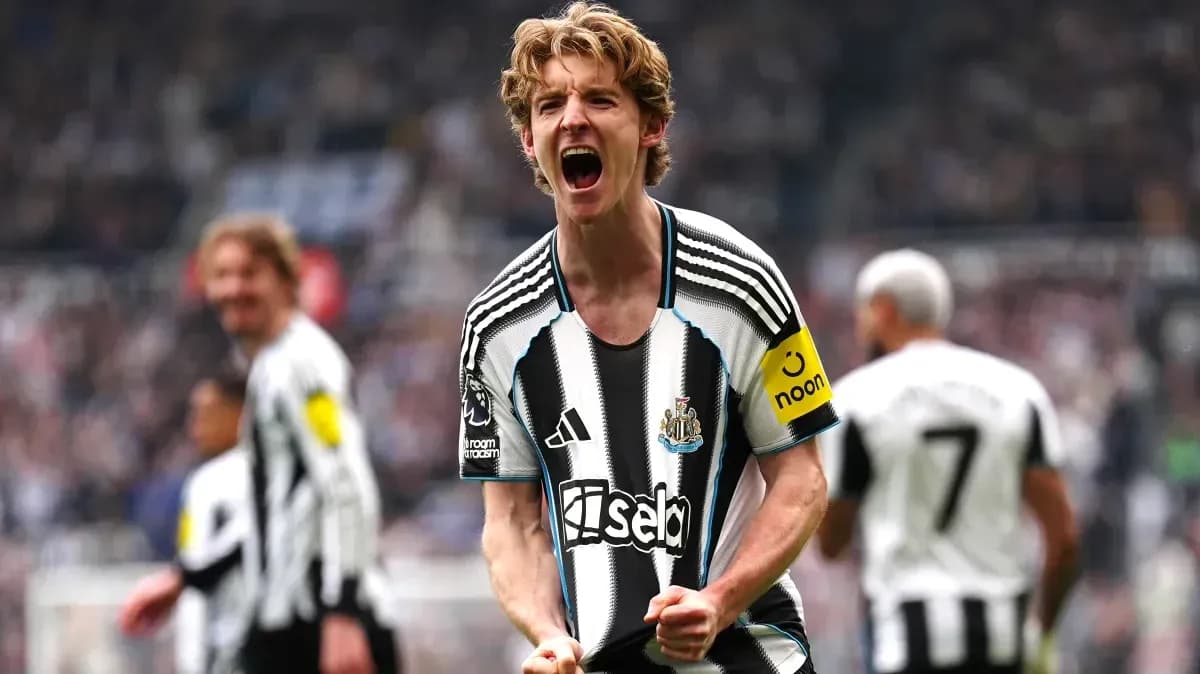
That philosophy has immediate consequences. It drags the futures of players such as Sandro Tonali and Anthony Gordon into the spotlight. It also puts Bruno Guimarães and Tino Livramento firmly on the radar of wealthier, less constrained clubs.
Champions League or compromise
The underlying issue is stark. Newcastle are wrestling with domestic and European financial regulations at the same time as facing uncertainty over next season’s revenues. The Champions League money that flowed in recently is not guaranteed to return.
If it doesn’t, the financial picture changes quickly.
With PIF determined to run Newcastle as a “sound business” rather than a vanity project, a failure to qualify for Europe’s top competition would create a sizeable hole in income. One obvious way to plug it: cash in on a star.
Hopkinson did not name names. He did not need to. The principle was laid down instead.
“We are not ready to answer that,” he said when asked directly about potential departures. “We can make a box-office signing but we might not be able to do that without selling somebody. What I do know is that players that leave this club will need to do so on our terms.”
The message is clear. If Newcastle want to keep making statement signings, someone important will almost certainly have to be sacrificed first.
Howe under scrutiny, but not on the brink
Off the pitch, the pressure has been building on Eddie Howe, particularly after the bruising home derby defeat to Sunderland – a result that cut deep into the club’s psyche as much as their league position.
Hopkinson, though, moved quickly to cool talk of imminent change in the dugout.
“I would not frame it that way,” he said when asked if Howe’s future was being left open. “We are not looking to make a change at the moment. We are not having those conversations. We are still in the midst of the season.”
He spoke of limited “bandwidth” and a club locked in on the final stretch of the campaign, seven games that will go a long way to deciding both Newcastle’s league finish and their financial flexibility.
“Right now we are focused on the seven matches we have remaining and not distracting ourselves with speculation about what we may or may not do in the summer,” he said.
The derby, though, has left scars.
“I don’t have a stance on his future. What I can tell you is that the derby loss hurt. We take it seriously. There’s nothing within us that thinks, ‘Well, it’s just three points and on we go.’ It has resonated.”
Hopkinson revealed he recently spent “a couple of hours” in a one-on-one lunch with Howe, working through a “multitude of things”, including the Sunderland defeat. It was a reminder that, for now at least, the manager remains very much part of the club’s immediate plan.
“Eddie’s our manager. I expect to have a great run to the end of the season here and we’ll talk about the future when it’s time. Right now we’re focused on this season’s competition.”
Profit on paper, pressure in reality
Hopkinson was speaking as Newcastle published accounts for the year ending June 2025, a season without European football but with a Carabao Cup triumph.
The numbers look healthy at first glance. Turnover climbed by £15 million to £335.3 million. Commercial income surged by 44 per cent. Post-tax profit came in at £34.7 million.
Those figures underline how far Newcastle have come commercially since the takeover. They also underline why the club’s hierarchy feel emboldened to talk about “buying well and selling well” rather than just throwing money at the squad.
But they do not remove the constraints. They highlight them.
Newcastle are growing, but they are not yet at the point where they can ignore the trade-offs required to stay on the right side of financial rules and still strengthen a squad that wants to live among Europe’s elite.
That is the tightrope: keep Howe focused, keep the fans onside, keep the accounts healthy – and, if the Champions League slips away, decide which star can be sold “on our terms” without ripping the heart out of the project.