Osasuna vs Atletico Madrid: Tactical Breakdown of La Liga Clash
Osasuna’s 2-1 defeat to Atletico Madrid at Estadio El Sadar was a study in territorial dominance undone by box efficiency and game-state management. In a La Liga fixture where Osasuna posted 58% possession, 23 total shots and an xG of 2.16, Diego Simeone’s side escaped with three points thanks to ruthless execution from the penalty spot, a direct transition goal, and a compact 4-4-2 block that accepted territorial inferiority but controlled central spaces.
I. Executive Summary
Osasuna, in a 4-2-3-1 under Alessio Lisci, tried to impose themselves through volume and width, funnelling 18 of their 23 shots from inside the box. Atletico Madrid’s 4-4-2, led by Diego Simeone, leaned on a disciplined mid-block, rapid vertical attacks, and a high defensive efficiency: only five shots in total, but four on target and 1.64 xG converted into two goals. Despite playing the final quarter-hour with ten men, Atletico’s structure and Juan Musso’s interventions (four saves, 0.32 goals prevented) allowed them to absorb Osasuna’s late surge and protect a 2-0 lead until Kike Barja’s stoppage-time strike.
II. Scoring Sequence & Disciplinary Log
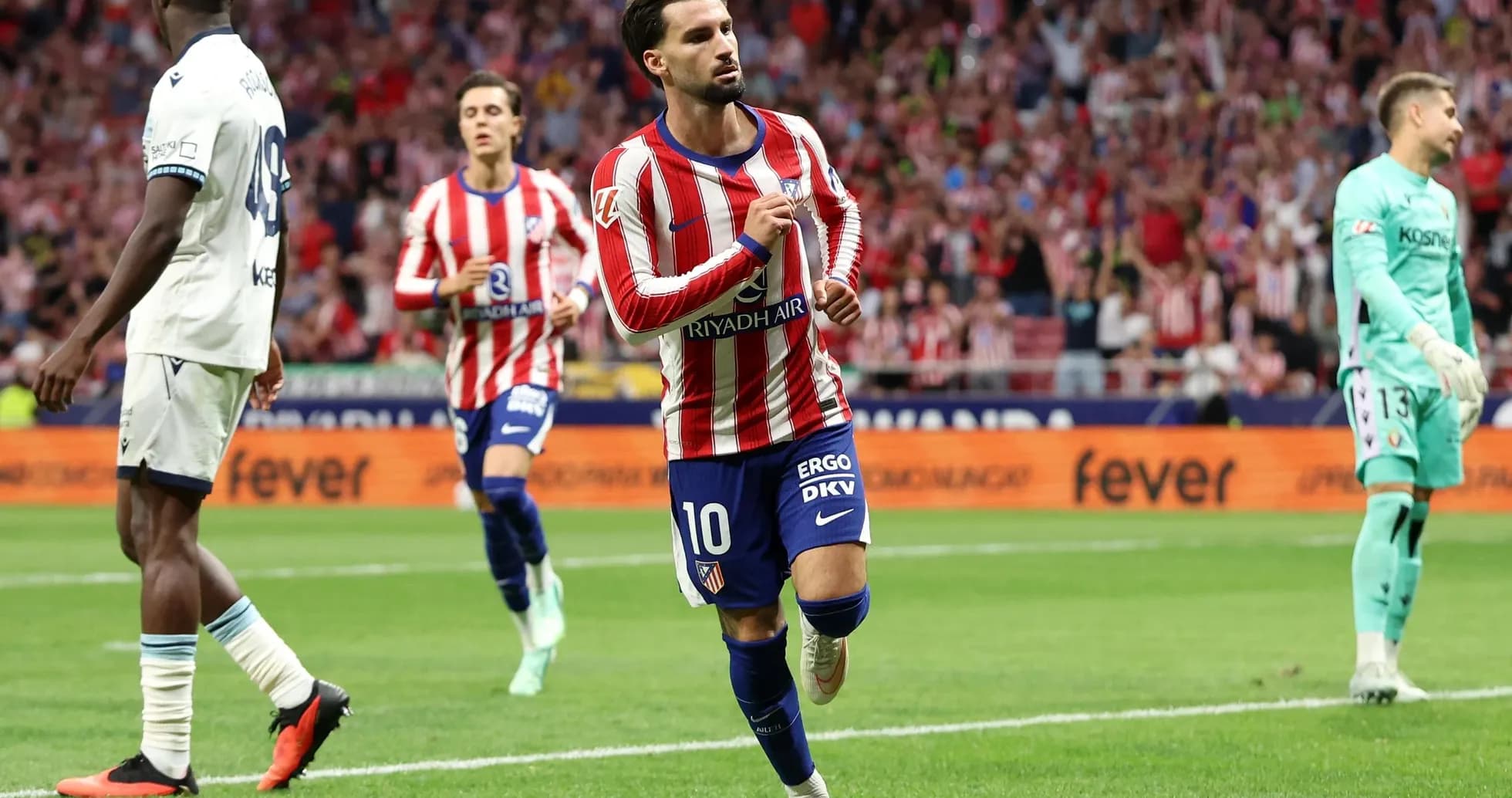
The opening tactical hinge came early: at 13', a VAR “Penalty confirmed” for Atletico Madrid involving Antoine Griezmann set the tone. Two minutes later, at 15', Ademola Lookman converted the penalty for Atletico Madrid (no assist), giving the visitors a 1-0 platform to drop slightly deeper and protect central zones.
Cards then began to shape the emotional temperature. At 14', Javi Galán (Osasuna) — Handball. At 30', Rubén García (Osasuna) — Foul. Osasuna’s frustration peaked around the interval: at 45+3' a potential penalty for Ante Budimir was denied as VAR recorded “Penalty cancelled” for Osasuna, and at 45+9' Ante Budimir (Osasuna) — Argument, underlining a growing sense of grievance as they went into half-time 0-1 down.
Second-half adjustments brought more contact and dissent. At 52', Marcos Llorente (Atletico Madrid) — Argument. At 57', Kike Barja (Osasuna) — Argument, and Koke (Atletico Madrid) — Foul, in the same minute. At 59', Marc Pubill (Atletico Madrid) — Foul, reflecting Atletico’s readiness to break rhythm with tactical infringements.
The second decisive attacking moment came at 71': Alexander Sorloth (Atletico Madrid) finished a “Normal Goal” assisted by Marcos Llorente, a classic Atletico pattern of direct exploitation of space after turnover, stretching Osasuna’s advanced full-backs. That made it 2-0 to Atletico Madrid.
Osasuna continued to push, but discipline further deteriorated. At 79', Marcos Llorente (Atletico Madrid) — Yellow Card, Foul, immediately followed at 79' by Marcos Llorente (Atletico Madrid) — Red Card, Foul, reducing Atletico to ten and forcing Simeone into an even more compact low block. At 85', Alejandro Catena (Osasuna) — Argument and Robin Le Normand (Atletico Madrid) — Argument, as tensions flared in repeated aerial and second-ball duels. At 90+2', Enzo Boyomo (Osasuna) — Foul.
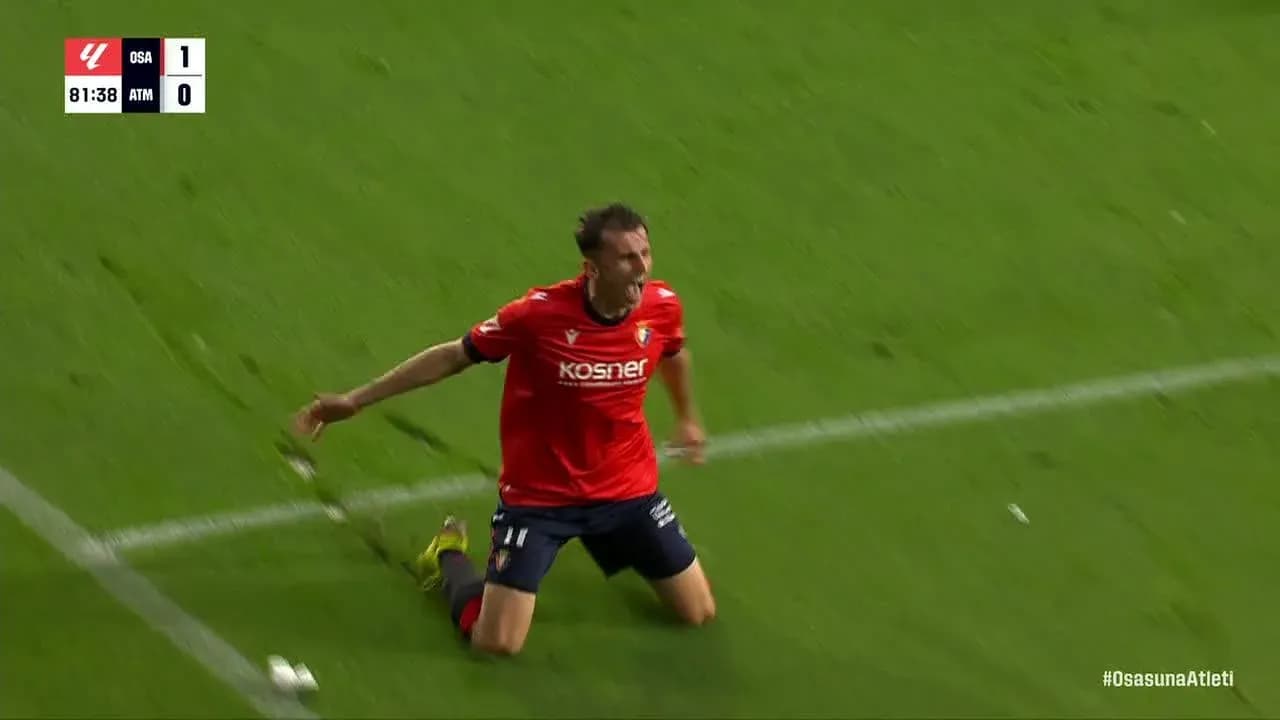
Osasuna’s pressure finally yielded a goal at 90': Kike Barja (Osasuna) scored a Normal Goal, assisted by Rubén García, capping a sustained spell of wide overloads and box occupation, but too late to alter the 1-2 full-time score.
Disciplinary totals were heavy: Osasuna 6 yellow cards, Atletico Madrid 5 yellow cards and 1 red card, total 12 cards.
III. Tactical Breakdown & Personnel
Osasuna’s 4-2-3-1 was built on territorial control and width. Jon Moncayola and Lucas Torró formed a double pivot designed to circulate possession and pin Atletico’s two forwards, while Rubén García and Moi Gómez operated between the lines. Full-backs Javi Galán and Enzo Boyomo pushed high, supported by R. Moro and Kike Barja on the flanks, creating consistent 2v1s against Atletico’s wide midfielders. The result: 477 passes, 415 accurate (87%), and eight corners, reflecting a sustained siege.
The trade-off was transition exposure. Atletico’s 4-4-2, with Marcos Llorente and Marc Pubill as aggressive, front-foot defenders, was content to concede space in front while protecting the central lane. Koke and R. Mendoza (replaced early by Robin Le Normand via the 18' substitution vector: R. Mendoza (OUT), R. Le Normand (IN)) stayed narrow, allowing Thiago Almada and O. Vargas to jump out selectively. Once ahead, Atletico consistently looked to hit the channels behind Osasuna’s advanced full-backs, a pattern that culminated in the 71' Sorloth goal from a Llorente assist.
Goalkeeper dynamics underlined the different defensive realities. A. Fernandez for Osasuna faced only four shots on goal, making two saves; the 0.32 goals prevented figure indicates he performed roughly in line with expectation, beaten once from the spot and once in open play. The real issue was not shot-stopping but the quality of Atletico’s few chances, often arriving in high-value spaces.
Juan Musso, by contrast, was central to Atletico’s resilience. He faced five shots on goal from Osasuna’s 23 attempts, making four saves. With 0.32 goals prevented, Musso marginally outperformed the xG of shots on target, particularly in the final stages when Osasuna, aided by the extra man after Llorente’s dismissal, flooded the box with crosses and cut-backs. His command of the area and timing off his line limited second-phase chances from the eight corners Osasuna earned.
Substitutions altered the tactical picture significantly. For Atletico, the 46' change — T. Almada (OUT), A. Sorloth (IN) — shifted the front line towards a more direct, target-man profile, allowing Griezmann to drop and link while Sorloth attacked depth. Later, at 82', A. Lookman (OUT), C. Lenglet (IN) effectively moved Atletico into a back five in all but name, with Lenglet and Le Normand reinforcing the box against aerial bombardment.
Osasuna’s changes were aimed at sustaining tempo and adding verticality. At 37', R. Moro (OUT), K. Barja (IN) injected direct dribbling and eventually produced the 90' goal. On 60', Rubén García (OUT), R. Garcia (IN, the forward with shirt 9) freshened the central attacking lane, and J. Galan (OUT), A. Bretones (IN) maintained the aggressive full-back profile. At 72', L. Torro (OUT), A. Oroz (IN) and M. Gomez (OUT), A. Osambela (IN) pushed Osasuna into an even more attacking posture, with extra bodies between the lines and in the half-spaces.
Once Atletico went down to ten, Simeone’s side collapsed into a narrow, low block, ceding the flanks entirely. Osasuna responded by overloading wide zones, particularly through Kike Barja on the right, and crashing the box with four and sometimes five bodies. The late goal was a direct consequence of this pattern: Barja arriving from a wide starting position into the box, assisted by the substitute R. Garcia, exploiting Atletico’s numerical deficit and fatigue.
IV. The Statistical Verdict
From a statistical standpoint, the match was an archetypal clash between volume and efficiency. Osasuna’s 23 shots to Atletico’s 5, and xG of 2.16 to 1.64, suggest the hosts generated more and slightly better chances overall, particularly once the visitors were reduced to ten men. However, Atletico’s shot profile was sharper: four of five attempts were on target, and they converted two of them, aligning closely with their xG.
Possession (58% to 42%) and passing data — Osasuna 477 passes, 415 accurate (87%); Atletico Madrid 358 passes, 287 accurate (80%) — underline Osasuna’s role as territorial protagonists. Yet Atletico’s defensive index, reflected in Musso’s four saves and the team’s ability to restrict Osasuna to five shots on target from 23 attempts, was superior. The visitors also absorbed a heavy disciplinary load (5 yellow cards, 1 red card) without fully losing structural cohesion.
Ultimately, Osasuna’s overall form in this match looked strong in terms of chance creation and pressure, but their penalty-area efficiency lagged behind Atletico’s ruthless, low-volume model. In a high-card, high-emotion contest at Estadio El Sadar, Simeone’s side leveraged game-state, set-piece pressure (the early penalty), and transition clarity to secure a 1-2 away win that outperformed their territorial metrics but fit their long-standing tactical identity.