PAOK vs Anderlecht: Tactical Analysis of a Low-Possession Victory
PAOK’s 4-2-3-1 at Toumba Stadium was built to dominate territory and rhythm, and the numbers confirm that the structural idea worked even if the outcome did not. With 65% possession and a 3–2 advantage in shots on target, Alessio Lisci’s side controlled the ball and the zones, but failed to convert volume into incision. Anderlecht, in a 4-3-3 under Vitor Bruno, accepted a low-possession, high-resistance brief and protected their early lead with compact spacing and aggressive duels, conceding 23 fouls but only five corners and three shots on goal.
From the first minute, the game state shaped the tactical landscape. The early strike from M. Cvetkovic allowed Anderlecht’s 4-3-3 to morph into a 4-5-1 without the ball, with wingers M. Cvetkovic and J. Onia Seke initially tasked with pinching in to screen passes into PAOK’s double pivot of C. Zafeiris and B. Santamaria. E. Llansana operated as the key balancing piece: his role as a linking midfielder in possession, and as the first presser out of the central three, helped Anderlecht contest second balls despite their reduced share of the ball.
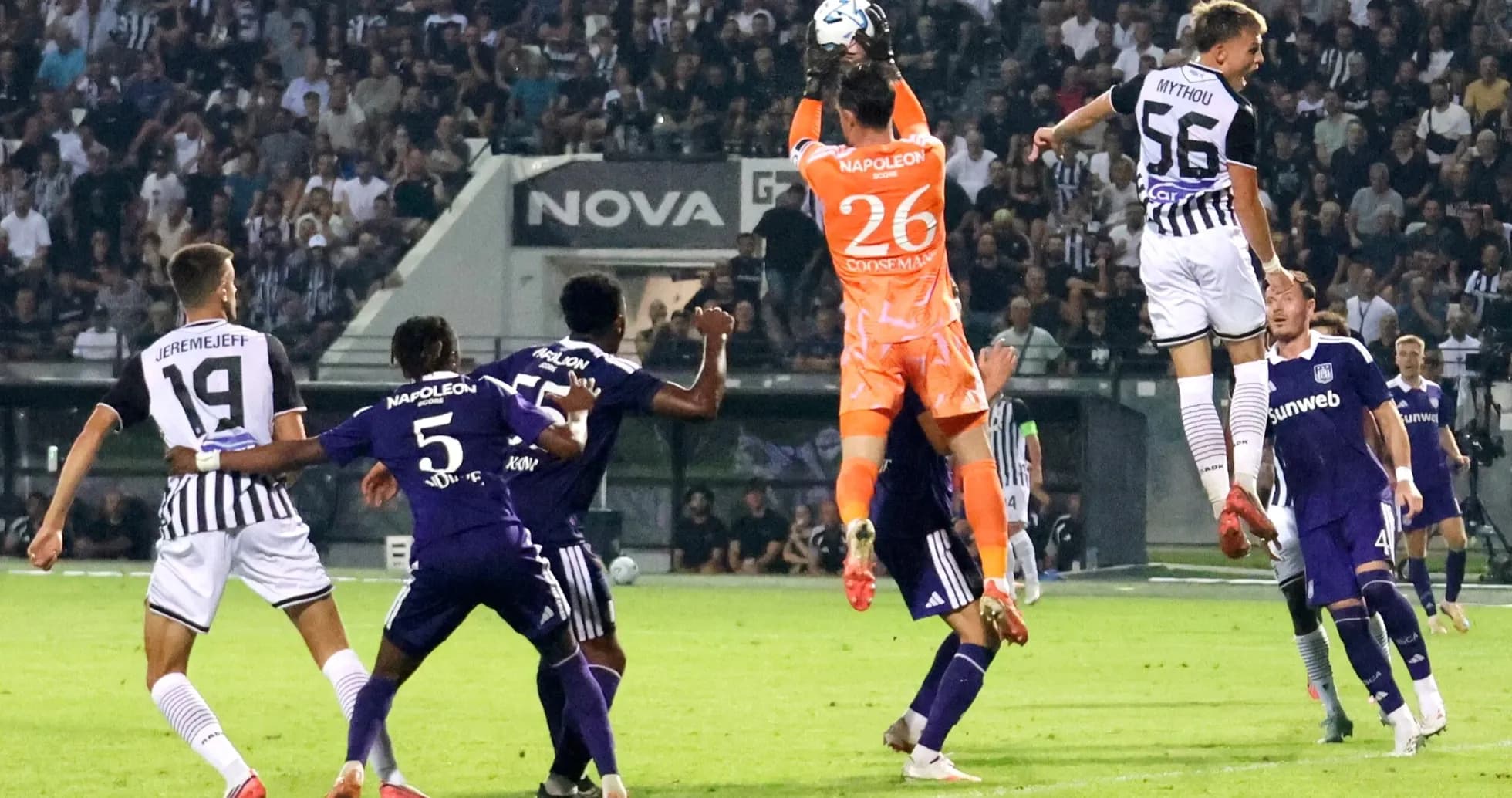
PAOK’s structure was clear: full-backs Jogo and G. Michailidis were encouraged to advance, with J. Kenny narrower on the right at times to form a three in the first line with P. Hatzidiakos. This was meant to free A. Zivkovic and Taison between the lines, with G. Konstantelias as the main interior creator behind A. Mythou. The 11 shots off target, however, reveal that much of PAOK’s final-third occupation resulted in rushed or low-quality attempts rather than clean, central finishes.
Anderlecht’s defensive approach leaned on timing and compactness rather than volume of blocks: they registered zero blocked shots, yet limited PAOK to just three efforts on goal despite long spells of defending. The back four of M. N’Diaye, G. Biancone, L. Petrot and A. Maamar stayed tight horizontally, forcing PAOK to shoot from imperfect angles. The midfield trio, with M. Kana dropping deeper as an auxiliary defender, narrowed the central corridor, leaving PAOK to circulate in front of the block.
Lisci’s in-game adjustments were aimed at refreshing the back line and adding width and presence. The 46' substitution — A. Elustondo (IN) came on for P. Hatzidiakos (OUT) — followed a first-half yellow for Pantelis Hatzidiakos and signalled a desire to maintain aggression in the defensive line without risking a red card in a foul-heavy contest (PAOK committed 15 fouls to Anderlecht’s 23). Later, the double change at 63' — A. Baba (IN) came on for Jogo (OUT) and G. Taylor (IN) came on for B. Santamaria (OUT) — subtly rebalanced the side. Baba offered more direct overlapping from left-back, while Taylor’s introduction for a holding midfielder tilted PAOK towards a more front-footed, almost 2-1-4-3 shape in possession, with C. Zafeiris often the lone pivot.
The 71' switch, with A. Jeremejeff (IN) coming on for Taison (OUT), further underlined PAOK’s shift to a more vertical, cross-heavy approach. Jeremejeff’s profile as a penalty-box target contrasted with Taison’s between-the-lines playmaking; combined with the later introduction of D. Pelkas (IN) for A. Mythou (OUT) at 83', PAOK ended the match with multiple central reference points and attacking midfielders trying to overload Anderlecht’s box. The five corners PAOK earned stemmed largely from this late-wave pressure, but Anderlecht’s penalty-box organisation held.
Anderlecht’s substitutions were more about energy management and preserving the defensive framework than changing the scheme. At 57', O. Antman (IN) came on for J. Onia Seke (OUT), providing fresh legs on the flank to continue pressing PAOK’s full-backs and tracking deep runs. The triple change at 71' — N. Saliba (IN) for L. Ambros (OUT) and T. Degreef (IN) for M. Cvetkovic (OUT), alongside the earlier Antman switch — maintained the 4-3-3 shape but with renewed intensity in the wide and midfield zones. Saliba’s presence helped Anderlecht cope with PAOK’s increasingly aggressive central occupation, while Degreef and Antman dropped deeper out of possession, effectively creating a 4-1-4-1 block.
Discipline became a tactical tool for Anderlecht. Their 23 fouls and three yellow cards reflect a deliberate willingness to disrupt PAOK’s rhythm and stop transitions at source. PAOK’s two yellows, including one for Aritz Elustondo late on, came more from defensive recovery situations as they pushed numbers forward. Crucially, despite the volume of infringements, neither side saw a red card, so the numerical balance — and therefore the basic tactical geometry — remained intact for the full 90 minutes.
Statistically, the match reads as a classic control-versus-clinicality trade-off. PAOK’s 65% possession, 3 shots on goal, 11 off goal, 3 blocked shots and five corners illustrate territorial dominance and sustained pressure, but without the precision to overturn the early deficit. Anderlecht, with only 35% of the ball, 2 shots on goal and 2 off goal, produced little going forward after the opening minutes, yet their defensive structure and foul management were sufficient to protect a 1-0 lead.
Without reliable data on xG, passes or goalkeeper saves, the clearest tactical verdict comes from the shot profile and possession split: PAOK’s positional play and late attacking reshapes generated volume but not efficiency, while Anderlecht’s compact 4-3-3/4-5-1 hybrid, backed by aggressive but controlled fouling, turned an early goal into a textbook low-block, low-possession European away win in the 3rd Qualifying Round of the UEFA Europa League.