Rangers vs Jagiellonia: UEFA Europa League 3rd Qualifying Round Preview
On 13 August 2026, the floodlights of Ibrox Stadium in Glasgow will frame a European night heavy with jeopardy. Rangers return home wounded, trailing after a 2-1 defeat to Jagiellonia in the first leg of this UEFA Europa League 3rd Qualifying Round tie, knowing only a statement performance can keep their continental journey alive. For Jagiellonia, it is a rare chance to finish the job on one of Europe’s most intimidating stages and turn a famous first-leg win into a historic qualification.
Season Context
With no full group standings available yet, Rangers’ European story so far is brutally simple: one match, one defeat, one goal scored and two conceded in this qualifying campaign. The 2-1 loss away has left them needing at least a one-goal victory at Ibrox to stay alive, and the pressure on a squad packed with attacking talent like Lawrence Shankland, Bojan Miovski and Youssef Chermiti is immediate and intense.
Jagiellonia arrive in Glasgow with a perfect opening chapter to their Europa League push: one game played, one win, two goals scored and just one conceded. That 2-1 home victory has given them both a lead on the scoreboard and a psychological edge. Now the Polish side must prove they can defend that advantage away from the comfort of Chorten Arena and survive 90 minutes in a far more hostile environment.
Form & Momentum
Rangers’ continental form line is stark: “L” in their only Europa League outing so far. The defeat in Bialystok exposed early fragility, with the team conceding twice in a single match while averaging just 1.0 goal scored and 2.0 goals conceded per game in this campaign (1 scored, 2 allowed over 1 match). For a club that expects to dictate at this level, that balance underlines how much they must raise their intensity and precision at Ibrox.
Jagiellonia’s momentum is the mirror image: “W” from their sole Europa League fixture to date. They have started this qualifying round confidently, averaging 2.0 goals scored and 1.0 conceded per match (2 for, 1 against in 1 game). That blend of cutting edge and relative defensive stability gives them a platform to approach Glasgow with belief, even if the sample size is still tiny and the true test of their resilience is yet to come.
Head-to-Head Patterns
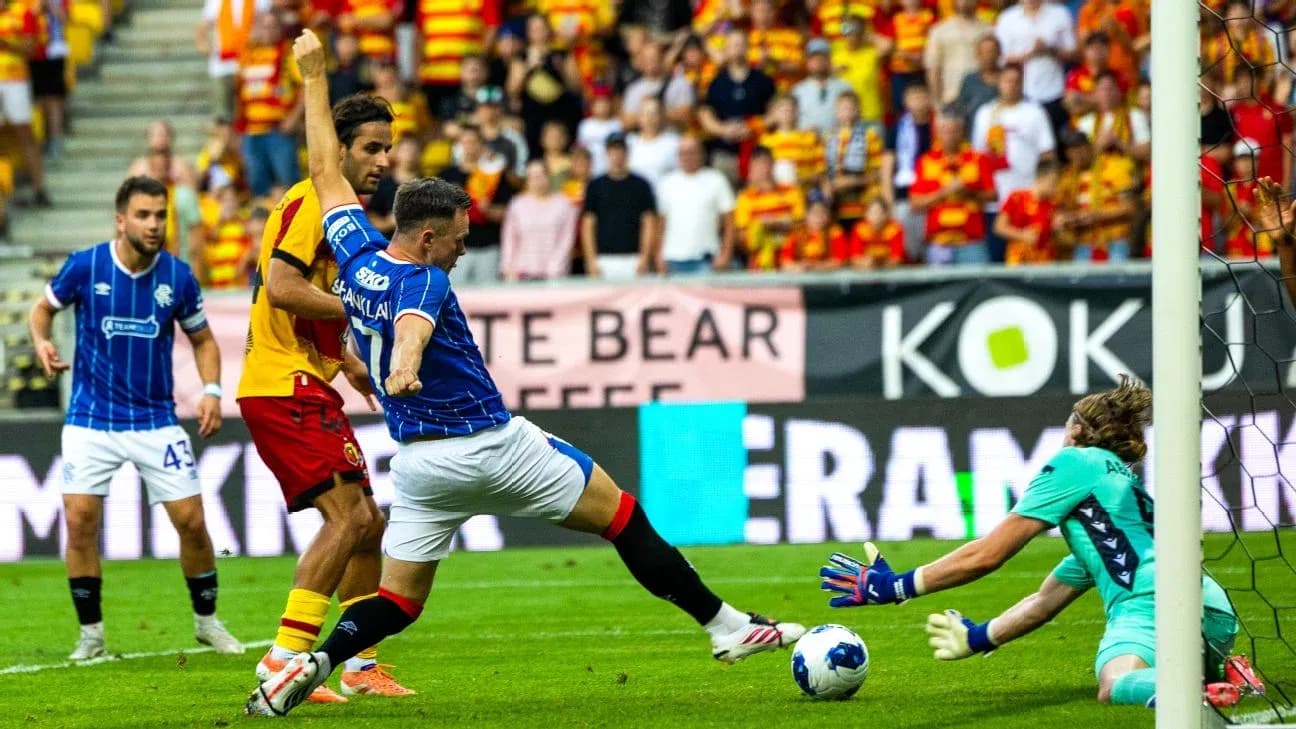
The historical story between these two clubs is only just beginning, but the opening chapter belongs to Jagiellonia. On 6 August 2026, at Chorten Arena in Bialystok, the Polish side claimed a 2-1 victory over Rangers in the UEFA Europa League 3rd Qualifying Round (2-1, UEFA Europa League, season 2026, August 2026). That match, with Jagiellonia as hosts and Rangers as visitors, set the tone for this tie: Jagiellonia incisive in key moments, Rangers punished for defensive lapses.
With no previous non-friendly meetings on record beyond that first leg, there are no long-term patterns of dominance to lean on. Instead, the narrative is immediate: Jagiellonia have shown they can hurt Rangers, and Rangers have already felt the cost of small margins going against them. The second leg at Ibrox becomes less about historic precedent and more about which side can adapt fastest to what they have just learned about each other.
Tactical Preview
Rangers’ statistical profile in this Europa League campaign is drawn from that single away defeat, but it still hints at their intended structure. They lined up in a 4-2-3-1 in their only match, a shape that suits a squad rich in forwards and attack-minded midfielders. With creative and goalscoring options such as Lawrence Shankland, Bojan Miovski and Youssef Chermiti available, the plan at Ibrox is likely to be front-foot: a high attacking line, full-backs pushing on, and a double pivot trying to pin Jagiellonia back while protecting against counters. The challenge is clear: they have allowed 2.0 goals per game so far, and tightening that defensive base without blunting their need for goals will be the key balancing act.
Jagiellonia, by contrast, have shown their hand as a 4-3-3 side in their lone Europa League outing. That system suits a blend of compact midfield work and sharp transitions, with wide attackers and advanced midfielders like Jesús Imaz and K. Jóźwiak capable of exploiting space if Rangers overcommit. Averaging 2.0 goals scored and 1.0 conceded per game, they have combined direct threat with enough defensive organisation to manage a narrow lead. In Glasgow, their likely approach will be to compress central areas, accept long spells without the ball, and spring forward quickly when Rangers’ full-backs vacate space.
The battle zones are obvious. Rangers will look to overload between the lines, using players such as N. Raskin and M. Diomandé to connect midfield and attack, while centre-backs like B. Godfrey and J. Souttar must be braver on the ball but cleaner in their defensive duels after conceding twice in Poland. Jagiellonia’s back line, anchored by figures like Bernardo Vital and Y. Kobayashi, will be tested aerially and physically, but their midfield trio in the 4-3-3 will be crucial in disrupting Rangers’ rhythm and launching breaks. If Jagiellonia can maintain the balance that saw them concede just once while scoring twice in the first leg, they will fancy their chances of surviving the Ibrox storm.
Statistical Snapshot
- Competition: UEFA Europa League, season 2026 — 13 August 2026.
- Venue: Ibrox Stadium, Glasgow.
- Prediction: Win or draw for Jagiellonia — Double chance : draw or Jagiellonia.
- Win Probabilities: Home 0% / Draw 50% / Away 50%.
- Model: Rangers 33 — Jagiellonia 67.
Betting Verdict
The prediction models lean strongly towards Jagiellonia avoiding defeat, with a double chance on draw or Jagiellonia backed by the fact they have the only win in this tie and a 2-1 aggregate lead. Market odds, however, make Rangers clear favourites at Ibrox, with home prices roughly between 1.53 and 1.60, implying an approximate 62–65% chance of a home win, while Jagiellonia’s away odds around 5.80–6.07 suggest only about a 16–19% chance of victory and the draw at roughly 3.95–4.14 sits near 24–25%. That disconnect between model and market creates an intriguing tension: Rangers’ need to chase the game at home justifies their short price, but Jagiellonia’s first-leg win and 4-3-3 counter-attacking platform support the analytical case for the underdog to hold on. For value-seekers, the conservative play aligns with the prediction engine: the double chance on draw or Jagiellonia, trusting their early momentum and the tactical suitability of defending a lead and countering into the spaces Rangers must leave.