Sassuolo vs Lecce: A Season in 90 Minutes
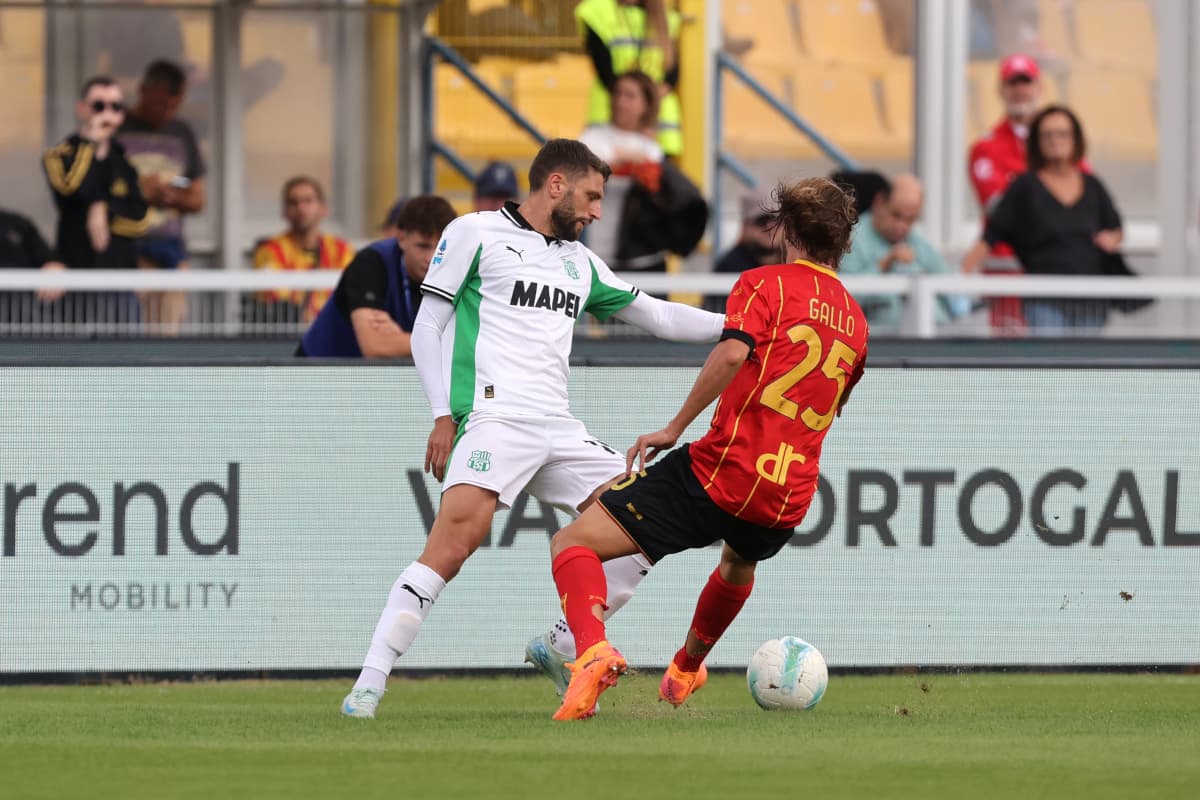
The evening at MAPEI Stadium – Città del Tricolore closed with a scoreline that felt like a distillation of both teams’ seasons: Sassuolo 2, Lecce 3, in a Serie A Round 37 contest that swung on fine margins and familiar flaws. Following this result, the table snapshots are telling. Sassuolo sit 11th with 49 points, their overall goal difference at -3 after scoring 46 and conceding 49 in 37 matches. Lecce, fighting nearer the trapdoor, cling to 17th with 35 points and a far harsher overall goal difference of -23, the product of 27 goals for and 50 against.
I. The Big Picture – Styles Laid Bare
This was always going to be a clash of identities. Sassuolo’s 4-3-3 under Fabio Grosso has been the structural backbone of their season, used in 35 of 37 league matches. It is a system built to give the front three – here Domenico Berardi, M’Bala Nzola and Armand Laurienté – the widest possible canvas. Heading into this game, Sassuolo’s attack at home produced 25 goals in 19 matches, an average of 1.3, but that creativity has come with a price: they conceded 26 at home, 1.4 per match.
Lecce arrived in their own comfort shape, a 4-2-3-1 that has been Eusebio Di Francesco’s go-to (21 league uses). Their season has been defined by scarcity and resistance. Overall, they have scored just 27 goals in 37 games – 0.7 per match – while conceding 50 (1.4 per match). On their travels, Lecce’s numbers are slightly better going forward, 15 away goals at 0.8 per match, but they still leak 26 away goals at 1.4 per match. A fragile attack, a stretched defence, and a league position that reflects that tension.
In Reggio Emilia, the half-time score of 1-2 to Lecce and the eventual 2-3 finish fit the profiles: Sassuolo can always score, but they rarely control the chaos; Lecce struggle to dominate, yet can punish moments of defensive looseness.
II. Tactical Voids – Who Was Missing, and What That Meant
Sassuolo came into the fixture with a sizeable list of absentees that reshaped their defensive and midfield rotations. D. Boloca (muscle injury), F. Cande and E. Pieragnolo (both knee injuries), S. Walukiewicz (leg injury), plus the inactive F. Romagna and A. Vranckx, all stripped Grosso of depth in the back line and in the pivot. It left T. Muharemovic, Pedro Felipe, W. Coulibaly and U. Garcia as the defensive quartet in front of S. Turati, with Nemanja Matic asked once more to be both metronome and shield.
For Lecce, the missing pieces were higher up the pitch: M. Berisha (thigh injury) and R. Sottil (back injury) reduced Di Francesco’s options for changing the attacking rhythm from the bench. That put more creative burden on Lameck Banda, S. Pierotti and L. Coulibaly behind W. Cheddira.
Disciplinary trends framed the risk profile. Sassuolo’s season-long yellow card distribution shows a pronounced late-game spike: 29.63% of their yellows arrive between 76-90 minutes, with another 14.81% in 91-105. Lecce mirror that volatility, with 29.85% of their yellows also in the 76-90 window and 13.43% in 91-105. In a tight, late-season match, both sides were primed to become more ragged just when legs and concentration fade.
III. Key Matchups – Hunter vs Shield, and the Engine Room
The “Hunter vs Shield” narrative for Sassuolo runs through two men: Andrea Pinamonti and Domenico Berardi. Pinamonti, though on the bench here, is Sassuolo’s leading scorer overall with 9 league goals, supported by 3 assists. His 57 total shots and 30 on target underline his volume and penalty-box presence. But his season also carries a blemish: he has missed 1 penalty, a reminder that high-leverage moments can turn on a single misstep.
Berardi, starting on the right of the front three, remains the side’s most complete attacking reference: 8 goals and 4 assists in the league, 33 shots (20 on target), and 32 key passes. His role is not just to finish, but to orchestrate the final third. Against a Lecce defence that has conceded 26 away goals, his ability to isolate full-backs and cut inside was always going to be central.
For Lecce, the offensive “hunter” is more collective than individual. W. Cheddira spearheads the line, but the real incision often comes from the wings and half-spaces: L. Banda’s direct running and 4 league goals plus 4 assists, and the work of S. Pierotti and L. Coulibaly in the band of three. Banda, notably, is a high-risk, high-reward figure: he has already seen red once this season, and his 6 yellows plus 1 red speak to a player who lives on the edge of duels.
The “Engine Room” duel was compelling. For Sassuolo, Nemanja Matic and Kristian Thorstvedt form a complementary axis. Matic’s season numbers – 1 goal, 1 assist, 1,699 completed passes at 86% accuracy, 43 tackles and 10 blocks – paint the picture of a deep-lying organiser who also provides a physical screen. He has, however, collected 7 yellows and 1 red, underlining the disciplinary risk when he is exposed in transition.
Thorstvedt, with 4 goals, 4 assists and 1,029 passes at 82% accuracy, is the vertical engine, breaking lines with late runs and progressive passing. His 8 yellow cards show how often he operates on the margins, pressing high and disrupting.
Opposite them, Ylber Ramadani is Lecce’s enforcer and organiser. His 90 tackles, 46 interceptions and 11 blocked shots are elite defensive numbers for a side under constant pressure. He has also taken 9 yellow cards, a reflection of both his role and Lecce’s need to foul strategically to break rhythm. In Reggio Emilia, Ramadani’s job was to clog the central lanes where Thorstvedt and I. Kone look to combine with Berardi and Laurienté.
Behind Ramadani, the “shield” extended to full-back Danilo Veiga. His 95 tackles, 14 blocked shots and 30 interceptions this season highlight his importance in wide defensive duels. Against Laurienté – who leads Serie A in assists with 9, alongside 7 goals and 54 key passes – Veiga’s timing in the tackle and one‑v‑one positioning were decisive. Laurienté’s 79 attempted dribbles and 29 successes show how relentlessly he tests full-backs; Veiga’s 9 yellows underline how costly a mistimed challenge can be.
IV. Statistical Prognosis – What This 3-2 Tells Us
Following this result, the numbers reinforce the story of two imperfect, but clearly defined, teams. Sassuolo’s overall scoring rate of 1.2 goals per match and concession rate of 1.3 combine with a goal difference of -3 to portray a side that will always give you a chance. Their 8 clean sheets in total are outweighed by 11 matches where they failed to score, and they have leaned heavily on individual brilliance from Berardi and Laurienté to tilt tight games.
Lecce, with their overall 0.7 goals scored per match and 1.4 conceded, remain structurally limited in attack but capable of grinding out results when their defensive block holds. Their 9 clean sheets overall, including 5 away, show that when the back four and Ramadani are in sync, they can suffocate more talented opponents.
In xG terms – even without explicit figures – the profiles suggest a pattern: Sassuolo tend to create a steady stream of mid-to-high value chances through volume crossing and cut-backs, while conceding from transitions and set-pieces when their full-backs push high. Lecce, conversely, generate fewer, more sporadic chances, often through Banda’s carries and second balls around Cheddira, but they are efficient when opponents leave space.
A 3-2 away win here hints at Lecce outperforming their usual attacking baseline, capitalising on Sassuolo’s defensive looseness. For future tactical previews, the intersection is clear: any opponent that can drag Sassuolo into an open game will find opportunities, while those facing Lecce must respect the discipline of Ramadani’s shield and Veiga’s flank work, even if the raw scoring numbers look modest.
In narrative terms, this match felt like a season compressed into 90 minutes: Sassuolo’s talent and volatility, Lecce’s austerity and defiance. The table may record only three points and a line in the goal difference column, but the tactical fingerprints are unmistakable – and they will shape how both squads are read heading into the final day and beyond.