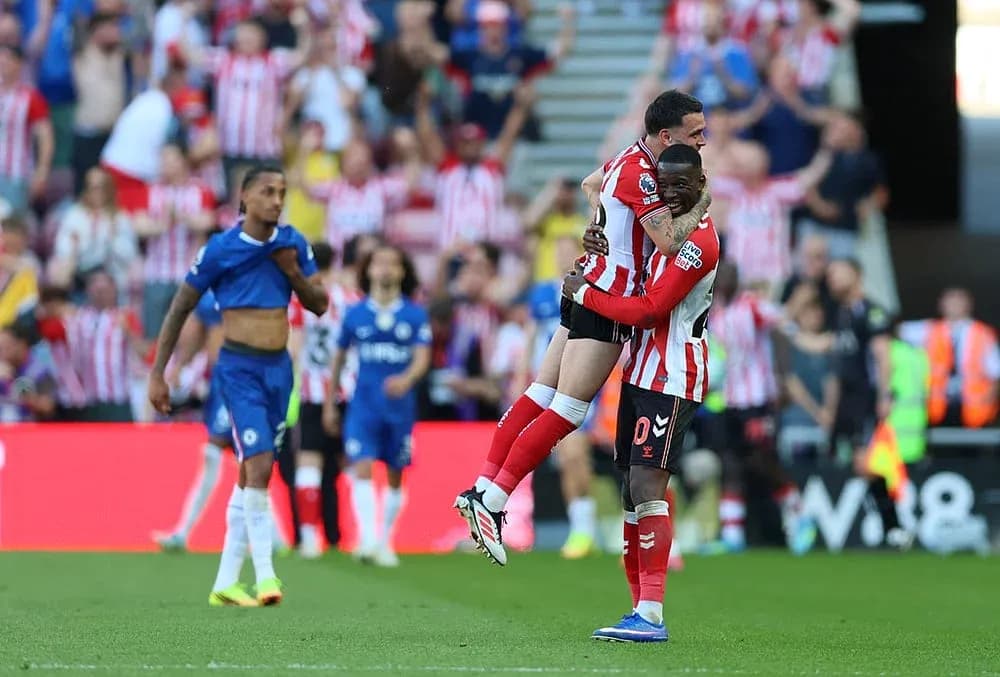
Sunderland's Tactical Victory Over Chelsea: A 2-1 Analysis
Sunderland’s 2-1 win over Chelsea at the Stadium of Light was built on a clear structural plan and a willingness to suffer without the ball. Regis Le Bris’ 4-2-3-1 ceded possession (45% to Chelsea’s 55%) but completely controlled territory and shot volume, turning a modest xG edge (1.94 vs 0.9) into a deserved final‑day victory.
Out of possession, Sunderland’s double pivot of Granit Xhaka and Noah Sadiki was decisive. Xhaka anchored the central lane in front of N. Mukiele and L. O’Nien, screening passes into Cole Palmer between the lines. Sadiki shifted laterally to close Chelsea’s wing‑backs, particularly on Sunderland’s right where L. Geertruida stepped aggressively to Marc Cucurella. The back four stayed compact, with full-backs narrowing early and trusting wide midfielders T. Hume and N. Angulo to track Chelsea’s wing-backs.
This structure forced Chelsea’s 3-4-1-2 into predictable patterns. With Joao Pedro and P. Neto often receiving with their backs to goal, Chelsea’s front line rarely attacked space behind the defence. The visitors finished with just 8 total shots and 4 inside the box, a direct reflection of Sunderland’s ability to compress the central corridor and deny clean through balls. When Chelsea did break the first line, G. Xhaka’s tactical fouls and Sunderland’s back line’s timing in duels prevented sustained pressure, even if it contributed to Sunderland’s five yellow cards.
With the ball, Sunderland’s 4-2-3-1 morphed into a 2-3-5 in settled possession. Mandava and Geertruida pushed high and wide, Xhaka dropped between the centre-backs to start play, and E. Le Fee operated as the primary connector between lines. The first goal at 25 minutes encapsulated the plan: Sunderland created overloads on the right, Hume attacking the half-space as Angulo held width and O’Nien underlapped. Hume’s finish, assisted by O’Nien, came from one of many entries into the right channel, exploiting the space behind Cucurella and beside Levi Colwill.
The shot profile underlined Sunderland’s territorial dominance. They generated 21 total shots to Chelsea’s 8, with 16 of those Sunderland attempts coming inside the box. Seven were blocked, showing how often they were able to work the ball into dangerous central areas and force last-ditch interventions. Chelsea, by contrast, split their 8 shots evenly between inside and outside the area, lacking the repeated penalty-box touches that Sunderland enjoyed.
The own goal at 50 minutes, credited to Sunderland via Malo Gusto’s misfortune, was the product of continued pressure down the flanks. Again Sunderland forced Chelsea to defend facing their own goal, with low deliveries and second balls around the six-yard box. At 2-0, Le Bris adjusted to game state: the double substitution on 61 minutes, with W. Isidor (IN) coming on for B. Brobbey (OUT) and H. Diarra (IN) for N. Angulo (OUT), shifted Sunderland towards more transitional, counter-attacking moments rather than relentless positional attacks.
Chelsea’s response was primarily structural rather than qualitative. Calum McFarlane’s 3-4-1-2 relied on the double pivot of M. Caicedo and Enzo Fernández to circulate possession, and they helped Chelsea to a passing edge: 426 total passes to Sunderland’s 341, both sides completing 83%. But much of Chelsea’s possession was sterile. Wing-backs M. Gusto and Cucurella often received with Sunderland’s block set, forced to play backwards or inside under pressure from Hume and Angulo, then later Diarra. Palmer’s goal at 56 minutes, assisted by P. Neto, came in one of the few sequences where Chelsea managed to connect quickly through the right half-space before Sunderland’s block reset.
The game’s tactical landscape tilted further on 62 minutes when Wesley Fofana’s quick succession of yellow and then red cards for “Foul” incidents reduced Chelsea to ten men. McFarlane reacted with substitutions: R. James (IN) for J. Hato (OUT) at 53 minutes had already hinted at a more aggressive right flank, and later T. Chalobah (IN) for P. Neto (OUT) at 65 minutes and L. Delap (IN) for M. Caicedo (OUT) at 85 minutes pushed Chelsea into a more direct, risk-heavy posture. Yet being a man down meant they could not sustain high pressing; instead, they oscillated between a 5-3-1 and 4-4-1, with Palmer often isolated as the central reference.
In goal, R. Roefs (Sunderland) was largely protected by the structure in front of him, facing only 3 shots on target and making 2 saves. The single goal conceded matched Chelsea’s limited xG of 0.9, reflecting that most of Chelsea’s possession did not translate into high-quality chances. At the other end, R. Sanchez (Chelsea) was far busier. Sunderland’s 6 shots on target forced him into 5 saves, and the negative goals prevented figure in Chelsea’s statistics underlined how the volume and quality of Sunderland’s finishing eventually told.
Discipline and game management were integral to the tactical story. Sunderland accepted a high card count as the cost of disrupting Chelsea’s rhythm: bookings for Nilson Angulo (“Foul”), Lutsharel Geertruida, Granit Xhaka, Habib Diarra, and Noah Sadiki (“Time wasting”) illustrated a deliberate edge in duels and clock control. Chelsea’s five yellows plus Fofana’s red – including Enzo Fernández (“Foul”), Joao Pedro (“Foul”) and Cole Palmer (“Argument”) – reflected growing frustration as Sunderland slowed the tempo and defended their lead.
Statistically, the verdict supports the eye test. Sunderland’s 1.94 xG from 21 shots, with 6 on target, aligns closely with their two goals and indicates a well-crafted attacking plan rather than opportunism. Chelsea’s 0.9 xG and 3 shots on target, despite more possession and passes, show a side kept at arm’s length. Sunderland’s blocked shots (7) and compact defensive shape limited Chelsea’s penalty-box presence, while their own high share of shots inside the box (16) highlighted repeated exploitation of Chelsea’s back three.
In the end, Sunderland’s 4-2-3-1 proved tactically superior to Chelsea’s 3-4-1-2: more vertical, more incisive, and better adapted once ahead, turning controlled aggression and structural clarity into a deserved 2-1 home win on the final day.