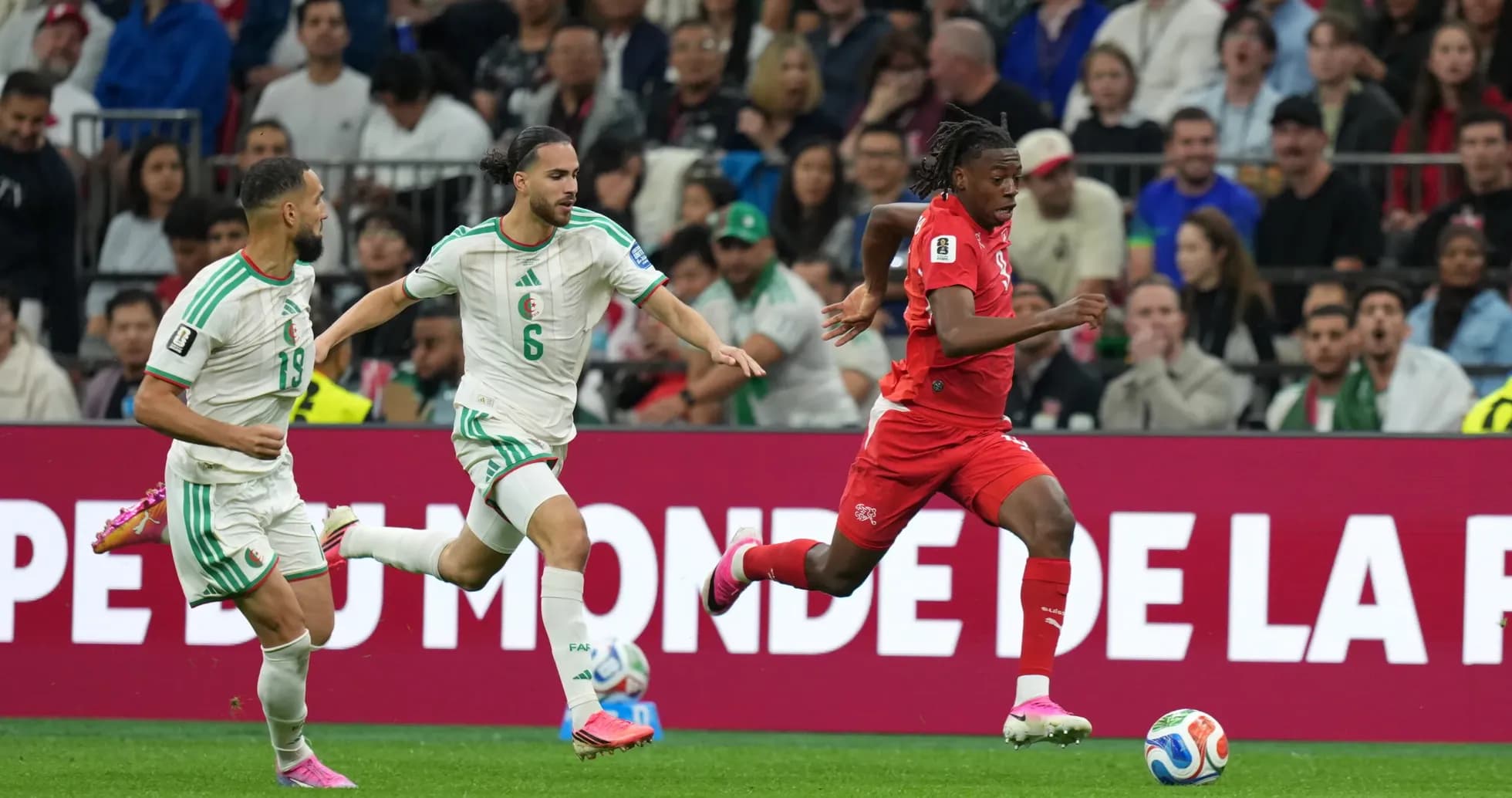
Switzerland's Tactical Mastery in 2-0 Victory Over Algeria
Switzerland’s 2-0 win over Algeria at BC Place in this World Cup Round of 32 tie was a controlled, structurally coherent performance built on a clear game plan without the ball and sharp exploitation of key attacking moments. Despite having only 45% possession and completing fewer passes (436 to 561), Switzerland consistently generated the higher-quality chances, reflected in a clear xG advantage of 2.56 to 0.73 and an 11–8 edge in total shots.
Formation and Structure
Murat Yakin’s 4-2-3-1 was very positionally disciplined. Manuel Akanji and Nico Elvedi formed a compact central pairing, with Ricardo Rodríguez and Denis Zakaria as full-backs, but the real platform came from the double pivot of Granit Xhaka and Remo Freuler. Xhaka dropped frequently to receive from the back line, allowing Switzerland to bypass Algeria’s first pressing line, while Freuler held a slightly higher, screening role to block central progressions from Nabil Bentaleb and Ramiz Zerrouki. This structure limited Algeria to more sterile possession, often in front of the Swiss block, rather than between the lines.
Attacking Strategy
In attack, Switzerland leaned heavily on verticality and half-space runs. The front four of Dan Ndoye, Johan Manzambi, Rubén Vargas and Breel Embolo were set up to break quickly once possession was regained. The opener on 10 minutes encapsulated the plan: Embolo peeled off the centre-backs into the channel, while Manzambi supplied the assist after Switzerland broke through Algeria’s midfield line. With 9 of their 11 shots coming from inside the box, Switzerland consistently managed to progress into dangerous zones rather than settling for speculative efforts.
Ndoye’s early-second-half goal at 46 minutes effectively killed any Algerian hopes of turning the tide. Coming immediately after the restart, it underlined Switzerland’s readiness to attack transitions from kick-off situations, catching Algeria before they could re-establish their defensive shape. From that point, Yakin’s side could manage the game more conservatively, sitting slightly deeper and inviting Algeria onto them, confident in their defensive structure and the ability of their wide players to relieve pressure through counters.
Defensive Approach
Out of possession, Switzerland’s pressing was selective rather than high-volume. They allowed Algeria to build to the halfway line, then triggered pressure when the ball entered central midfield or moved toward the full-backs. This approach helped keep their foul count to 10, avoiding unnecessary cards and maintaining control of rhythm. The back four stayed narrow, forcing Algeria’s front three of Riyad Mahrez, Ibrahim Maza and Houssem Aouar to receive wide and often with their backs to goal.
Algeria’s Strategy
Algeria, in a 4-3-3 under Vladimir Petkovic, saw more of the ball (55% possession) and posted a cleaner passing profile — 561 passes with 476 accurate at 85% — but struggled to convert circulation into penetration. Their 8 total shots included only 5 inside the box and just 2 on target, a sign that Switzerland’s block was effective at contesting the final ball and limiting clear looks. The 3 blocked shots Algeria suffered highlight how often Swiss defenders were able to get tight and defend the edge of the area.
The Algerian midfield triangle of Zerrouki, Bentaleb and Farès Chaïbi was tasked with progressing play and finding Mahrez and Aouar between the lines, yet Switzerland’s double pivot consistently cut off vertical lanes. As a result, Algeria were forced into more lateral passing, with full-backs Rayan Aït-Nouri and Ramy Bensebaini pushed high to provide width. This, however, exposed them to Swiss counters whenever possession was lost, particularly on the Swiss right where Ndoye and Zakaria could surge into space.
Substitution Patterns
The substitution pattern underlined both teams’ tactical intentions. At 58 minutes, Algeria introduced Jaouen Hadjam and Amine Gouiri, with “Amine Gouiri (IN) came on for Ramiz Zerrouki (OUT)” and “Jaouen Hadjam (IN) came on for Houssem Aouar (OUT)” reshaping the front line and left side. Later, at 71 minutes, Anis Hadj Moussa and Hicham Boudaoui were introduced — “Anis Hadj Moussa (IN) came on for Riyad Mahrez (OUT)” and “Hicham Boudaoui (IN) came on for Nabil Bentaleb (OUT)” — signaling a push for more energy and directness. Yet these changes did not fundamentally alter the pattern: Algeria still found themselves channeled wide and crowded out near the box.
Switzerland’s substitutions were more about game management. At 71 minutes, “Fabian Rieder (IN) came on for Rubén Vargas (OUT)” and “Noah Okafor (IN) came on for Johan Manzambi (OUT)”, refreshing the attacking midfield line to maintain counter-threat while preserving defensive work rate. Later, “Zeki Amdouni (IN) came on for Breel Embolo (OUT)” at 83 minutes and “Silvan Widmer (IN) came on for Denis Zakaria (OUT)” plus “Michel Aebischer (IN) came on for Dan Ndoye (OUT)” at 87 minutes shored up the flanks and added legs in the full-back and wide areas to see out the result without conceding territory.
Goalkeeping Performance
In goal, Gregor Kobel (Switzerland) made 2 saves, reflecting how well the structure in front of him limited Algeria’s shot quality; his involvement was more about claiming crosses and organizing the line than dealing with sustained bombardment. Luca Zidane (Algeria) also recorded 2 saves, but Switzerland’s higher xG of 2.56 indicates that the chances he faced were more dangerous. Both goalkeepers carried a goals prevented figure of -0.29, suggesting that, on balance, the finishing in the match slightly outperformed the pure shot-stopping numbers.
Discipline and Tactical Tone
Discipline further illustrates the tactical tone. Switzerland finished without any cards, a product of controlled pressing and good positional play. Algeria, by contrast, picked up 2 yellows: at 36 minutes, “Farès Chaïbi (Algeria) — Tripping”, and at 72 minutes, “Hicham Boudaoui (Algeria) — Roughing”. Both incidents point to late or reactive defensive actions as they tried to disrupt Swiss transitions or counter-press after turnovers.
Statistical Overview
Statistically, Algeria’s superiority in possession and pass completion did not translate into territorial dominance or threat. Switzerland’s 5 shots on goal to Algeria’s 2, combined with a 4–2 edge in corners and the pronounced xG gap, underline that Yakin’s side executed a classic knockout template: compact mid-block, efficient transitions, and ruthless finishing in key moments. Algeria’s 12 fouls versus Switzerland’s 10 also hint at a side increasingly stretched and forced into riskier defensive actions as they chased the game.
Overall, the match was a tactical victory for Switzerland’s structure and clarity of roles. Their 4-2-3-1 maximized the strengths of Xhaka and Freuler in control, unleashed the mobility of Ndoye and Embolo in transition, and kept Kobel (Switzerland) largely protected. Algeria’s 4-3-3 offered technical quality and possession, but lacked the mechanisms to consistently destabilize a well-drilled Swiss block, ultimately exiting the Round of 32 with more of the ball but fewer answers in the decisive zones.