Tactical Analysis of Universitatea Craiova vs Ararat-Armenia: A 1-1 Draw
Universitatea Craiova’s 3-4-3 against Ararat-Armenia’s 4-3-3 produced a structurally clear but tactically nuanced 1-1 at Stadionul Ion Oblemenco, with both sides leaning heavily on their shape rather than on-ball control metrics. With ball possession listed at 0% for both teams, the statistical frame is incomplete, so the tactical reading must hinge on shot distribution, fouls, and positional roles.
Craiova’s back three of V. Screciu, A. Rus and O. Romanchuk underpinned a high, proactive structure. In possession they effectively became a two-plus-one base: Screciu and Rus stepping wider, Romanchuk staying slightly deeper as the spare, enabling wing-midfielders N. Bancu (left) and C. Mora (right) to push high and behave almost as orthodox wing-backs. Ahead of them, A. Cicaldau and A. Mekvabishvili formed the central hinge, tasked with linking into the narrow front three of S. Baiaram, A. Al Hamlawi and D. Matei.
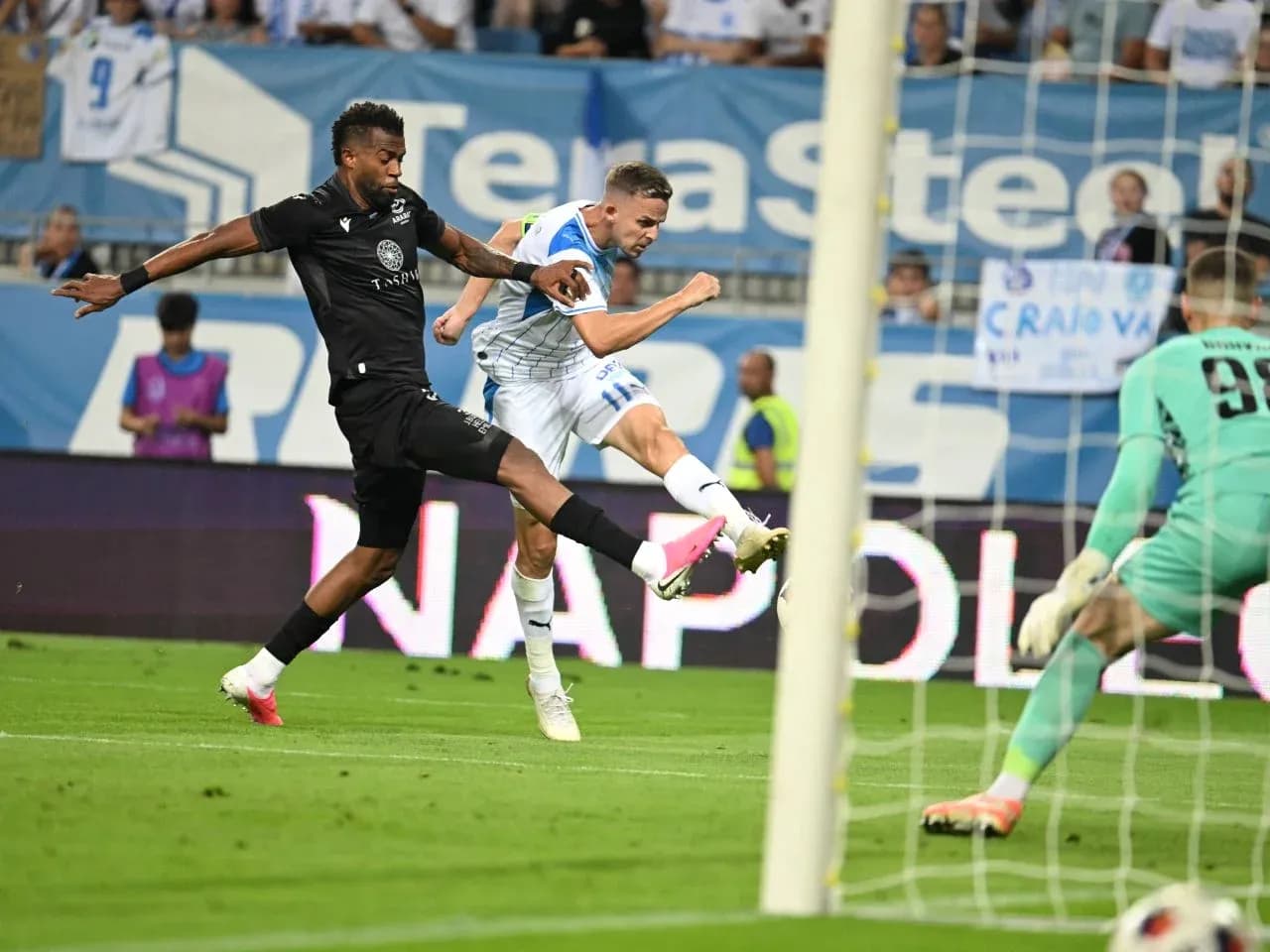
The shot profile supports this aggressive posture. Universitatea Craiova generated 7 shots on goal and 7 shots off goal, plus 1 blocked shot, indicating a steady stream of attempts rather than isolated breaks. Eight corner kicks further confirm sustained territorial pressure, especially from wide overloads on the left where Bancu and Cicaldau combined. The equaliser at 33’ – N. Bancu scoring from an assist by A. Cicaldau – is a textbook expression of that lane: the left midfielder finishing a move created by the central midfielder, likely after a positional rotation that dragged Ararat’s right side out of shape.
Out of possession, Craiova’s 15 fouls and 4 yellow cards point to an intense, occasionally overstretched counter-press. Cards for David Matei (39’), Oleksandr Romanchuk (47’), Adrian Rus (69’) and Monday Etim (78’) map almost perfectly onto the structural spine: one advanced midfielder/forward, two centre-backs, and a substitute forward. This suggests that Craiova repeatedly defended forward – stepping into duels early, often high up – and were willing to absorb disciplinary risk to prevent Ararat’s transitions from maturing.
Ararat-Armenia’s 4-3-3, by contrast, was more conservative and vertically direct. The back four of E. Grigoryan, A. Malis, B. R. Wilson Valdez and Junior Julio, with H. Oliveira stationed slightly ahead, formed a compact defensive shell. In midfield, Benny and K. Muradyan (before his substitution) plus A. Serobyan later, operated more as stabilisers than high pressers. With only 5 fouls and no yellow cards, Ararat defended largely in a mid-block, relying on positional discipline rather than aggressive challenges.
Their attacking pattern was clear: use the defensive line and H. Oliveira as launch points for direct progression into the front three. The opening goal at 20’ – A. Malis scoring from a pass by H. Oliveira – underlines this. A centre-back finishing from a defender’s assist suggests a set-piece or a second-phase situation where Ararat pushed their central defenders into advanced zones, exploiting Craiova’s high line and possible marking lapses on dead balls. Given Ararat’s modest shot output – 2 shots on goal, 4 off goal, 2 blocked – their threat was concentrated rather than continuous, built around a few well-prepared situations rather than sustained pressure.
Substitution patterns reinforce the tactical story. At 62’, Craiova made a double attacking adjustment: S. Nsimba (IN) came on for A. Al Hamlawi (OUT), and M. Etim (IN) came on for D. Matei (OUT). This refreshed the front line with more direct running and penetration, aiming to convert territorial dominance and shot volume into a winning goal. Later, at 69’, Teles (IN) replaced A. Cicaldau (OUT), a switch that likely altered the profile of the left half-space, perhaps trading some creativity for fresh legs and stability against transitions as Ararat began rotating their midfield.
Ararat’s substitutions between 69’ and 80’ were layered and conservative in nature. Franca Carlos (IN) for Benny (OUT) at 69’ refreshed the central unit, while J. A. Balanta (IN) for H. Oliveira (OUT) at 75’ removed the initial assister and rebalanced the midfield. The triple change at 80’ – Z. Shaghoyan (IN) for Z. Banjaqui (OUT), M. Carlier (IN) for K. Muradyan (OUT), and A. Tera (IN) for A. Serobyan (OUT) – looks like a late-game attempt to inject energy and ball-carrying into the wide and central channels while preserving the 1-1 scoreline. The absence of any cards for Ararat’s players throughout supports the idea that even with fresh legs, their priority was control and compactness, not all-out pursuit of a winner.
Craiova’s final wave of changes at 85’ – T. Baluta (IN) for A. Mekvabishvili (OUT) and L. Basceanu (IN) for S. Baiaram (OUT) – completed a transformation of the midfield and front line. By this point, only a fraction of the original attacking unit remained, underlining coach Filipe Coelho’s intent to keep intensity and vertical threat high until the final whistle. The high corner count and shot volume, combined with these attacking substitutions, suggest that Craiova finished the match on the front foot, pinning Ararat back but lacking the final touch to break the deadlock.
Without reliable possession or passing data, the clearest tactical contrast emerges from discipline, shot patterns and substitution logic. Universitatea Craiova used their 3-4-3 as a platform for pressure, width and repeated final-third entries, accepting defensive risk and card accumulation as the cost of an assertive game plan. Ararat-Armenia, in a 4-3-3 that often behaved like a 4-1-4-1 without the ball, prioritised compactness, clean defending and targeted attacking moments, especially from set pieces and structured restarts. The 1-1 scoreline reflects not balance of ambition, but the clash between a high-volume, high-risk approach and a low-foul, low-volume, efficiency-driven game plan that ultimately resisted Craiova’s pressure.