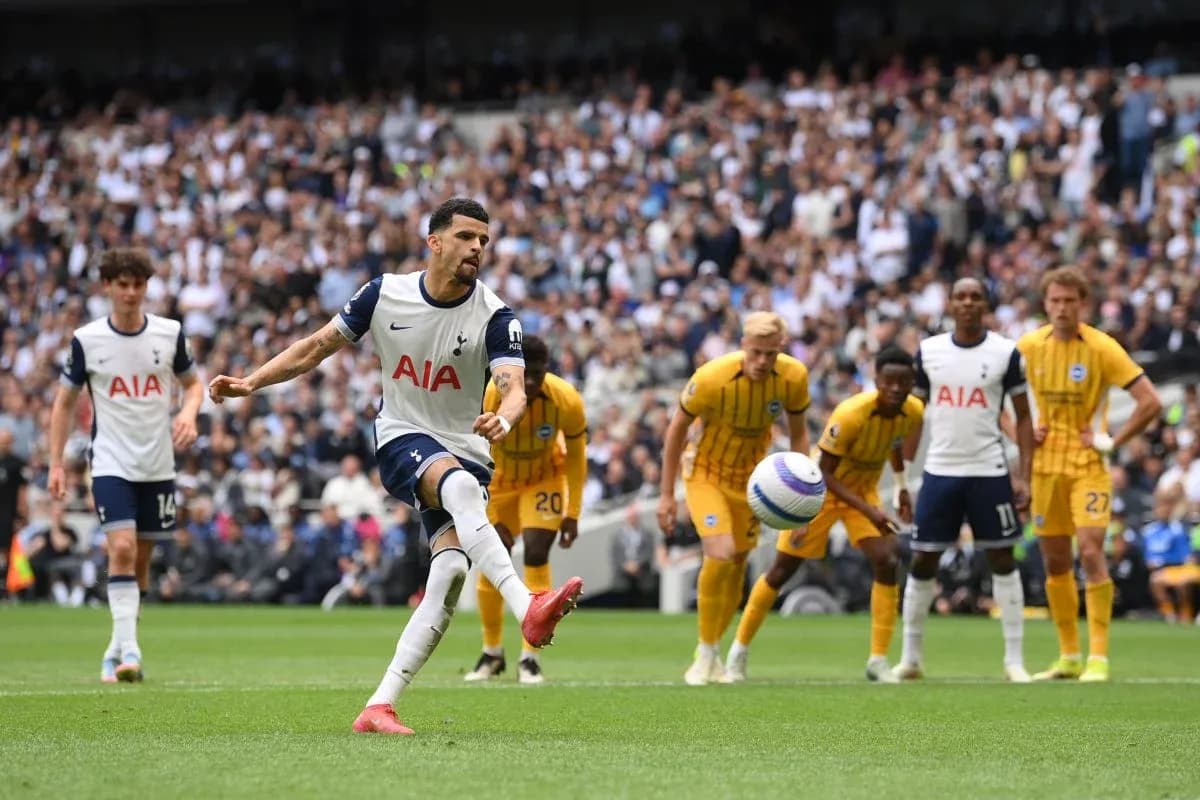
Tottenham vs Brighton: Tactical Analysis of Premier League Draw
Tottenham and Brighton shared a 2-2 draw at the Tottenham Hotspur Stadium in Premier League Round 33, a match that tactically swung between Spurs’ vertical 4-3-3 and Brighton’s more controlled 4-2-3-1. Tottenham led twice through Pedro Porro and Xavi Simons, but Brighton equalised at 45+3' via Kaoru Mitoma and again at 90+5' through Georginio Rutter. The halftime score was 1-1, reflecting a first period where Brighton controlled possession but Spurs carried the sharper threat in transition. Over 90 minutes, the underlying numbers (Tottenham 1.08 xG, Brighton 0.89 xG) and the 2-2 final were closely aligned, underscoring a contest defined by structure, substitutions, and late-game management rather than sheer chance creation.
The scoring opened on 39' when Pedro Porro advanced from right-back into the half-space and finished a move assisted by Xavi Simons, who had drifted inside from the left of the front three. That goal crowned Tottenham’s growing threat on the break after a cagey opening. Brighton’s response came deep into first-half stoppage time: at 45+3', Pascal Groß found Kaoru Mitoma, who punished Spurs’ failure to close down the left channel, restoring parity at 1-1 for the interval.
Second Half
The second half’s key attacking swing came after Tottenham’s substitution wave. On 77', Xavi Simons put Spurs 2-1 up, finishing a move created by substitute Lucas Bergvall, whose introduction had tilted the midfield dynamic. Yet Brighton’s persistence was rewarded at 90+5', when Jan Paul van Hecke’s involvement from the back led to Georginio Rutter’s late equaliser, sealing the 2-2.
Disciplinary control played a quiet but real role. Three Tottenham players were booked: Yves Bissouma for a foul on 34', Kevin Danso for a foul on 65', and Xavi Simons with a yellow at 78' (no additional reason specified, so not logged as simulation or dissent). Brighton received one yellow: Mats Wieffer for a foul on 37'. There were no red cards, and no penalties or VAR-defined incidents in the event log, so all four goals stood without formal review-related interruption.
Tottenham’s 4-3-3 under Roberto De Zerbi was clearly built around verticality and aggressive full-back play. Antonín Kinský, with only 1 recorded save, operated more as a high starting-point distributor than a shot-stopper in a busy game; Brighton’s 10 total shots translated into just 3 on target, indicating that Spurs’ defensive structure forced lower-quality finishing positions despite conceding territory.
The back four had asymmetrical roles. Pedro Porro (23) attacked relentlessly down the right, often forming a de facto wide playmaker lane, which is precisely how he arrived to score at 39'. On the left, Destiny Udogie (13) provided width but was more cautious, balancing against Brighton’s right-sided threats. The centre-back pairing of Kevin Danso (4) and Micky van de Ven (37) defended a relatively high line, which limited Brighton’s ability to play directly into Danny Welbeck but left them exposed when Brighton could break the first press, particularly in wide-to-central switches, as seen before both Brighton goals.
In midfield, Yves Bissouma (8) anchored the structure as the deepest pivot, with Rodrigo Bentancur (30) and Conor Gallagher (22) as more advanced eights. Their main task was to compress the central lanes against Pascal Groß and Yasin Ayari. Bissouma’s yellow on 34' reflected the intensity required to disrupt Brighton’s circulation. When Bissouma (OUT) was replaced by Archie Gray (IN) at 57', Tottenham traded some ball-winning for fresher legs and slightly more passing security.
Up front, the starting trio of Xavi Simons (7), Dominic Solanke (19), and Randal Kolo Muani (39) was built for fluidity. Simons constantly moved inside from the left, allowing Udogie to overlap; Kolo Muani stretched the right channel, and Solanke played as the central reference. The first goal encapsulated this: Simons’ inside positioning allowed him to assist Porro’s overlapping run.
De Zerbi’s substitution pattern reshaped the attack. At 57', Mathys Tel (IN) came on for Randal Kolo Muani (OUT), adding more direct running in behind, while Gray (IN) for Bissouma (OUT) subtly shifted the midfield’s balance. At 67', Joao Palhinha (IN) replaced Bentancur (OUT), restoring a stronger defensive presence in the centre. The 76' double switch — Djed Spence (IN) for Destiny Udogie (OUT) and Lucas Bergvall (IN) for Conor Gallagher (OUT) — was decisive. Spence provided fresh legs to defend Brighton’s left, while Bergvall injected progressive passing and line-breaking carries. Within a minute, Bergvall’s forward involvement directly produced the assist for Xavi Simons’ 77' goal, evidence of how Spurs’ bench was used to sharpen their transitional punch.
Brighton, under Fabian Hurzeler, used a 4-2-3-1 that prioritised control. With 58% possession and a higher pass volume (424 total passes at 83% accuracy), they tried to dictate tempo through the double pivot of Pascal Groß (30) and Yasin Ayari (26). Groß’s creative weight was obvious: he assisted Mitoma’s 45+3' goal and consistently connected Brighton’s build-up to the attacking line.
The back four — Mats Wieffer (27), Jan Paul van Hecke (6), Olivier Boscagli (21), and Ferdi Kadıoğlu (24) — played relatively high, compressing the pitch and enabling Brighton’s midfield to stay advanced. Wieffer’s yellow on 37' for a foul underlined the risk in Brighton’s counter-press when Tottenham broke through the first line. Van Hecke’s late assist at 90+5' was a product of Brighton’s insistence on involving centre-backs in the final-third circulation as Spurs dropped deeper to protect the lead.
Ahead of the pivot, Diego Gómez (25), Jack Hinshelwood (13), and Yankuba Minteh (11) supported Danny Welbeck (18). Early on, this trio offered rotations and half-space occupation, but Hurzeler’s key attacking adjustment came as early as 20', when Kaoru Mitoma (IN) replaced Diego Gómez (OUT). Mitoma’s introduction added directness and 1v1 threat from the left, culminating in his 45+3' equaliser. Later, the 75' triple substitution — Maxim De Cuyper (IN) for Mitoma (OUT), Matt O'Riley (IN) for Jack Hinshelwood (OUT), and Georginio Rutter (IN) for Danny Welbeck (OUT) — reconfigured the attack. De Cuyper gave fresh width, O'Riley more passing control between the lines, and Rutter a more mobile, drifting focal point. Finally, at 82', Charalampos Kostoulas (IN) replaced Yasin Ayari (OUT), adding attacking bias to the midfield in pursuit of an equaliser that Rutter eventually delivered.
In goal, the contrast was stark: Bart Verbruggen made 4 saves to Kinský’s 1, underlining how Tottenham’s attacks, though less frequent in volume and possession, were more efficient at forcing on-target efforts (6 shots on goal from 13 total versus Brighton’s 3 from 10). Verbruggen’s workload reflected Tottenham’s tendency to attack quickly and directly once they broke Brighton’s structure.
Statistically, the match was finely balanced. Tottenham’s 42% possession and 319 passes at 80% accuracy show a side comfortable without the ball, using transitions and full-back surges to generate their 1.08 xG. Brighton’s 58% possession, 424 passes at 83%, and 0.89 xG reflect a more methodical, territorially dominant approach that struggled at times to turn circulation into clear chances. Both teams committed 14 fouls, and the card tally finished 3-1 in Tottenham’s disfavor, consistent with Spurs’ more reactive, duel-heavy defensive posture.
From a broader tactical lens, Tottenham’s overall form on the day can be characterised as opportunistic and vertically sharp, but with late-game game-management issues, as evidenced by conceding at 90+5'. Defensively, their index is mixed: limiting Brighton to 3 shots on target and sub-1.0 xG is positive, yet allowing two goals — both from wide-to-central collapses — highlights vulnerabilities in defending second-phase and late-box entries.
Brighton’s overall form was that of a possession-dominant side that needed structural and personnel tweaks (especially Mitoma and later Rutter) to translate control into threat. Defensively, their index is also nuanced: conceding 2 goals from 1.08 xG and allowing 6 shots on target suggests that while their high line and pressing limited volume, they were exposed by Tottenham’s capacity to find high-quality moments, particularly after De Zerbi’s bench interventions.
Ultimately, the 2-2 draw is a fair statistical and tactical reflection: Tottenham maximised transitions and substitutions to carve clear chances, while Brighton’s sustained control and late attacking reconfiguration earned them a deserved point at the death.