Trabzonspor vs Ferencvarosi TC: Tactical Breakdown of the 0-1 Defeat
Trabzonspor’s 0-1 home defeat to Ferencvarosi TC at Papara Park was defined by a sharp contrast between territorial control and penalty-box efficiency. In a UEFA Europa League Play-offs tie where the hosts held 66% possession and a massive shot volume advantage, the Hungarian side absorbed pressure, fouled aggressively, and struck with one clean attacking pattern to take a critical away win.
The decisive moment came early and framed the tactical story. On 17 minutes, Ferencvarosi TC executed a classic right-side overload and vertical run from midfield. K. Zachariassen broke beyond Trabzonspor’s double pivot from the right half-space, timing his movement onto a pass from O. Nagy. The finish was a textbook “third-man” arrival: Zachariassen attacking the gap between centre-back and full-back, converting Ferencvaros’s first real attacking incision into a 1-0 lead. From that point on, Balazs Borbely’s side were structurally content to compress space, concede the ball, and defend their own box.
Trabzonspor's Formation
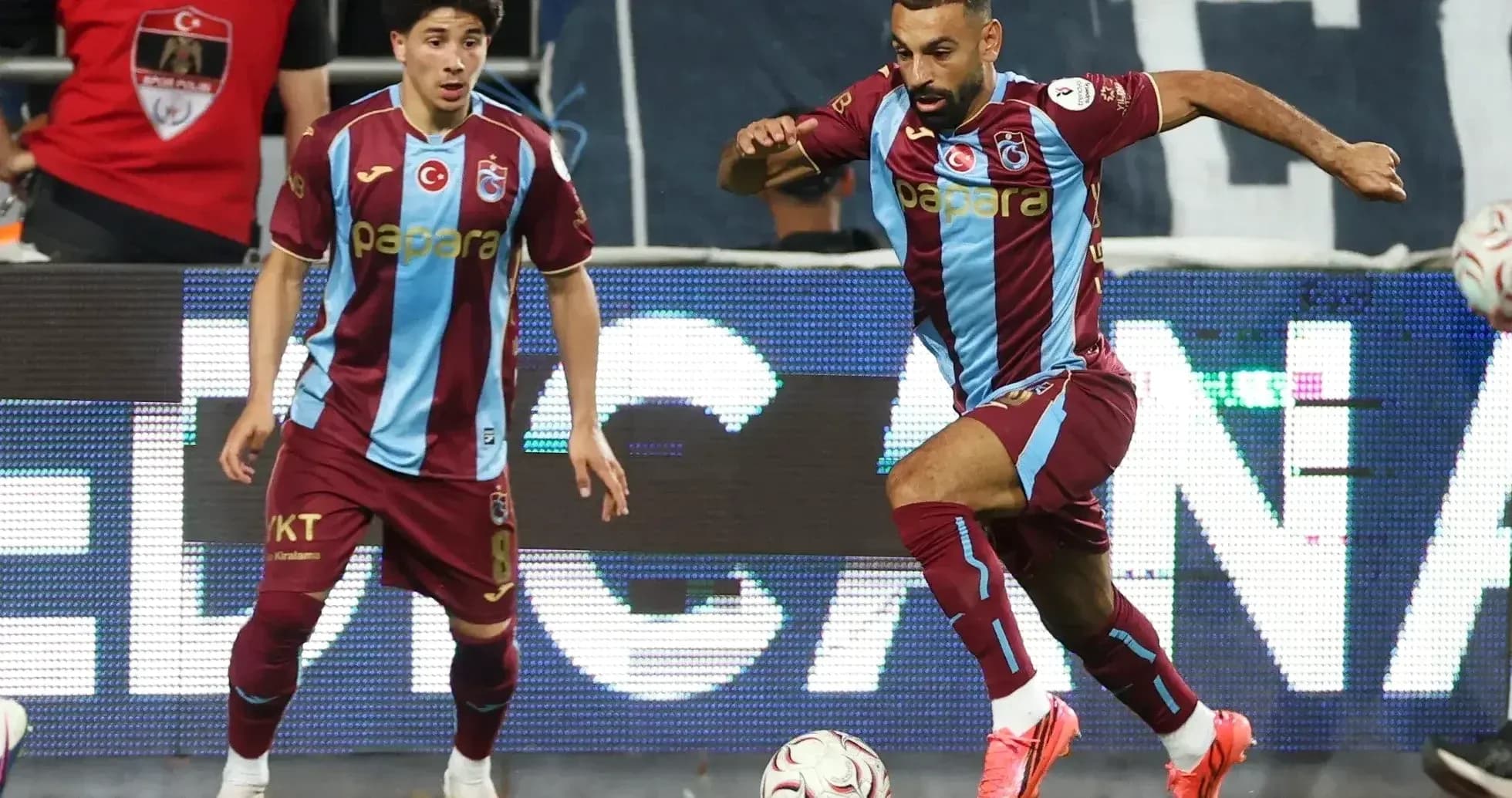
Trabzonspor lined up in a 4-2-3-1 under Fatih Tekke, with A. Onana in goal behind a back four of S. Lopes Cabral, C. Ozkacar, C. Nwaiwu and W. Pina. The double pivot of B. Bouchouari and M. Kabasakal was tasked with both ball progression and rest defence, while the line of three – N. Saviolo from the left, M. Salah centrally and U. Nayir starting nominally from the right – was built to feed P. Onuachu as a penalty-box reference.
In possession, Trabzonspor’s structure often resembled a 2-3-5. Both full-backs pushed high, with S. Lopes Cabral especially aggressive on the right touchline, while one of the pivots dropped between the centre-backs to initiate build-up. The 66% ball possession underlines how effectively they established themselves in Ferencvaros’s half, but the shot profile is revealing: 3 shots on goal out of 24 attempts (3 on target, 15 off target, 6 blocked). The hosts repeatedly arrived into crossing zones but struggled to create clear central lanes for cut-backs or flat low crosses. Too many attacks ended in floated deliveries towards Onuachu against a well-set back four.
Ferencvarosi TC's Defensive Strategy
Ferencvarosi TC’s 4-4-2 was extremely compact without the ball. The front pair of Dele and L. Joseph initially pressed in a curved fashion to block central access, then gradually dropped into a mid-block once they had the lead. The wide midfielders, C. O’Dowda and M. Corbu, narrowed aggressively, helping the double pivot of K. Zachariassen and P. Rommens to crowd the middle. This forced Trabzonspor to circulate wide and cross from less advantageous positions. The visitors’ defensive commitment is clear in the numbers: 24 fouls, 5 yellow cards, and 4 blocked shots. They repeatedly accepted tactical fouls to disrupt rhythm and deny transition opportunities, particularly once Trabzonspor tried to accelerate play after half-time.
The disciplinary pattern shows how Ferencvaros weaponised aggression. Dele’s yellow card for “Roughing” on 29 minutes and Zachariassen’s own “Roughing” caution at 43 minutes signalled a readiness to contest every duel. After the interval, P. Rommens was booked for “Holding” on 50 minutes, while late substitute A. Osvath (89’ “Roughing”) and G. Kanichowsky (90+1’ “Unsportsmanlike conduct”) added to the tally as Ferencvaros defended deeper. The visitors finished with five yellows but no red, illustrating a controlled, if cynical, game management.
Trabzonspor's Vulnerabilities
Trabzonspor, by contrast, were clean but vulnerable in rest defence. They committed only 3 fouls all match, a figure that speaks to both their territorial dominance and their lack of tactical fouling to stop counters. The one major disciplinary lapse was catastrophic: at 90+6 minutes, centre-back C. Nwaiwu received a straight red card for “Roughing”. Beyond the immediate numerical disadvantage, it encapsulated Trabzonspor’s frustration as they chased an equaliser with increasingly direct play and higher defensive risk.
Tekke’s substitution pattern was a clear attempt to add creativity and central dynamism. At half-time, R. Malinovskyi (IN) came on for B. Bouchouari (OUT), and A. Simsir (IN) replaced U. Nayir (OUT), signalling a shift towards more vertical passing and late runs from midfield. On 64 minutes, E. Muci (IN) entered for N. Saviolo (OUT), adding another line-breaking carrier between the lines. Later, M. Eskihellac (IN) replaced W. Pina (OUT) at 83 minutes, with the right flank pushed even higher to pin back Cadu and O. Nagy. Structurally, Trabzonspor ended in a quasi 2-1-4-3, with both full-backs advanced, Malinovskyi orchestrating, and multiple runners around Onuachu.
Borbely’s response was conservative and coherent. On 61 minutes, A. Nagy (IN) for Dele (OUT) and G. Kanichowsky (IN) for P. Rommens (OUT) freshened the midfield line, adding energy and ball-carrying for counter-attacks. At 78 minutes, A. Osvath (IN) replaced the booked Zachariassen (OUT), removing a yellow-card risk in central midfield while maintaining defensive intensity. K. Lisztes (IN) for L. Joseph (OUT) at 78 minutes and N. Zohore (IN) for Cadu (OUT) at 89 minutes further tilted the team towards fresh legs in the final third and at full-back, but the primary objective remained: protect the 1-0.
Statistical Overview
From a statistical perspective, the match is a classic case of territorial dominance versus compact defending. Trabzonspor’s 66% possession, 7 corner kicks, and high shot volume suggest sustained pressure, yet only 3 efforts tested D. Dibusz’s goal directly. Ferencvaros, with 34% possession, produced 4 shots on goal from a far lower total attempt count, underscoring better shot selection and more efficient use of transitions. The 4 blocked shots for Ferencvaros show they were prepared to defend the box with numbers, while Trabzonspor’s 6 blocks reflect how often Ferencvaros’s rare attacks still forced emergency interventions.
Without explicit xG values, the qualitative balance still leans towards Ferencvaros in terms of chance quality: one clear early pattern converted, then a disciplined low block protecting the central lane. Trabzonspor’s overall form in this tie reads as possession-heavy but blunt, while Ferencvaros’s defensive index is high – many fouls, many cards, but structurally coherent and ultimately decisive in securing a 1-0 away win.