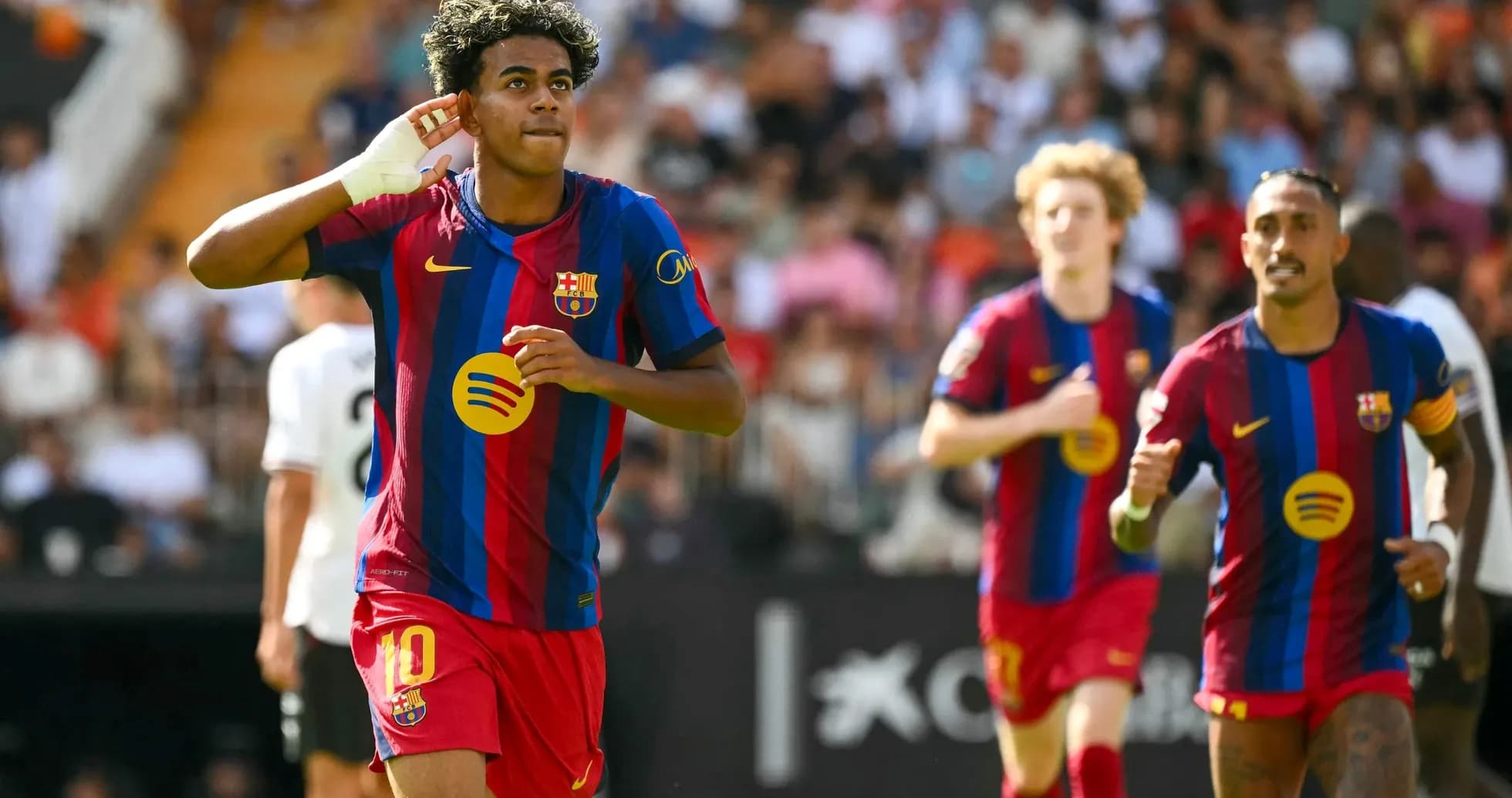
Valencia's Struggles Highlighted in 5-0 Defeat to Barcelona
The Mestalla floodlights had barely cooled when the numbers told a brutal story. Valencia’s 5-0 home defeat to Barcelona did more than settle a single fixture; it crystallised the gulf between a side rooted to the bottom and a league leader operating at full throttle.
I. The Big Picture – Two Trajectories, One Scoreline
Following this result, Valencia remain 20th in La Liga with 1 point from 4 matches. Overall they have scored 1 goal and conceded 9, a goal difference of -8 that underlines a fragile structure rather than mere bad luck. At home, the picture is even starker: 3 matches, 0 wins, 1 draw, 2 defeats, 0 goals scored and 6 conceded. They have failed to score in all three home outings and average 0.0 goals for and 2.0 goals against at Mestalla.
Barcelona, by contrast, leave Valencia as league leaders in 1st place on 12 points from 4 games. Overall they have scored 17 and conceded 2, a goal difference of +15 that perfectly matches the eye test: an attack humming at 4.3 goals per game and a defence conceding just 0.5 on average. On their travels they have been devastating: 2 away wins from 2, 10 goals scored, none conceded, averaging 5.0 goals for and 0.0 against away from home.
The formations reflected those realities. Carlos Corberan doubled down on a 5-4-1, the same structure Valencia have used in all 4 league games, with S. Dimitrievski behind a back five of P. Maffeo, A. Martinez, M. Diakhaby, Pepelu and J. Vazquez. Ahead of them, a narrow four of D. Otorbi, F. Ugrinic, A. Dieng and J. Guerra supported lone forward A. Danjuma.
Hansi Flick’s Barcelona answered with a bold 4-3-3: J. Garcia in goal; a back line of X. Espart, G. Martin, P. Cubarsi and E. Garcia; a midfield trio of Pedri, Rodri and Fermín; and a front three of Lamine Yamal, Raphinha and A. Gordon. On paper it was a clash between a low block and an attacking wave; on the pitch, the wave simply never stopped.
II. Tactical Voids – Valencia’s Missing Spine vs Barcelona’s Depth
Valencia entered this fixture stripped of experience and variety. S. Canos (knee), J. Copete (ankle), J. De Haas (ankle), D. Foulquier (injury), D. Lopez (knee), L. Rioja (injury), G. Rodriguez (muscle) and U. Sadiq (muscle) were all ruled out. That is a swathe of potential rotation across the back line, wings and attack, leaving Corberan with a thin bench where youngsters like A. Mayol, R. Gamon, R. Sato and J. Dura were more about future promise than immediate impact.
The defensive burden consequently fell heavily on M. Diakhaby, already one of La Liga’s more card-prone defenders with 2 yellow cards in 4 appearances. He has blocked 2 shots and made 6 interceptions this season, but here he was stretched horizontally by Barcelona’s width and vertically by their constant runs in behind. The five-man line often became a flat, reactive band rather than a proactive shield.
Barcelona had absences of their own – R. Bardghji (knee), J. Bisiwu (ankle) and F. de Jong (knee) all missing – yet their depth turned those setbacks into tactical variety rather than structural weakness. With J. Kounde, J. Cancelo, A. Christensen, A. Balde, Gavi, M. Bernal, Dani Olmo, Gabriel Jesus, H. Abdelkarim and K. Adeyemi on the bench, Flick could have reshaped the game in multiple ways even if the starting XI had faltered. It never needed to.
Disciplinary patterns also framed the risk profiles. Valencia’s yellow cards this season cluster late: 33.33% between 31-45 minutes and another 33.33% between 76-90, with additional bookings in the 16-30 and 61-75 windows. That late-game surge in cautions is symptomatic of a team chasing shadows and arriving late into duels. Barcelona, by contrast, concentrate their bookings between 16-30 (25.00%), 46-60 (50.00%) and 61-75 (25.00%), reflecting a side that presses aggressively but in a more controlled, structured fashion.
III. Key Matchups – Hunter vs Shield, Engine Room vs Engine Room
Hunter vs Shield
No duel embodied the mismatch more than Raphinha against Valencia’s back five. Heading into this game, Raphinha already led La Liga’s scoring charts with 6 goals and 1 assist in 4 appearances, converting 8 of his 9 shots on target and completing all 7 of his dribbles. He arrived averaging a goal every roughly 53 minutes and carrying the confidence of having already won and converted a penalty this season.
Facing him, Valencia’s collective defensive record was brittle: overall 9 goals conceded in 4 matches at 2.3 per game, and at home 6 conceded in 3 matches with no clean sheet beyond a single shutout earlier in the campaign. Their biggest defeats – 0-5 at home and 3-1 away – show that once the dam breaks, it collapses entirely.
The tactical nightmare for Corberan was that Raphinha was not an isolated threat. Lamine Yamal, with 4 goals from 17 shots and 19 key passes, constantly attacked the far post and half-spaces, while A. Gordon, La Liga’s leading assist provider with 4, stretched the left channel and repeatedly delivered into the box. When Valencia’s wing-backs stepped out to meet the wingers, gaps opened inside for Fermín and Pedri to attack.
Engine Room vs Engine Room
In midfield, the contrast in control was stark. Barcelona’s trio of Pedri, Rodri and Fermín offered a blend of line-breaking passes, counter-pressing and late runs. Fermín in particular has been a revelation: 4 goals, 2 assists, 9 shots (8 on target), 137 completed passes and 4 tackles, all while winning half of his 32 duels. His ability to arrive into the box from deep made him a second wave that Valencia’s midfield four struggled to track.
On the flanks, X. Espart quietly underpinned everything. In 4 appearances he has contributed 2 assists, 195 completed passes at 85% accuracy, 14 tackles and 7 interceptions. His overlaps and underlaps on the left pinned back P. Maffeo and J. Vazquez, ensuring Valencia’s wide players spent more time defending than countering.
Valencia’s engine room, led by J. Guerra, F. Ugrinic and A. Dieng, was set up more to survive than to dictate. With Pepelu redeployed as part of the back five, they lacked a natural deep playmaker to break Barcelona’s first press. A. Danjuma, isolated up front, often dropped into midfield just to give his side a breather, further blunting any counter-attacking threat.
IV. Statistical Prognosis – A Result Written in the Trends
When you overlay the season data onto this 5-0 scoreline, it feels less like an outlier and more like an inevitable convergence. Barcelona’s overall attacking average of 4.3 goals per game met a Valencia side conceding 2.3 per match, with a home attack averaging 0.0 goals at Mestalla against an away defence yet to concede.
Barcelona’s defensive solidity is not just about clean sheets (3 in 4 games overall, 2 in 2 away) but about control. They have not failed to score once, and with a perfect penalty record – 1 taken, 1 scored, none missed – they punish every mistake. Valencia, on the other hand, have yet to earn or take a penalty this season and have already failed to score in 3 of their 4 league games overall.
Following this result, the tactical verdict is clear. Barcelona’s 4-3-3 under Flick is a mature, multi-layered system where Raphinha, Lamine Yamal and A. Gordon provide the cutting edge, Fermín and Pedri orchestrate the tempo, and X. Espart anchors the flank. Valencia’s 5-4-1, by contrast, is still a reactive shell – one that, without key injured players and with mounting disciplinary strain, is struggling to protect Dimitrievski or to launch Danjuma and his supporting cast into meaningful transitions.
Unless Valencia can add more progressive passing from the back line and a second outlet alongside Danjuma, nights like this at Mestalla may become a grim pattern rather than a painful exception. For Barcelona, this was less a statement than a continuation: a league leader playing exactly like one.