Vancouver Prepares for FIFA World Cup 2026: Changes Ahead
Vancouver is bracing for a World Cup it hasn’t yet kicked a ball in.
On Wednesday, the city officially steps into FIFA World Cup 2026 “event period” mode, and residents are about to feel it: more structures, louder nights, tighter rules, and a very different grip on public space around B.C. Place and Hastings Park.
City hall calls it preparation. Critics call it something else entirely.
A city rewired for FIFA
The FIFA World Cup 2026 Bylaw hands Vancouver sweeping temporary powers from May 13 to July 20, 2026. On paper, it’s about delivering what officials describe as a “clean, safe, and organized” tournament as the province projects roughly 350,000 visitors to B.C. Place alone.
In practice, it reshapes how the city looks, sounds, and operates for more than two months.
Temporary event infrastructure gets a green light: fan zones, towers of signage, and branded installations can go up faster and more easily around key sites. Street vending and busking, the usual texture of downtown streets, will face new restrictions in designated event areas. Certain advertising activities will be curbed to protect FIFA’s commercial footprint, with unauthorized commercial signs set for rapid removal.
Noise rules will stretch late into the night, tailored to international broadcast schedules and game-day operations. Delivery trucks and routes may be rerouted through the downtown core to clear space for security and event logistics.
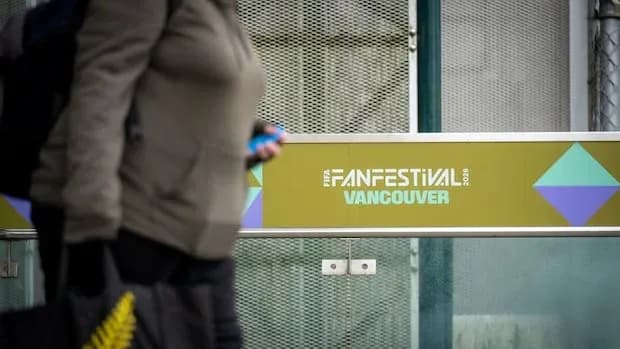
Most of these changes lock into a two‑kilometre “controlled area” around B.C. Place and the FIFA Fan Festival site at Hastings Park. Inside that ring, the city’s normal rhythms give way to World Cup tempo.
Break the rules, and the cost is clear: bylaw officers can hand out tickets between $250 and $1,000 for common violations. Enforcement will be shared between the City of Vancouver and the Vancouver Police Department.
All of this comes with a hefty price tag. Vancouver expects to spend between $532 million and $624 million to host seven matches, with the city itself on the hook for up to $281 million. The financial gamble is enormous; so is the power being ceded to make the event happen.
Whose space is it?
As the banners go up, so do the concerns.
Housing advocates and legal experts warn that the bylaw’s heavy emphasis on “cleanliness” and “beautification” risks becoming a blunt instrument against people already living on the margins.
“This is basically the privatization of public space,” said Penny Gurstein, professor emeritus at the University of British Columbia’s School of Community and Regional Planning. “I think people should be worried, especially people who are experiencing homelessness, living on the streets.”
The fear is simple: when a city is under pressure to look spotless for a global audience, those who don’t fit the picture often pay the price.
City officials insist that won’t happen. They stress that the bylaw does not alter existing protections for unhoused residents. People experiencing unsheltered homelessness, they say, will still be permitted to erect temporary overnight shelter in parks where current bylaws allow it.
On beautification, the city points to concrete, not people. The term, officials say, refers to physical repairs and upgrades—fixing sidewalks, tidying and decorating construction sites—and they maintain this work has “no assessed impact on human rights.”
The tension lies in how those words play out on the ground, not in a written statement.
Celebration for some, disruption for others
The World Cup is sold as a festival, a once‑in‑a‑generation spectacle. But not everyone will experience it the same way.
Margot Young, a constitutional law professor at UBC’s Allard School of Law, underlines that the disruption won’t be evenly shared.
“There will be disruption, but that disruption will be different for different groups in the city depending really upon their … social and economic status,” she said.
For wealthier residents, the tournament can feel like a month-long party: tickets to matches, fan festivals, packed bars, and a city buzzing late into the night.
For those at the bottom of the income and wealth ladder, the story shifts. Street checks, displacement, and a reordered public realm become part of the daily reality.
“For those with money, they maybe can go to games, they can take part in the parties,” Young said. “But for individuals who are at the bottom of our ... income and wealth distribution … they will be moved around by the reordering of city space by FIFA.”
City officials have spoken about “trauma-informed” enforcement. Young isn’t convinced that promise will be easy to measure or enforce.
“There’s no system in place to sort of monitor what is happening with respect to the vulnerable populations,” she said.
Without a clear oversight mechanism, assurances remain just that—assurances.
Services under strain
Vancouver says it won’t abandon its most vulnerable residents during the tournament. Homelessness services and outreach programs, officials insist, will continue to operate while the city hosts the world.
They point to more than 1,500 shelter beds and roughly 8,100 supportive housing units, backed by outreach teams, hygiene services, and storage programs designed to help people living without stable housing.
Those numbers set the baseline. The question is whether they hold under the pressure of a global event that demands both spectacle and control.
In a written statement, the city framed the World Cup as a “once-in-a-generation opportunity” to showcase Vancouver.
Over the next two months of the event period, the city will find out what that showcase really looks like—and who gets pushed to the edges to make room for the world’s game.