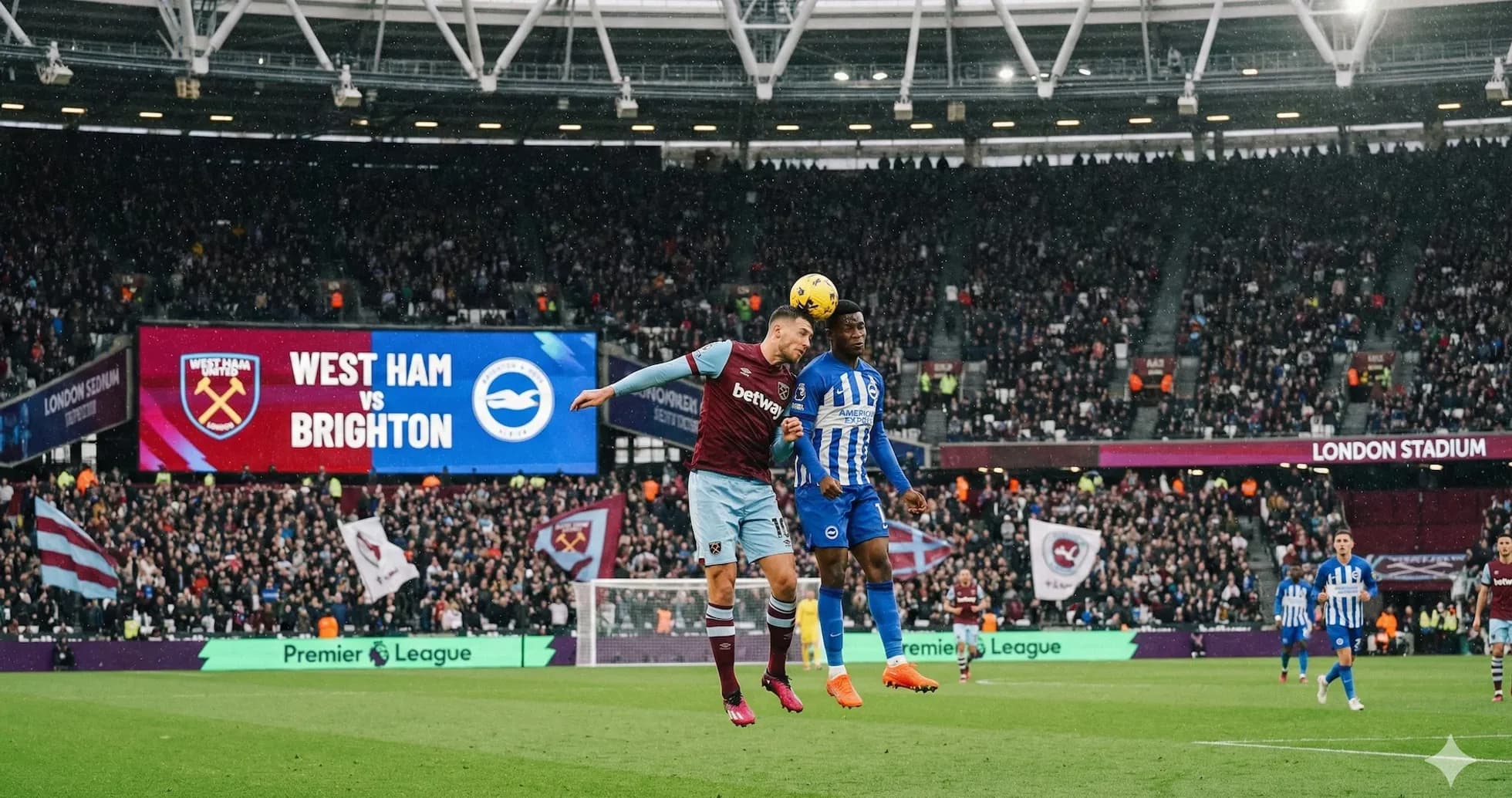
West Ham and Brighton Battle to a 2-2 Draw at London Stadium
In an exhilarating clash at the London Stadium, West Ham United and Brighton & Hove Albion played out a gripping 2–2 draw, a contest shaped by early incision, penalty drama, and Brighton’s sustained pressure across the 90 minutes. With West Ham twice in front and Brighton twice responding, the match underlined both teams’ strengths in transition and their lingering issues in game management. Despite operating with significantly less of the ball, West Ham made key moments count, while Brighton’s control and chance volume ultimately earned them a share of the points.
First Half Analysis
West Ham began sharply and were rewarded early when Jarrod Bowen struck in the 10th minute, finishing a move that reflected the hosts’ directness and ability to punish space quickly. Importantly, the opener came in a phase where Brighton were already dictating the rhythm through possession, but West Ham’s threat in moments of transition meant the game never settled into a one-way pattern.
Brighton’s response was immediate and increasingly assertive, and the first half became defined by a remarkable sequence of penalty incidents. Danny Welbeck converted from the spot in the 32nd minute to restore parity, and just minutes later Brighton were awarded another penalty. This time, Welbeck’s attempted Panenka struck the crossbar, a turning point that kept West Ham alive and lifted the home crowd. The tempo remained high, tackles became more forceful, and the referee was forced into repeated interventions as emotions rose on both sides.
Deep into stoppage time, West Ham reclaimed the lead through a Lucas Paquetá penalty, sending the hosts into the break at 2–1 despite Brighton’s territorial control. The halftime scoreline suggested West Ham efficiency, but Brighton’s ability to build pressure and generate repeated entries into dangerous areas hinted that the game was far from finished.
A Second Half Filled with Drama
Brighton emerged after the interval with renewed intensity, circulating the ball faster and pushing higher to sustain attacks. Their approach was reinforced by changes that added pace and variety in the final third, increasing the number of deliveries and second-ball situations around West Ham’s box. The equaliser arrived in the 61st minute when Joël Veltman made the decisive contribution, bringing Brighton level at 2–2 and shifting the momentum firmly toward the visitors.
West Ham attempted to respond through fresh legs and a more compact defensive structure, looking to regain control of the spaces Brighton were exploiting. Callum Wilson’s spell in the match provided a focal point for relief outlets and helped West Ham carry the ball higher at times, but Brighton’s pressure quickly reasserted itself. As the closing stages unfolded, both teams had windows to win it—West Ham through direct breaks and set-piece situations, Brighton through sustained possession and late surges into the area—but neither could land the finishing blow.
In the end, West Ham’s defensive resistance and key interventions from Alphonse Areola ensured they held on, while Brighton’s overall control and chance creation secured a deserved point.
Statistical Breakdown
The numbers underline the contrast in styles and the fine margins. Brighton dominated possession (over 60%) and produced more volume in attack, finishing with 16 shots and 6 on target. West Ham, by comparison, registered 10 shots and 4 on target, but remained dangerous because their chances often came with clearer sight of goal. Expected goals also reflected Brighton’s greater pressure, with the visitors posting the higher xG, while West Ham’s figure showed that their best moments still carried real threat.
Passing metrics reinforced the same story: Brighton completed far more accurate passes at a higher completion rate, while West Ham were more selective and direct, prioritising vertical progression over long spells of circulation. Corners were evenly split, reflecting how both teams had sustained spells in the attacking third even if Brighton controlled the match flow for longer periods.
Individual Performances and Tactical Insights
Jarrod Bowen again proved decisive in big moments, combining sharp movement with composed finishing to give West Ham an early platform. Lucas Paquetá’s influence was central to West Ham’s attacking structure, providing creativity between the lines and converting the penalty that briefly put the hosts back in front.
For Brighton, Danny Welbeck’s first penalty conversion was important in settling the side after conceding early, even if the missed second penalty added an element of chaos to an already frenetic half. Joël Veltman’s equaliser was the reward for Brighton’s persistent pressure, while Brighton’s defensive unit showed composure late on to manage West Ham’s counter-attacking threats. Areola stood out for West Ham with several key saves that preserved the draw when Brighton’s late momentum threatened to tip the match.
Match Significance and Looking Ahead
For West Ham, the draw offers a point but also reinforces a familiar frustration: twice leading and still not securing maximum return, a pattern that keeps the pressure high near the bottom end of the table. Brighton, meanwhile, will take confidence from both the comeback and the underlying performance indicators—possession control, chance creation, and sustained territorial dominance—while also acknowledging that sharper finishing could have turned a draw into a win.
As the season moves into the new year, West Ham need greater composure in protecting leads and converting possession-resistant spells into cleaner relief phases. Brighton will look to carry forward this attacking momentum, but must be more ruthless when their control produces repeated high-quality opportunities.