World Cup Portraits: The Art of Capturing Footballers
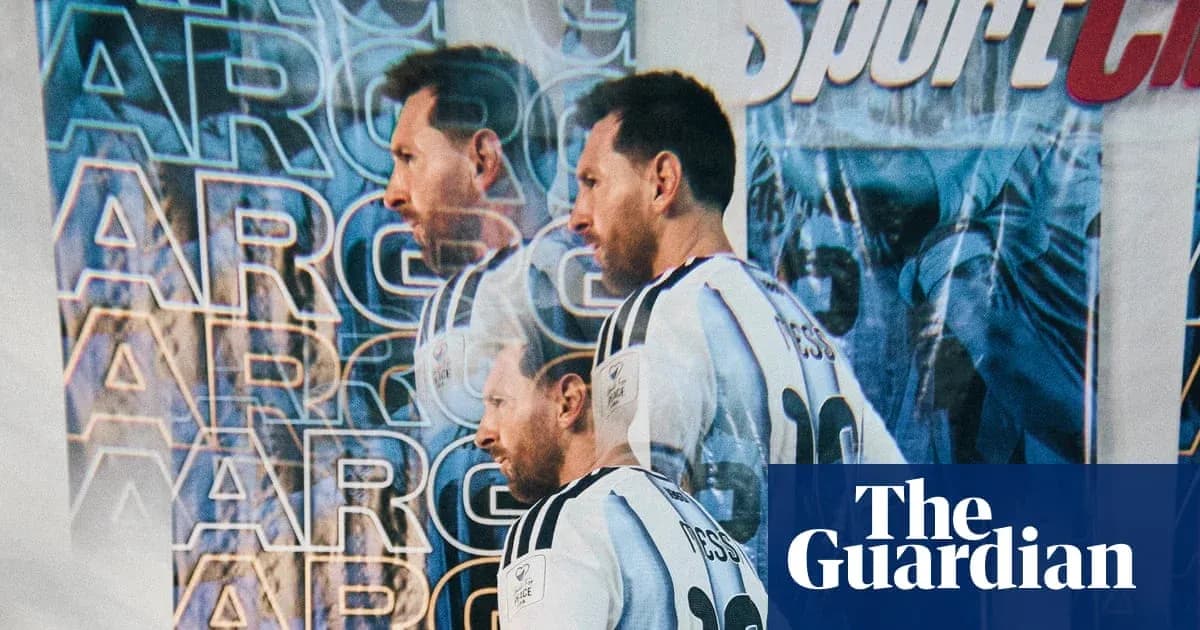
Lionel Messi doesn’t move. He stands bolt upright, eyes fixed, body locked, as if someone has just called his name and he’s bracing for impact. A few feet away in another corner of this World Cup circus, Marc Cucurella is all motion – hair flying, shoulders rolling, caught mid-boogie like he’s wandered into a nightclub, not a studio.
Diego Moreira lifts his forearm, shields his eyes and, in doing so, reveals an unsettling tattoo that says more than any smile could. Harry Kane drops on to one knee, leaning awkwardly, as if the pose has been suggested rather than felt.
Welcome to the most unavoidable fixture of any major tournament: the official portrait.
Production line of personalities
There are 1,248 footballers and 48 managers at this World Cup. Every single one of them has had to stand under the lights and offer up a version of themselves to the lens. No one skips this duty. Not the kids on their first call-up, not the veterans, not even Messi.
Getty Images, commissioned by Fifa, has spent recent weeks turning training bases and hotels into temporary studios. The results are everywhere: a flood of faces, poses and carefully curated expressions that reveal as much about the modern player’s image consciousness as they do about their football.
The portraits are only half the story. The behind-the-scenes frames, released by Getty, show the conveyor belt in motion – kit men hovering, media officers checking watches, players shuffling in and out, some buzzing, some bored, some clearly counting down the seconds until they can get back to the pitch.
Two photographers are assigned to each squad. One set-up is deliberately plain, the other more distinctive. Players and coaches rotate between them with military efficiency. No one gets long. No one is allowed to drift.
Simple lights, strange magic
The lighting is stripped back to basics: a big studio strobe with a softbox blasting the front, a couple of rim lights carving out shoulders and cheekbones from behind. No elaborate rigs, no fashion-house drama. Just clean, controlled light.
The backdrops this time are muted, less showy than the 2022 World Cup’s glossy theatre. The drama comes from elsewhere. Special lens filters twist the scene, smearing colours, splitting highlights, throwing up unexpected blurs and kaleidoscopic smears. Messi’s portrait, for instance, looks as if the air around him has fractured.
Tom Jenkins, The Guardian’s veteran sports photographer, knows the drill all too well.
“With these kinds of shoots, you only get a few minutes with each player and you have to bash out various pictures and think incredibly quickly,” he says.
The clock never stops. You need the safe, school-photo frame – the one that will sit neatly on a team sheet or in a broadcast graphic – but you also chase something else now: emotion, playfulness, ego. Some players arrive with their own script: trademark goal celebrations, hand signs, rehearsed looks. Others need direction, a nudge, a suggestion.
“You want some shots that are dead plain like a school photo – that’s how player portraits always used to be done – but these days you also want pictures that are more emotive and fun,” Jenkins explains. “A lot of players will have their own poses and goal celebrations already but you’ve also got to have a list in mind.”
The strange part, he says, is the power shift. For once, the superstar isn’t in control of the arena.
“The interesting thing is that you’re in control of these superstars and every aspect of the shoot. There’s a lot of pressure that comes with that. You have to make sure you’ve set things up and tested everything before they arrive, so that when the shoot starts you can just focus on them.”
Name cards, Instagram and a very modern vanity
On a trestle table just out of shot, name cards are laid out for every player. Yes, even for Messi. No one wants an editor, hours later, to mislabel the most famous footballer on the planet.
The process is brisk but not cold. Players often step over to the monitor after a burst of shots, checking angles, hair, jawlines. A quick nod. A request for one more. A quiet veto.
“Most football players are very aware of their own image these days and they know how powerful it can be, especially through Instagram,” Jenkins says.
They are no longer strangers to the studio. Eberechi Eze has posed for Burberry. Declan Rice has fronted L’Oréal. These are athletes who understand light, framing, and the currency of a single striking image. Some stride in and treat it as a break from the grind of training. Others treat it like work.
“They’ve done this kind of thing before for big brands – Eberechi Eze did Burberry and Declan Rice did L’Oreal – so actually they’re much more comfortable with being in front of the camera and some of them really enjoy it.”
Comfort doesn’t protect them from the court of public opinion, though. England’s portraits, in particular, became instant social-media fodder. Rice was mocked for his sunburnt face. Anthony Gordon drew comparisons with Princess Diana. Dean Henderson’s intense side-eye unsettled more than a few viewers.
The jokes flew, but beneath them sat something more interesting. The more inventive frames – Jude Bellingham and his peers caught in shards of light and blur – showed what can be done in camera when photographers are allowed to push a little, even if the subject in front of them offers little more than a shrug.
Bielsa, the reluctant subject
And yet, the portrait that has dominated conversation isn’t of a player at all. It belongs to Uruguay’s head coach, Marcelo Bielsa.
Shot by Michael Regan at Uruguay’s base in Cancún, Mexico, the image breaks the unspoken rules of the genre. Bielsa refuses the game. He doesn’t square up to the lens. He doesn’t play along. Instead, he looks down at his feet, shoulders slumped, gaze fixed somewhere on the floor.
The result is a frame that crackles with stubbornness. It’s awkward, almost confrontational in its refusal to perform. It also feels utterly, unmistakably Bielsa.
“I’m not a model,” he protested afterwards. Of course he did.
For Jenkins, that’s exactly the point.
“Ultimately I think the best portrait is one that displays the individual’s personality, and that’s why the Bielsa picture is so brilliant. It’s perfectly him.”
In a World Cup drowning in images, the most powerful photograph might be the one where the subject simply declines to play the part.