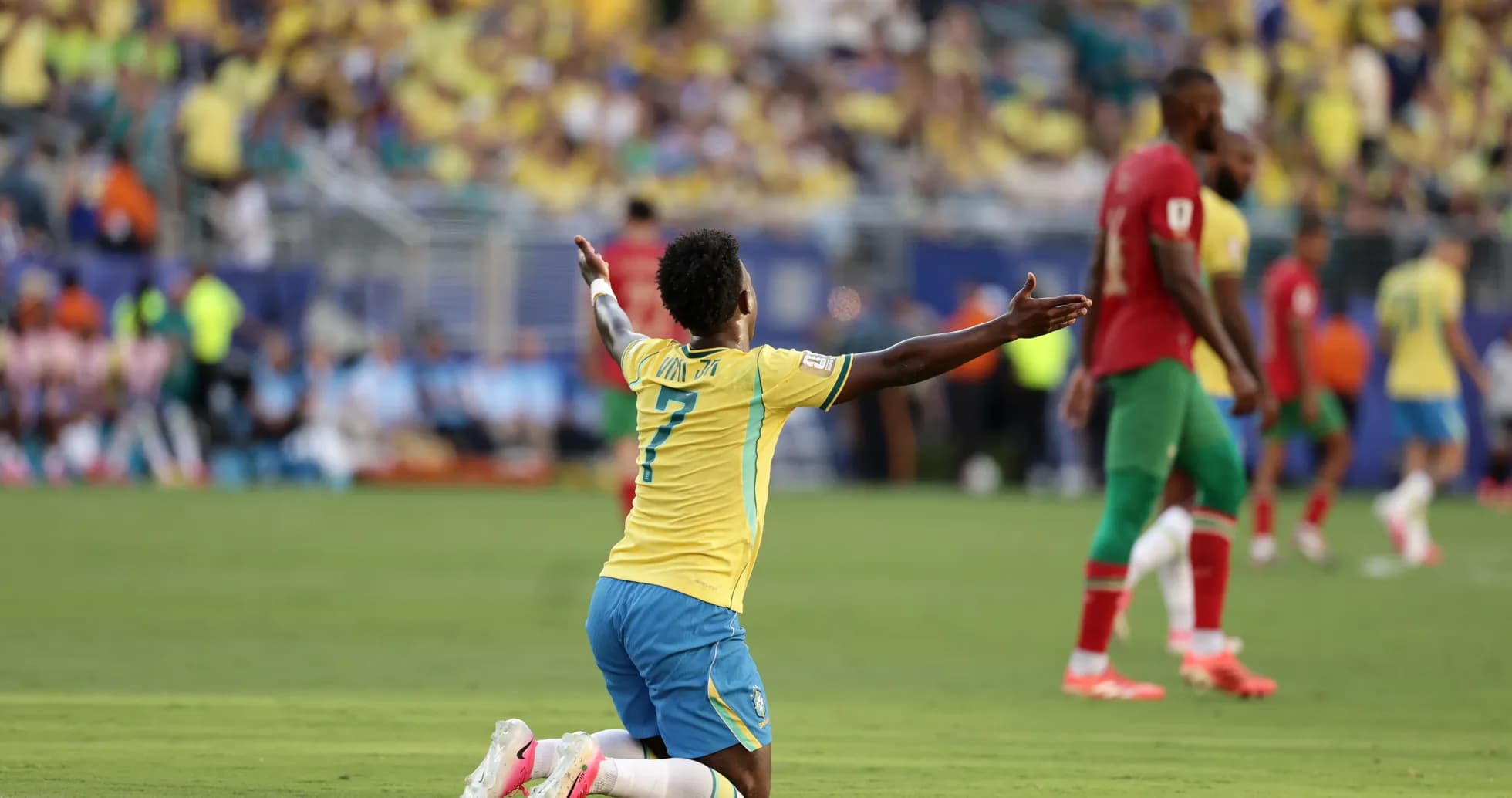
Brazil and Morocco Battle to Tactical Draw in World Cup Opener
Brazil and Morocco opened their World Cup campaigns at MetLife Stadium with a 1-1 draw that felt tactically rich rather than explosive. Both coaches mirrored each other in a 4-2-3-1, and the match evolved into a duel between Brazil’s structured, possession-based progression and Morocco’s compact mid-block with sharp transitional punches. The statistical balance – 12 shots each, possession 54%-46%, and virtually identical xG (Brazil 1.24, Morocco 1.28) – underlined how finely poised the contest was. In the end, Brazil’s technical control and Morocco’s defensive resilience cancelled each other out, setting a clear tactical blueprint for the rest of Group Stage - 1.
First Half
Ismael Saibari’s 21' opener for Morocco, assisted by Brahim Díaz, was the archetype of their plan: fast vertical exploitation of spaces behind Brazil’s advanced full-backs. Positioned as the lone forward in the 4-2-3-1, Saibari benefited from the intelligent occupation of half-spaces by Díaz and Bilal El Khannouss, who drew Brazilian centre-backs out before the decisive pass. The move exposed Brazil’s double pivot, with Casemiro and Bruno Guimarães caught between screening passing lanes and protecting the back line, leaving just enough room for Morocco to break the last line.
Brazil’s equaliser at 32' from Vinícius Júnior, assisted by Bruno Guimarães, showcased the other side of the tactical equation. Operating nominally as a left-sided midfielder in the three behind Igor Thiago, Vinícius frequently inverted into the half-space while Douglas Santos overlapped. The goal stemmed from Brazil’s patient circulation – 501 passes at 88% accuracy – and their ability to pin Morocco’s back four. Bruno Guimarães, as the deeper of the two central midfielders in possession, found the angle to thread a line-breaking pass into Vinícius’ inside-left channel, exploiting the narrow positioning of Achraf Hakimi and Issa Diop. It was a textbook example of how Brazil’s structure is designed to isolate their star winger in advantageous 1v1 or 1v1.5 situations.
Discipline and Midfield Battle
Discipline played a subtle but important role in the midfield battle. Brazil collected both yellow cards in the match, reflecting the strain Morocco’s transitions placed on their structure:
- 37' Casemiro (Brazil) — Foul
- 43' Roger Ibañez (Brazil) — Foul
Both bookings were direct outcomes of Morocco’s attempts to break through the first and second lines of pressure, forcing Brazil’s defensive leaders into risk-management decisions. Casemiro’s caution, in particular, altered his defensive aggression for the rest of the contest and partly explained Carlo Ancelotti’s double change at 46'.
Halftime Adjustments
The halftime adjustments were decisive in rebalancing the tactical picture. At 46', Danilo (IN) came on for Roger Ibañez (OUT), and Fabinho (IN) replaced Casemiro (OUT). The introduction of Danilo at right-back stabilised Brazil’s rest defence: with a more conservative full-back, Brazil could maintain a back three in possession (Danilo tucking in alongside Marquinhos and Gabriel Magalhães) while Douglas Santos pushed higher on the opposite side. This reduced the exposure that Morocco had exploited for the opening goal.
Fabinho’s arrival shifted the dynamic of the double pivot. Where Casemiro had been more of a destroyer stepping into duels, Fabinho offered better horizontal coverage and positional discipline, screening passing lanes into Saibari and the Moroccan No. 10 zone. This helped Brazil compress Morocco’s central progression and forced them to rely more on longer phases of build-up rather than pure transition.
Attacking Structures
On the ball, Brazil’s 4-2-3-1 often resembled a 2-3-5 in settled possession: Marquinhos and Gabriel Magalhães as the base, Danilo tucking inside, Douglas Santos advancing, and the front five of Raphinha, Lucas Paquetá, Vinícius Júnior and Igor Thiago occupying the last line. The high volume of shots inside the box (9 of 12) shows how effectively they managed to enter the penalty area, even if their shot quality did not translate into a winning margin.
Morocco’s 4-2-3-1, under Mohamed Ouahbi, was built on the double pivot of Neil El Aynaoui and Ayyoub Bouaddi, who were crucial in absorbing pressure centrally. With only 46% possession and zero corner kicks, Morocco accepted long defensive phases. Their 6 blocked shots underline how compact the block became around the box, with centre-backs Issa Diop and Chadi Riad stepping out to confront shooters while full-backs Hakimi and Noussair Mazraoui narrowed inside to protect the half-spaces.
Goalkeeping and Defensive Performances
In goal, Alisson (Brazil) was relatively underworked, making 1 save, with Brazil’s defensive structure limiting Morocco to 2 shots on target from 12 total attempts. The goals prevented figure of 0.46 reflects that while he was not heavily tested in volume, the interventions he did make carried real value relative to the xG conceded. At the other end, Bono (Morocco) made 3 saves, mirroring the pressure Brazil exerted in the final third. His own goals prevented value of 0.46 underscores how decisive he was in preserving the draw when Brazil’s attacks broke through Morocco’s block.
Substitution Waves
The substitution wave around the hour mark reshaped the attacking profiles on both sides. For Brazil at 61', Luiz Henrique (IN) came on for Igor Thiago (OUT), and Matheus Cunha (IN) replaced Lucas Paquetá (OUT). This tilted Brazil towards a more mobile, interchanging front line rather than a fixed reference No. 9. Luiz Henrique’s movement into wide and half-space zones created more dynamic rotations with Raphinha and Vinícius, but it also meant fewer classic penalty-box presences against Morocco’s physically strong centre-backs.
Morocco’s response at 64' with Samir El Mourabet (IN) for Azzedine Ounahi (OUT) and Chemsdine Talbi (IN) for Brahim Díaz (OUT) signalled a shift from creative ball retention towards fresher legs and vertical running. Later, at 80', Ayoube Amaimouni Echghouyab (IN) replaced Bilal El Khannouss (OUT), and Anass Salah-Eddine (IN) came on for Noussair Mazraoui (OUT), reinforcing the defensive flanks and giving Morocco renewed energy to defend wide areas as Brazil chased the game. The 89' change, with Soufiane Rahimi (IN) for Ismael Saibari (OUT), was a late attempt to maintain a counter-attacking threat while preserving defensive effort up front.
Statistical Summary
Statistically, the match was almost perfectly balanced. Brazil’s 54% possession and 501 passes, with 441 accurate (88%), indicate a slight territorial and control edge. Morocco, however, matched them closely with 432 passes, 375 accurate (87%), and the same total of 12 shots. The shot profiles differed: Brazil were more box-oriented (9 shots inside the area), while Morocco split their efforts evenly between inside and outside (6 and 6). Brazil’s 5 corner kicks to Morocco’s 0 underline where the territorial pressure lay, yet Morocco’s 6 blocked shots against Brazil’s 4 speak to their intense penalty-area defending.
The xG numbers – Brazil 1.24, Morocco 1.28 – confirm that a 1-1 scoreline was a fair reflection of chance quality. Both sides’ goalkeepers prevented an estimated 0.46 goals, reinforcing that this was not a game of glaring misses but of marginal gains and fine defensive interventions. Fouls were nearly even (Brazil 15, Morocco 14), with Brazil’s two yellow cards the only disciplinary difference, a by-product of their slightly higher defensive risk in preventing Moroccan counters.
Overall, this was a high-level tactical stalemate: Brazil showed a clear possession structure and capacity to reach the box, while Morocco demonstrated a disciplined, flexible block and clinical transitional threat. For a Group Stage - 1 fixture, both teams left MetLife Stadium with a point and, more importantly, a well-defined identity for the rest of the World Cup campaign.