France vs Senegal: World Cup Group Stage Insights
MetLife Stadium watched a statement of intent. In a World Cup Group Stage opener that felt closer to a knockout tie in intensity, France’s 3–1 win over Senegal did more than bank three points: it sketched the tactical identities of both sides heading into the rest of Group I.
I. The Big Picture – Structure and Stakes
On paper, it was symmetry: both teams in a 4‑2‑3‑1, both with a clear star focal point. In practice, France’s version was a high‑control, vertical machine; Senegal’s, a compact counter‑punching unit that flickered into life too late.
Following this result, France sit 2nd in Group I with 3 points, a goal difference of +2 (3 goals for, 1 against). Across the campaign so far they have played 1 match in total, winning that single home fixture 3–1. Their attacking output at home stands at 3 goals in total, an average of 3.0, while they have conceded 1 goal at home, an average of 1.0. There is no away sample yet, but the early numbers underline a side that creates and converts.
Senegal, by contrast, leave East Rutherford with zero points and a goal difference of -2 (1 goal for, 3 against). They have played 1 match in total, that one on their travels, losing 3–1. On their travels they have scored 1 goal, an average of 1.0, but conceded 3, an away average of 3.0. The pattern is stark: they can threaten, but their defensive structure was stretched beyond its limits.
II. Tactical Voids – Where the Lineups Left Space
France: controlled aggression, no clean sheet
Didier Deschamps stayed loyal to a single blueprint: the 4‑2‑3‑1 that has been used in 1 lineup in total this tournament. Mike Maignan anchored a back four of Jules Kounde, Dayot Upamecano, William Saliba and Theo Hernandez. Ahead, Aurelien Tchouameni and Adrien Rabiot formed a double pivot, with Michael Olise, Ousmane Dembele and Desire Doue supporting Kylian Mbappe.
The “void” in this structure is calculated: with both Olise and Dembele nominally as attacking midfielders, France accept that their full‑backs, especially Theo Hernandez, will be exposed in transition. The statistics already hint at this trade‑off: in total this campaign, France have yet to keep a clean sheet (0 clean sheets overall), conceding 1 goal despite their dominance.
Deschamps’ bench options underline how he intends to manage games rather than rescue them. N’Golo Kante, Warren Zaire‑Emery and Manu Kone offer three distinct ways to lock down a lead in midfield, while Marcus Thuram, Jean‑Philippe Mateta and Bradley Barcola are impact forwards who can either stretch a tiring defence or attack space in behind.
Senegal: compact but brittle under sustained pressure
Bouna Thiaw Pape mirrored the shape with his own 4‑2‑3‑1, also used in 1 lineup in total so far. Edouard Mendy stood behind a back four of Krepin Diatta, Kalidou Koulibaly, Moussa Niakhate and Mamadou Diouf. Idrissa Gueye and Pape Gueye sat as the screening pair, with Ismaila Sarr, Lamine Camara and Sadio Mane underneath Nicolas Jackson.
The idea is clear: a double pivot to protect Koulibaly and Niakhate, with Mane drifting inside to overload central zones. But the numbers show the flaw. On their travels they have already conceded 3 goals, an away average of 3.0, and have yet to register a single clean sheet in total. Once France pulled their block from side to side, the distances between Senegal’s lines grew, and the back four were left defending wide channels without enough help.
The bench, however, hints at a different, more chaotic Senegal. Iliman Ndiaye, already with 1 assist in total this World Cup, and Ibrahim Mbaye, who has scored 1 goal in total, changed the tone when introduced. Both are among the early statistical standouts for Senegal: Ndiaye with 10 passes at 90% accuracy and a key pass, Mbaye with 1 shot, 1 on target and an 87% passing accuracy in limited minutes. The question for Thiaw is whether he dares to start them, sacrificing some initial control for sharper cutting edges.
Discipline and durability
Card data is still a blank canvas: there are no recorded yellow or red card distributions by minute for either side. That leaves both managers free of suspension worries, but also without clear trends on when their teams lose composure. With no penalties taken or missed in total for either team, the narrative is one of open‑play solutions rather than set‑piece dependence.
III. Key Matchups – Hunter vs Shield, Engine Room Battles
Hunter vs Shield: Mbappe against Koulibaly and Niakhate
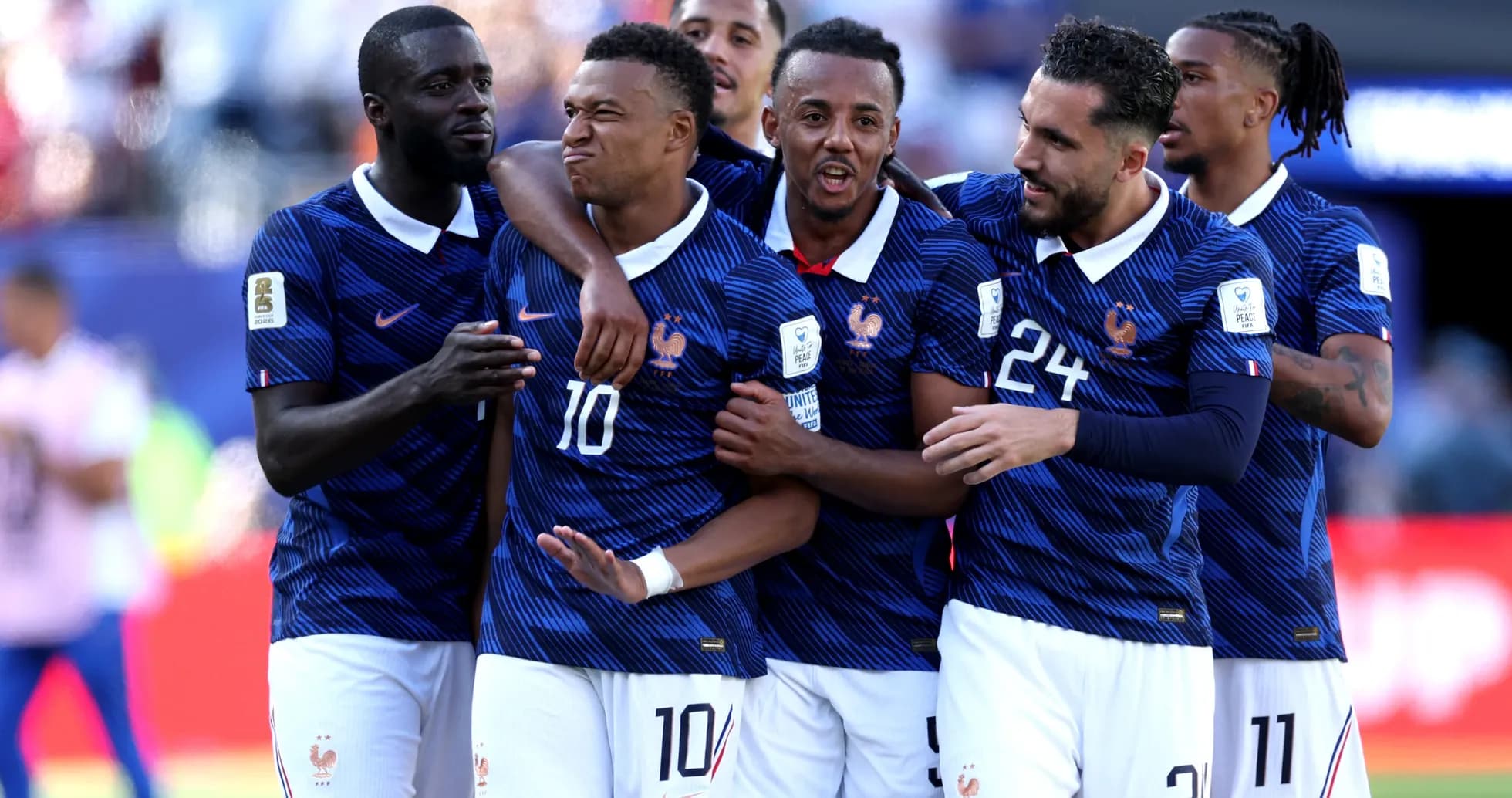
Kylian Mbappe has exploded out of the blocks. In total this World Cup he has 2 goals from 4 shots, all 4 on target, with an 8.2 rating and 90 minutes played. His efficiency is ruthless: 16 passes at 93% accuracy, 6 dribble attempts, and a constant willingness to run at the last line.
Against him, Koulibaly and Niakhate were asked to hold a high line and defend large spaces. Senegal’s defensive record on their travels – 3 goals conceded in 1 match, an away average of 3.0 – exposes how dangerous that gamble was. Whenever France managed to isolate Mbappe against a single centre‑back, the duel tilted heavily towards the French captain in all but the raw duel count.
From the bench, Bradley Barcola adds another dimension to this “Hunter” profile. In total this tournament he has 1 goal from 1 shot on target, with 7 completed passes at 85% accuracy and 2 successful duels from 3. He is the late‑game runner who turns tired legs into numerical advantages.
Engine Room: Tchouameni & Rabiot vs Idrissa Gueye & Pape Gueye
The heart of the contest lay in the double pivots. For France, Tchouameni and Rabiot are tasked with both shielding and launching. Their work underpins a side that, in total, has failed to score in 0 matches and has scored 3 goals overall. They recycle quickly, allowing Olise and Dembele to receive between the lines rather than in front of Senegal’s block.
Idrissa Gueye and Pape Gueye, by contrast, are fire‑fighters. Their remit was to close passing lanes into Mbappe’s feet and track the half‑space movements of Olise and Doue. For 45 minutes they largely held, reflected in the half‑time score of 0–0. But as the game stretched, France’s superior rotation and bench depth tilted the balance.
The late‑game disruptor in this zone is Iliman Ndiaye. His profile in total this World Cup – 1 assist, 10 passes at 90% accuracy, 1 interception – suggests a player who can both knit play and press. When he came on, Senegal’s attacks gained a second and third wave, culminating in Mbaye’s goal.
IV. Statistical Prognosis – What This Performance Predicts
From a statistical lens, France look like a side whose xG profile will be high every match. With 3 goals in total from their first game, an overall scoring average of 3.0 and no failures to score, their attacking baseline is set. The absence of any penalties, combined with Mbappe’s shot efficiency and Barcola’s impact, suggests these numbers are being built from open‑play superiority rather than variance from the spot.
Defensively, the warning light is clear: 1 goal conceded in total, an overall average of 1.0, and 0 clean sheets. Against more clinical opponents than Senegal, that looseness could be punished. Deschamps’ likely adjustment will be to lean more on Kante or Zaire‑Emery to close the central lanes earlier, especially if France are ahead.
For Senegal, the prognosis is more fragile but not hopeless. On their travels they are averaging 1.0 goal scored and 3.0 conceded. If we map that to an Expected Goals outlook, they are likely to be in matches where they must out‑score rather than shut down opponents. The encouraging sign is the bench impact: Mbaye’s 1 goal in total and Ndiaye’s 1 assist in total show that there are solutions beyond the starting XI.
Tactically, the next step for Thiaw may be to tilt the 4‑2‑3‑1 into a more aggressive 4‑3‑3, using Ndiaye as a high‑energy eight and Mbaye as a wide forward to press from the front. The defensive risk is obvious, but the current away record already suggests that passive containment is not working.
Following this result, France emerge as early contenders to top Group I, their squad depth and attacking ceiling already visible. Senegal, wounded but not broken, must now turn their flashes of late‑game quality into 90‑minute plans. The narrative of their World Cup will hinge on whether that boldness arrives in time.