Spain’s Tactical Mastery Secures 1-0 Win Over Argentina in World Cup Final
Spain’s 1-0 extra-time win over Argentina at MetLife Stadium was a tactical strangulation as much as a World Cup Final. Over 120 minutes, Spain turned a 4-2-3-1 into a suffocating positional machine, pinning a 4-4-2 Argentina so deep that the runners-up finished a World Cup Final without a single shot on goal. The raw numbers frame the story: 65% possession, 20 total shots to 2, and an xG of 1.94 to 0.22 in Spain’s favour. The lone breakthrough, from Ferran Torres in extra time, merely confirmed a territorial dominance that had been building since kickoff.
Tactical Setup
Luis de la Fuente’s 4-2-3-1 was textbook Spain: Unai Simón behind a back four of Pedro Porro, Pau Cubarsí, Aymeric Laporte and Marc Cucurella; Rodri and Fabián Ruiz as the double pivot; Lamine Yamal, Dani Olmo and Alex Baena underneath Mikel Oyarzabal. The structure was designed to stretch Argentina’s 4-4-2 horizontally and vertically, then attack the half-spaces. Spain’s 852 passes, 762 of them accurate (89%), show how relentlessly they recycled possession until gaps appeared.
In build-up, Rodri dropped between or alongside the centre-backs, forming a 3+1 base with Cubarsí and Laporte, while Cucurella often inverted into midfield. This allowed Porro to push high on the right, creating a wide outlet to pin Nicolás Tagliafico. Fabián Ruiz operated slightly left of Rodri, connecting with Baena and Cucurella to overload Argentina’s right side, forcing Rodrigo De Paul and Gonzalo Montiel to defend deep and narrow. The result was Spain’s repeated access to the left half-space, where Dani Olmo and Oyarzabal could receive between the lines.
Higher up, Lamine Yamal stayed wide and high on the right, stretching the back four and isolating Tagliafico. His positioning opened inside lanes for Olmo to drift into the right half-space, making Spain’s attacking band fluid: Baena tucking in, Olmo roaming, Oyarzabal dropping short. Against Argentina’s flat 4-4-2, with Lionel Messi and Julián Alvarez offering limited backward pressure, Spain consistently created a free man in midfield. Enzo Fernández and Alexis Mac Allister were forced into constant lateral shuttling, a dynamic that contributed to Argentina’s 25 fouls and six yellow cards plus one red.
Defensive Control
Defensively, Spain’s counter-press was the game’s defining control mechanism. Losing the ball, the nearest three or four players immediately compressed the space around Enzo Fernández and Mac Allister, cutting off vertical passes into Messi and Alvarez. With just two total shots conceded and none on target, the block of Rodri–Fabián in front of Cubarsí and Laporte prevented Argentina from ever stringing together transition attacks. Spain’s 3 blocked shots in attack contrasted with Argentina’s 1, underlining how often La Roja managed to get bodies in the way of the rare Argentine efforts.
Argentina's Strategy
Lionel Scaloni’s 4-4-2 was clearly designed for defensive resilience and transitional threat rather than control. Messi and Alvarez stayed high to offer counters, while Nicolás González and De Paul were asked to double up wide and help full-backs Montiel and Tagliafico. However, Argentina’s 463 passes (357 accurate, 77%) and just 35% possession show they were permanently second-best in circulation. Their block was compact but increasingly reactive, and the disciplinary record betrayed the strain: early cards for Cristian Romero and Lisandro Martínez, followed by bookings for Leandro Paredes, Enzo Fernández (twice, leading to a red), and Alexis Mac Allister, all stemming from late or desperate interventions.
Substitution Patterns
The substitution patterns tell the tactical evolution. Argentina’s first changes at 44' and 46' — Nicolás Otamendi (IN) for Lisandro Martínez (OUT) and Leandro Paredes (IN) for Nicolás González (OUT) — signalled a shift toward even more defensive solidity and central congestion. Nahuel Molina (IN) for Gonzalo Montiel (OUT) at 58' freshened the right flank defensively, while later introductions of Facundo Medina, Giuliano Simeone and Marcos Senesi for Cristian Romero, Rodrigo De Paul and Julián Alvarez further tilted the team towards a survival, low-block approach, sacrificing attacking reference points for defensive legs and aerial presence.
Spain’s response from the bench sharpened their attacking mechanisms rather than changing identity. At 62', Pedri (IN) for Fabián Ruiz (OUT) and Ferran Torres (IN) for Mikel Oyarzabal (OUT) increased verticality and penalty-box occupation. Pedri’s arrival shifted the structure closer to a 4-3-3 in possession, with Rodri anchoring and Pedri plus Dani Olmo (before his later replacement) operating as dual interiors. At 75', Nico Williams (IN) for Alex Baena (OUT) and Mikel Merino (IN) for Dani Olmo (OUT) added direct 1v1 threat on the left and late-arriving runs from midfield. Williams’ pace and dribbling forced Argentina’s back line even deeper, while Merino’s timing into the box created the kind of second-wave presence that Spain had previously lacked.
Extra Time Dynamics
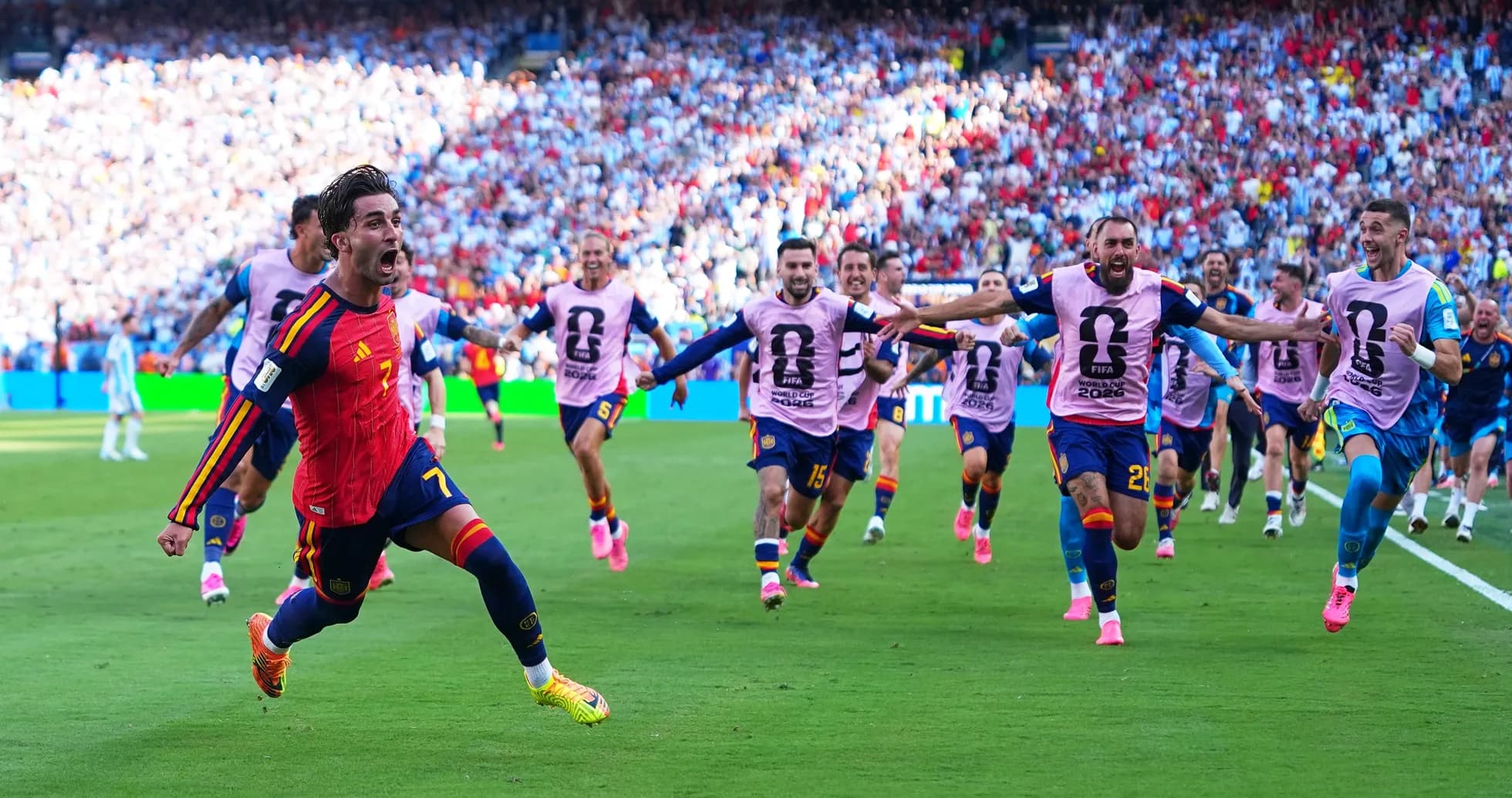
Extra time crystallised the pattern. Martín Zubimendi (IN) for Rodri (OUT) and Eric García (IN) for Aymeric Laporte (OUT) at 99' maintained the structural integrity of the build-up while refreshing legs in the deepest zones. Marcos Senesi (IN) for Julián Alvarez (OUT) at 102' was effectively an admission from Argentina that penalties were the target, converting the side into a 4-5-0/5-4-0 without a true forward outlet. Under that pressure, Spain’s sustained crossing and cut-back game finally paid off at 106', when Ferran Torres, now acting as a central penalty-box forward, converted after service from Nico Williams. It was the logical endpoint of a plan that had progressively increased the number of runners in and around the box.
Goalkeeper Performances
The goalkeeper story underlines the tactical one. Unai Simón (Spain) did not register a single save, a rare feat in a World Cup Final and testament to how completely Spain’s structure protected their box. Emiliano Martínez (Argentina), by contrast, made 11 saves, repeatedly bailing out a defence that was being shelled from multiple angles. His 1.81 goals prevented, matching Spain’s 1.81 goals prevented figure from their statistics block, reflects how he kept Argentina alive far beyond what the shot quality against them would normally allow.
Statistical Overview
Statistically, Spain’s 12 shots on goal from 20 attempts, with 9 from inside the box, show a side that not only dominated territory but also generated high-quality chances. Argentina’s 2 total shots, split evenly inside and outside the box and with 0 on target, underline their almost total offensive impotence. Spain’s 9 corners to Argentina’s 4 further capture where the game was played: in and around Argentina’s area. Offside numbers (4 for Spain, 1 for Argentina) are consistent with Spain’s high line and repeated attempts to run behind a deep defence, versus Argentina’s rare and increasingly isolated counters.
Discipline and Control
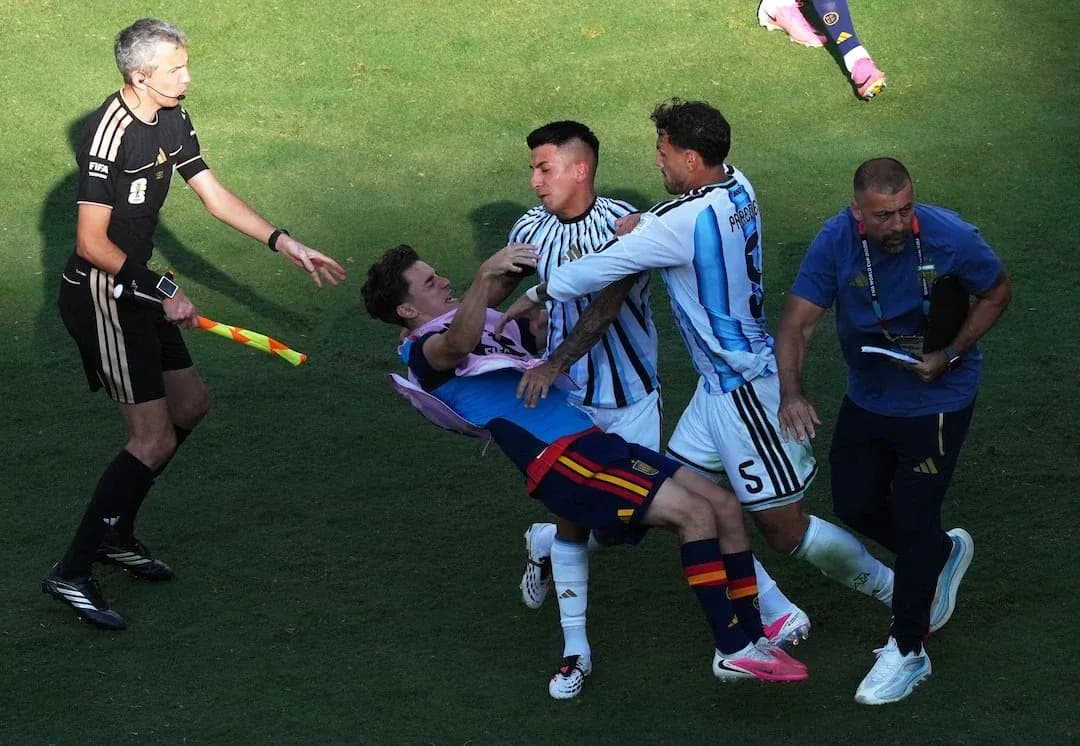
Discipline was decisive in the closing stages. Argentina finished with 6 yellow cards and 1 red, all to their players, while Spain avoided bookings entirely. The dismissal of Enzo Fernández at 90+3' for a second yellow (Argument then Foul) left Argentina to endure extra time with ten men, making their low block even more passive and reducing already minimal counter-attacking outlets. Spain’s ability to maintain control without resorting to tactical fouling — 21 fouls to Argentina’s 25, but no cards — speaks to their superior spacing and pressing structure.
In sum, this Final was a clinic in territorial control and risk management from Spain. The 1-0 scoreline after extra time only hints at their dominance: a near-2.0 xG, 12 shots on target, and a clean sheet in which Unai Simón (Spain) was effectively a spectator. Argentina, built for moments and transitions, never found the platforms to launch them. Spain’s rotations, positional play and well-timed substitutions gradually squeezed the life out of the contest, and when Ferran Torres struck, it felt less like a twist and more like an inevitability finally realised.