France vs England: Tactical Insights from the World Cup 3rd Place Final
France’s 6-4 defeat to England in the World Cup 3rd Place Final at Hard Rock Stadium, Miami Garden unfolded as a chaotic, high‑tempo contest where structural choices, pressing height and transition management mattered more than any sterile notion of control. England’s 4-0 half‑time lead and France’s three‑goal second‑half surge were both logical outcomes of the same tactical dynamic: aggressive midfields, high full-backs, and huge spaces around the first line of build-up.
With no explicit formations listed, the personnel strongly suggest France building around Kylian Mbappé as the central reference, supported by Michael Olise, Rayan Cherki and Désiré Doué between the lines. England mirrored that with Ivan Toney up front and a fluid band of Marcus Rashford, Bukayo Saka, Eberechi Eze and Morgan Rogers behind, anchored by Declan Rice.
England’s early dominance came from superior control of central zones and second balls. Rice repeatedly stepped beyond his nominal holding role, both to press Warren Zaïre-Emery and Adrien Rabiot and to arrive late around the box – perfectly illustrated by his 3' opener. France’s double pivot struggled to protect the back line when their advanced midfielders vacated central spaces; with both full-backs, Malo Gusto and Theo Hernández, naturally aggressive, France’s rest defence often collapsed into exposed 1v1s and 2v2s.
On set plays and crosses, England exploited that fragility. Ezri Konsa’s 18' goal reflected a structural issue: France’s central defenders, Ibrahima Konaté and Maxence Lacroix, were overloaded while the zonal line lacked a dominant first-contact presence. With England pushing both full-backs Djed Spence and Jarell Quansah high, Saka and Rashford could attack half-spaces, dragging French defenders out and creating mismatches on the far side.
The first half’s 4-0 scoreline aligned with England’s territorial and structural superiority rather than sheer shot volume. Overall shots finished level at 19-19, but England created 16 efforts inside the box to France’s 12, a clear sign of their ability to access high‑value zones. Their xG of 2.58 versus France’s 2.87 underlines how ruthlessly England converted early, while France’s finishing lagged behind the quality of chances until the second half.
Didier Deschamps’ quadruple change at 46' – Désiré Doué (OUT) for Bradley Barcola (IN), Cherki (OUT) for Ousmane Dembélé (IN), Konaté (OUT) for Dayot Upamecano (IN) and Theo Hernández (OUT) for Lucas Digne (IN) – was effectively a tactical reset. Barcola’s introduction gave France a true wide runner to stretch England’s back line, while Dembélé added direct 1v1 threat and vertical dribbling. At the back, Upamecano and Digne brought more composure in build-up and slightly better defensive balance.
The impact was immediate. France’s 48' and 54' goals, both involving Mbappé and Olise/Barcola combinations, came from cleaner progression through the thirds. France leaned into quick vertical patterns: centre-back into Rabiot or Zaïre-Emery, then directly into Mbappé’s feet or into the channel for Barcola. England’s mid-block, with Rice as the lone genuine pivot, struggled once the wide midfielders were forced deeper by France’s full-backs and wingers. The French front four began to pin England’s back line, creating space for late runs and cutbacks.
Kylian Mbappé’s second goal at 66' encapsulated the adjusted French approach: repeated use of Olise between the lines, quick wall passes, and Mbappé attacking the inside‑left channel against an isolated defender. England’s defensive line, which had been proactive and compact in the first half, now retreated closer to Dean Henderson’s box, conceding territory and inviting pressure.
From England’s side, Thomas Tuchel’s substitutions at 79' – Jude Bellingham (IN) for Eberechi Eze and Elliot Anderson (IN) for Ivan Toney – recalibrated their structure. With Bellingham joining Rice, England gained a second central ball‑carrier to help them escape pressure and hold possession phases. The later introduction of Reece James for Quansah at 83' also added a more conservative, defensively reliable presence on the flank, trying to stem France’s momentum down that side.
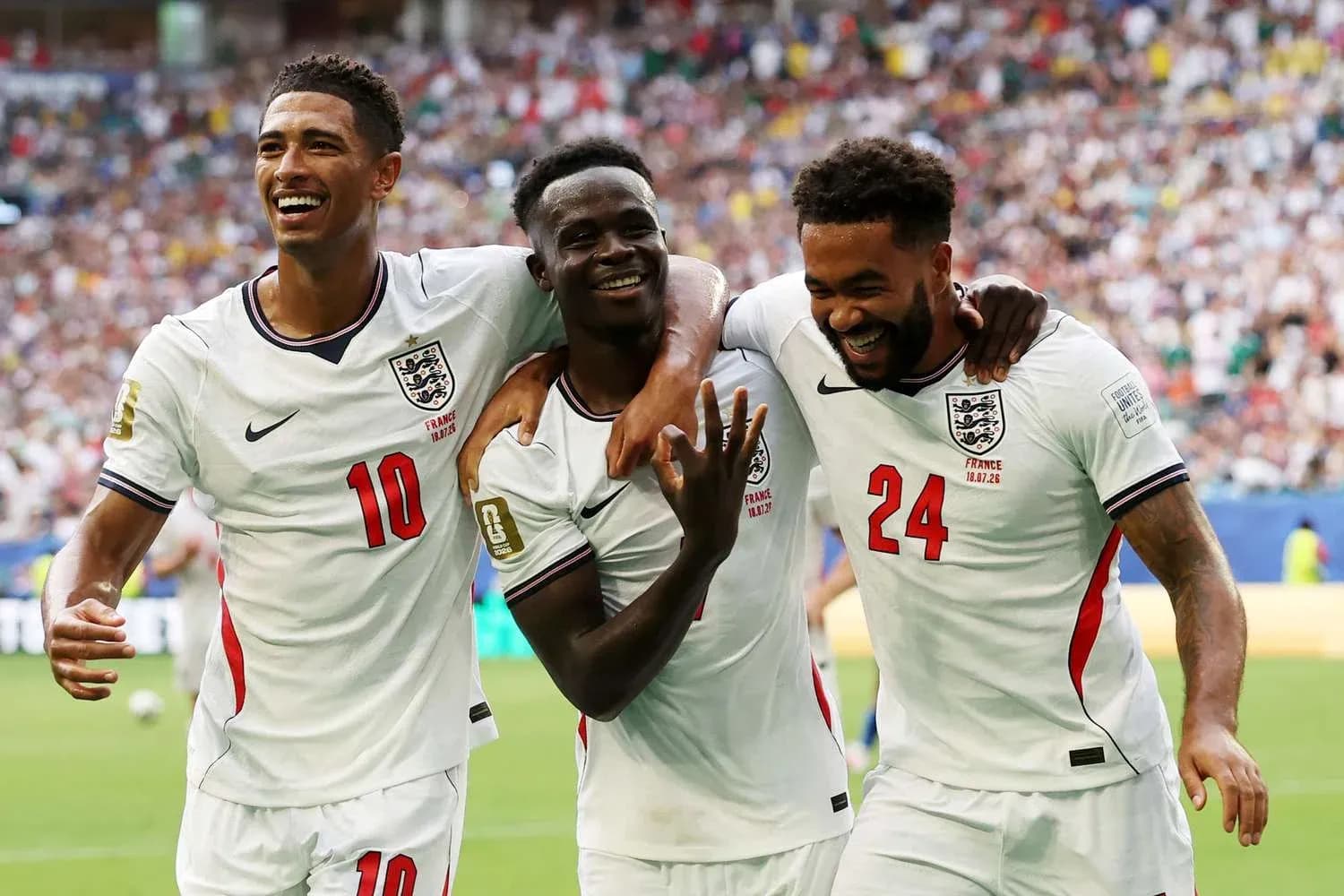
The penalty converted by Saka at 87' was as much about game state as individual quality. France, chasing an equaliser, pushed numbers forward and left themselves vulnerable to direct attacks and 1v1s in transition. England’s ability to draw fouls and win duels in advanced areas was facilitated by their fresh legs in attack and midfield.
In goal, the statistical profile underlines how open the game was. Mike Maignan (France) faced 11 shots on target and made 5 saves, conceding 6, with a goals prevented figure of 0.05 – essentially par for the quality of shots allowed. The burden on Maignan was a direct consequence of France’s porous rest defence and England’s high proportion of shots inside the box. At the other end, Dean Henderson (England) made 4 saves from 9 shots on target, also with 0.05 goals prevented, indicating that England too conceded several clean looks once France’s attacking structure clicked.
Possession was narrowly in England’s favour at 54% to France’s 46%, but both sides posted identical passing accuracy at 91%. England completed 467 of 515 passes, France 405 of 445. This was not a game of one side ceding the ball; instead, it was a contest of who used it more vertically and who protected transitions better. England’s early control came from combining secure circulation with aggressive vertical entries, whereas France’s late surge came when they accepted risk, shortened their build-up and played more directly into Mbappé and Barcola.
Defensively, the foul count – 14 for France, 8 for England – hints at France’s need to break up transitions more often, particularly once England had established a rhythm in the first half. England, by contrast, relied more on structural compactness and counter-pressing than on tactical fouling.
The blocked shots numbers (4 for France, 6 for England) reinforce the picture of England’s back line and midfield throwing bodies in front of efforts as France chased the game. Combined with England’s 4 corner kicks to France’s 3, it suggests England had slightly more sustained attacking platforms, especially before the break.
In synthesis, this 6-4 spectacle was less about chaos than about two high-talent attacks repeatedly exploiting systemic weaknesses. England’s superior early control of central spaces and set‑piece organisation built an insurmountable platform; France’s second‑half revival, powered by Deschamps’ attacking substitutions and more direct patterns into Mbappé, exposed England’s own structural fragilities. The underlying numbers – near‑par xG on both sides, similar total shots and passing accuracy – frame the result as a story of timing and game state: England maximised their dominance when France were still structurally vulnerable, and then survived a late onslaught once France finally found the right attacking configuration.