Spain Triumphs Over Argentina in World Cup Final
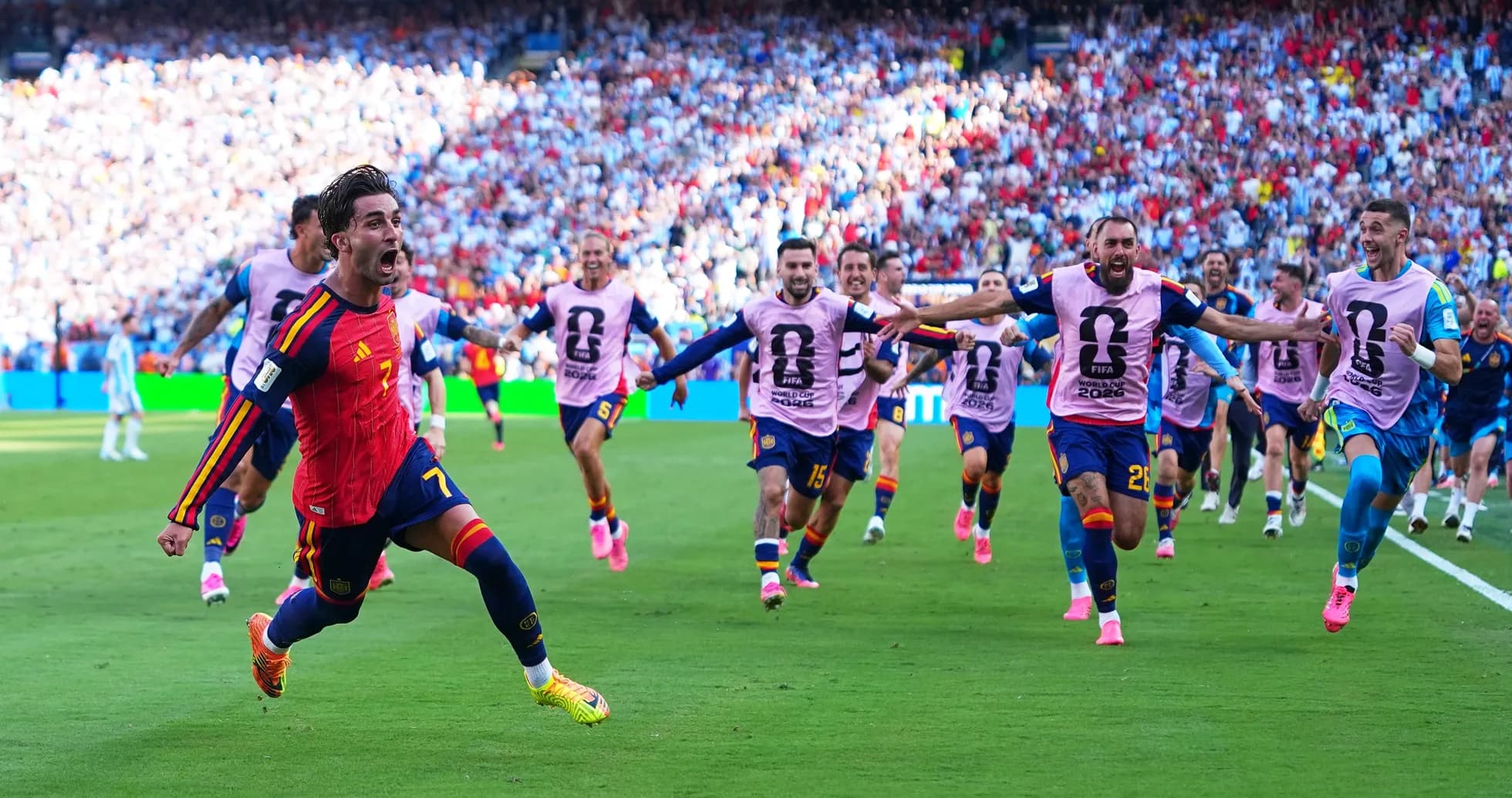
MetLife Stadium under New Jersey’s summer glare became the crucible for a World Cup Final that went beyond systems and reputations. Spain 1–0 Argentina after extra time was not just a scoreline; it was the culmination of two contrasting footballing identities stretched to their limits over 120 minutes.
I. The Big Picture – Two Perfect Arcs Collide
Both sides arrived in East Rutherford with near-flawless campaigns behind them. In the group phase, Spain topped Group H with 7 points, a goal difference of 5 built on 5 goals scored and none conceded in 3 matches. Argentina were even more ruthless in Group J: 9 points from 3 games, 8 goals scored and just 1 conceded for a goal difference of 7.
Across the entire tournament, Spain’s record was defined by control and denial. They had played 8 fixtures, winning 7 and drawing 1, with no defeats. Overall they scored 14 goals and conceded just 1, an almost absurd defensive line that translated into an average of 1.8 goals scored and 0.1 conceded per match. Argentina, by contrast, embraced volatility. Also with 8 fixtures, they won 7 and lost 1, scoring 19 and conceding 8, for an overall average of 2.4 goals scored and 1.0 conceded per match.
The final itself reflected that tension: Spain’s defensive perfection against Argentina’s attacking firepower. The 0–0 at full time, followed by Spain’s extra-time breakthrough, felt like the logical end point of that statistical tug-of-war.
Luis de la Fuente stayed loyal to Spain’s most-used structure, a 4-2-3-1 that had already been deployed 6 times this World Cup. Lionel Scaloni, equally consistent, went with the 4-4-2 that had underpinned 5 of Argentina’s lineups. The stage was set for a duel of reference systems rather than experimental gambits.
II. Tactical Voids and Discipline – Where the Edges Frayed
There were no official absentees listed, so both coaches entered with full arsenals. But the disciplinary histories of these squads shaped how aggressively they could approach the margins of the match.
Spain’s tournament had been remarkably clean in both senses. With 7 clean sheets in 8 matches and only 1 goal conceded, their back line and midfield shield rarely lost structure. Their card profile told a similar story: yellow cards clustered late, with 33.33% between 31–45 minutes and a significant 50.00% coming in the 91–105 window. That pattern hinted at a side that only really stretched its aggression when matches moved into high-stress, late phases.
Argentina lived closer to the edge. They had just 2 clean sheets overall and had conceded 8 goals, with their defensive wobble most obvious after the break. Fully 33.33% of their goals conceded came between 46–60 minutes, 22.22% between 61–75, and another 22.22% in extra time between 106–120. Their card distribution was even more revealing: yellow cards spiked in the 91–105 period (33.33%) and remained high in 106–120 (20.00%). They also had a red card in the 91–105 window. This was a team that, when dragged into extended, chaotic games, tended to flirt with self-destruction.
Crucially, Argentina’s penalty record heading into this final was a liability: 3 penalties awarded, but only 1 converted and 2 missed, a success rate of just 33.33%. Even their talisman L. Messi had missed 2 penalties this tournament. In a final that always threatened to go to the spot, that psychological baggage hung heavy, even if the match ultimately ended in extra time without a shootout.
III. Key Matchups – Hunter vs Shield, Engine Room vs Enforcer
The headline duel was obvious: L. Messi, the tournament’s leading creative force, against a Spanish defensive unit that had allowed just 1 goal in 8 matches.
Messi arrived at MetLife with 8 goals and 4 assists, an 8.85 average rating, 28 shots (18 on target), and 38 dribble attempts with 27 successful. He had also created 26 key passes and drawn 20 fouls. Spain’s answer was collective rather than individual: U. Simon behind a back four of P. Porro, P. Cubarsi, A. Laporte, and M. Cucurella, screened by Rodri and F. Ruiz.
Spain’s defensive record suggested that Messi would not find the open spaces he had enjoyed earlier in the tournament. Their minute-by-minute concession profile was minimal: only 1 goal allowed in total, split between 31–45 and 46–60 minutes. There was no obvious “soft” period to target. For Messi and J. Alvarez, the usual late surges that Argentina relied on – 44.44% of their goals came between 76–90 minutes and another 11.11% in 106–120 – would be contested against a side that did not statistically fade.
On the other side, Spain’s main cutting edge came from M. Oyarzabal, who had 5 goals and 1 assist across the tournament. Operating as the lone forward in the 4-2-3-1, he was supported by a fluid band of three: Lamine Yamal wide right, D. Olmo centrally, and A. Baena from the left. Their task was to probe a back line anchored by C. Romero and L. Martinez, both aggressive defenders who had each collected 2 yellow cards.
Romero, with 15 tackles and 3 blocked shots, and Martinez, with 12 tackles and 1 block, are natural front-foot defenders. That aggression, combined with Argentina’s late-game card spikes, made the half-spaces around them fertile ground for Olmo’s drifting and Oyarzabal’s diagonal runs. It was no coincidence that Spain’s own goal distribution included a late-game surge of 23.08% between 76–90 and a further 7.69% between 106–120. Their offensive peak overlapped almost perfectly with Argentina’s defensive fatigue and disciplinary risk.
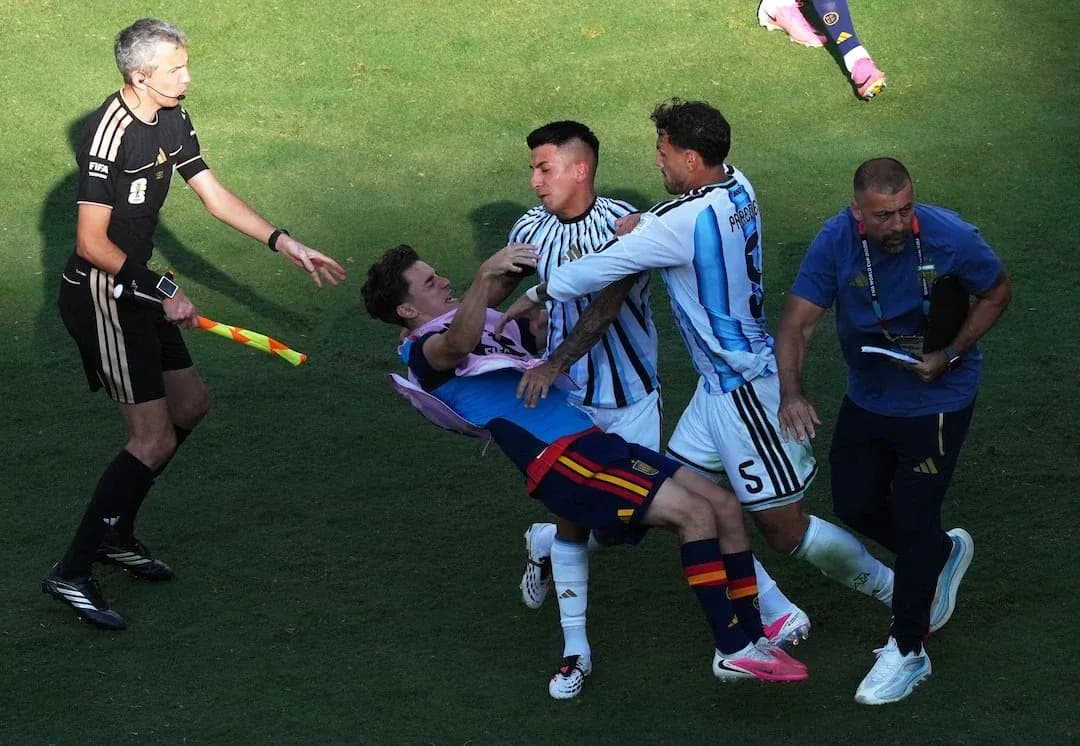
In midfield, the “engine room” confrontation pitted Rodri and F. Ruiz against E. Fernandez and A. Mac Allister, with R. de Paul adding legs and needle. Fernandez had walked a disciplinary tightrope all tournament, with 1 yellow card and a yellow-red combination on his record, alongside 12 fouls committed. Against Spain’s possession-heavy double pivot, any mistimed challenge risked tilting the balance.
IV. Statistical Prognosis – Why Extra Time Favoured Spain
From a probabilistic lens, the matchup always tilted slightly towards Spain once the game dragged deep. Spain had failed to score in only 1 of their 8 matches and had scored in every phase of the game, including a late burst: 30.77% of their goals came between 16–30 minutes, 23.08% between 76–90, and a further strike in the 106–120 window.
Argentina, by contrast, were structurally vulnerable in those same late phases. Their defensive minute distribution showed that 22.22% of goals conceded arrived between 61–75, 11.11% between 91–105, and 22.22% between 106–120. In other words, nearly half of the goals they allowed came after the hour mark, precisely when Spain’s controlled possession and bench options – from Pedri and Gavi in midfield to N. Williams and F. Torres in attack – could be introduced to accelerate the tempo.
Add in Argentina’s fragile relationship with penalties – 2 misses out of 3 – and the longer the match stayed level, the more the psychological and statistical weight shifted towards Spain. Even without xG values, the patterns were clear: Spain’s defensive solidity and late-game scoring profile were better suited to a final that would inevitably tighten and stretch into extra time.
In the end, the narrative played out along those lines. Spain absorbed Argentina’s surges, denied space to Messi, and trusted that their structure, discipline, and late-game profile would eventually produce the decisive moment. When the extra-time goal finally arrived, it felt less like a twist and more like the inevitable convergence of two tournament arcs: the hunter blunted by the shield, and a meticulous, almost machine-like Spain finishing the World Cup as they had played it – on their own terms.