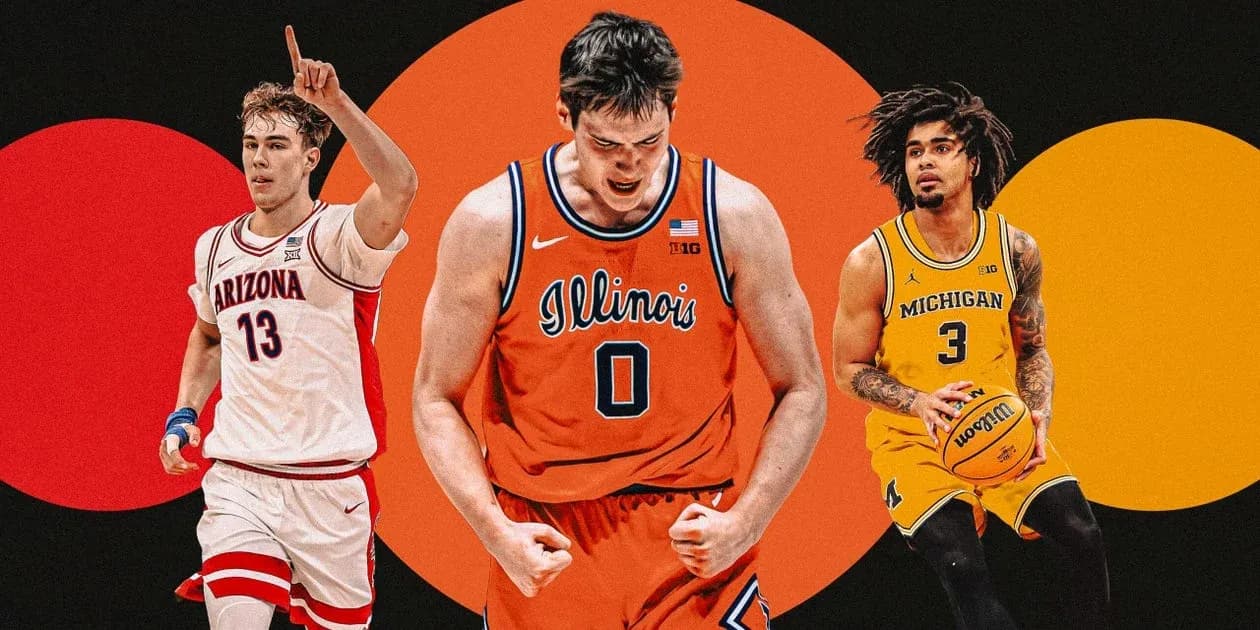
College Basketball 2026-27 Outlook: Teams to Watch
The transfer portal doesn’t even open until Tuesday, but the sport has already tilted toward 2026-27. Rosters aren’t close to finished, NIL deals aren’t finalized, and a lot of draft decisions still hang in the air. It doesn’t matter. The shape of next season is already visible — and it starts in Champaign.
1. Illinois: Built, loaded, and one guard away
Brad Underwood’s board is simple: find a point guard, then get out of the way.
Illinois returns size, skill and continuity everywhere else. David Mirkovic is on the verge of becoming an All-America-level focal point, a 6-9 creator who already plays like the offense belongs to him. Around him, the Illini bring back Zvonimir Ivisic, Ty Rodgers, Brandon Lee and Jason Jakstys, with Tomislav Ivisic and David Mirkovic anchoring what should be one of the most imposing frontcourts in the country.
Underwood’s recent history with freshmen suggests at least one of Quentin Coleman, Lucas Morillo, Ethan Brown or Landon Davis will pop in a big way. Coleman, a four-star shooting guard, and Brown, a combo guard with buzz inside the program, give Illinois more perimeter juice. Rodgers’ return after two lost years adds the kind of big wing defender and connector Underwood loves.
All that’s missing is the lead guard to tie it together. Land that, and Illinois has the clearest path to No. 1.
2. Michigan: Title defense with questions at the top
Michigan’s repeat chances hinge on two names: Aday Mara and Morez Johnson Jr.
Both bigs are legitimate NBA options. If Dusty May can convince even one to return — and the bet here leans toward Mara — the Wolverines step right back into the inner circle of title contenders. Keep Mara, add another high-level big from the portal, and Michigan’s front line remains terrifying.
The backcourt is already intriguing. Elliot Cadeau and Trey McKenney give May a high-floor pairing: Cadeau as the organizer, McKenney as the scoring wing. Brandon McCoy Jr., once viewed as one of the elite talents in his class before sliding in the rankings, becomes the wild card. If May unlocks that early reputation, Michigan’s ceiling spikes.
If the frontcourt comes together, this group will not be sneaking up on anyone.
3. Arizona: Defense, size, and a missing point guard
Tommy Lloyd has a familiar puzzle: elite size, elite defense, and a hole at point guard.
Assuming Ivan Kharchenkov and Motiejus Krivas return, Arizona will again field one of the nastiest defenses in the country. Krivas anchors the paint, Kharchenkov stretches the floor and guards multiple spots, and Sidi Gueye looms as the next Gonzaga-style big who waits, develops, then suddenly matters.
Caleb Holt arrives as a ready-made impact wing, a top-tier high school prospect and a natural replacement for Brayden Burries. Like Koa Peat before him, he already knows Lloyd’s voice from USA Basketball.
The question is simple and decisive: can Lloyd land a stud point guard, whether from the transfer portal or overseas? If he does, Arizona’s ceiling looks like a Final Four.
4. Florida: Frontcourt royalty in Gainesville
Todd Golden can sleep well. His frontcourt might be the best in America.
If Alex Condon and Rueben Chinyelu both return — and NIL gives Florida a real shot to outpay the NBA for another year — the Gators roll out a devastating inside duo. Condon’s skill and touch, Chinyelu’s physicality and rim protection: that’s a title-level base.
Florida still needs portal help on the perimeter and some depth up front, but the core is already strong. With CJ Ingram, Alex Lloyd, Alex Kovatchev and AJ Brown returning, plus 7-footer Jones Lay as a developmental piece, Golden isn’t scrambling. This roster, as is, looks like a preseason top-10 group. Add the right guards, and it becomes something more.
5. Duke: No Flagg, no Boozer star — but a grown roster
For once, Duke enters a season without the obvious, generational headliner.
There is no Cooper Flagg, no Cameron Boozer. What Jon Scheyer does have is experience and continuity, a different kind of strength. Caleb Foster, Dame Sarr, Cayden Boozer and Patrick Ngongba II have already lived through high-pressure ACC and NCAA Tournament moments.
Ngongba could bolt for the NBA, but even if he does, Duke is Duke: the Blue Devils are a magnet for elite bigs, and Flory Bidunga’s name has already hovered around Durham. Deron Rippey Jr. steps into the backcourt, with Bryson Howard and 7-1 Maxime Meyer adding depth and size.
Scheyer’s track record as a roster builder in the portal era is already strong. Even if he loses a piece like Boozer to the portal, the expectation is simple: Duke will arrive with a top-five-caliber roster again.
6. UConn: Guard play in place, frontcourt under construction
Dan Hurley has his backcourt. The frontcourt will decide how scary UConn looks.
Silas Demary and Solo Ball form a tough, versatile guard duo. If Ball rediscovers his 41.4 percent 3-point stroke from two years ago and Demary makes a Tristen Newton-style sophomore leap, the Huskies will be hell on the perimeter. Jayden Ross, Colben Landrew and Junior County add length and scoring on the wing.
The question is Eric Reibe. UConn was nearly 12 points per 100 possessions better with Tarris Reed on the floor than with Reibe at center. Reibe has flashed talent, but Hurley’s best teams have always had two high-level bigs. It would be very on-brand for him to chase an elite center in the portal even with Reibe returning.
If that happens, the Huskies look like a threat again.
7. Michigan State: Betting on Fears, trusting Izzo
Tom Izzo burned a lot of preseason believers this past year. Don’t expect the same mistake twice.
Jeremy Fears Jr. gives Michigan State a floor. His presence, leadership and edge stabilize everything. The concern shifts from shooting — last year’s issue — to low-post scoring after Carson Cooper and Jaxon Kohler graduate.
Right now, the projected frontcourt of Coen Carr and Cam Ward doesn’t feature a classic back-to-the-basket bruiser. Carr is a hyper-athlete who attacks facing the rim; Ward has more post skill but profiles more as a four than a true five. Freshman Ethan Taylor and returner Jesse McCulloch are options at center, but Izzo has often defaulted to his best five players and solved the rest on the fly.
With Kur Teng, Jordan Scott and a strong freshman class headlined by Jasiah Jervis, this group has talent. With Fears, it has a heartbeat.
8. Iowa State: Otzelberger stays, and the ceiling rises
T.J. Otzelberger could have chased North Carolina. Instead, he doubled down on Ames — and Iowa State doubled down on him.
That decision, backed by a stronger financial commitment, changes the Cyclones’ recruiting gravity. Otzelberger already had a reputation as one of the sport’s sharpest evaluators and developers. Now he has the backing to target even better prospects.
On paper, Iowa State has five players capable of starting. Killyan Toure, Jamarion Batemon, Milan Momcilovic, Blake Buchanan and Dominykas Pleta form a strong core. The staff could still upgrade the frontcourt and slide Toure back to shooting guard while adding a portal point guard to replace Tamin Lipsey.
Momcilovic is the swing piece. He averaged 16.9 points and shot a blistering 48.7 percent from 3. He could leave for the NBA now, or return and play himself into 2027 lottery range. If he’s back, Iowa State’s offense becomes a problem for everyone.
9. Arkansas: Calipari’s backcourt, missing its backbone
John Calipari inherits a roster that already has bite on the perimeter.
Jordan Smith Jr. might be the most important tone-setter. On the grassroots circuit, he built a reputation as a relentless defender and selfless guard who drags teammates up to his intensity level. Pair him with Meleek Thomas, Billy Richmond, JJ Andrews and Abdou Toure, and Arkansas suddenly has a deep, talented wing and guard rotation.
The issue is obvious: size and rim protection. Right now, the Razorbacks are all teeth on the perimeter and little presence at the rim. Calipari has to use the portal to find bigs who can anchor the defense and clean the glass.
If he does, Arkansas’ defensive profile flips from “meh” to menacing.
10. Nebraska: Hoiberg’s shooters and two big holes
Fred Hoiberg knows what he is: he’s going to spread you out and shoot you out of the gym.
With Pryce Sandfort, Braden Frager and Connor Essegian returning, Nebraska will again be one of the best shooting teams in the country. Add Colin Rice and Jacob Lanier on the wing, and the Cornhuskers are loaded with spacing and scoring.
But Hoiberg still needs a point guard to steer the offense and a big man to anchor the paint. Veteran Cale Jacobsen is good enough to start, but the plan is clear: go into the portal and find a starting-caliber lead guard and center.
If those two spots hit, Nebraska’s offense becomes one of the most dangerous in the Big Ten.
11. Iowa: Life after Bennett Stirtz
Ben McCollum just took Iowa to the Elite Eight and announced himself as one of the sharpest tacticians in the sport. Now he faces his first big rebuild question in Iowa City: how do you replace Bennett Stirtz?
Stirtz did everything for the Hawkeyes. McCollum’s system leans heavily on a do-it-all lead guard, and that spot now reads “Portal TBD.” The frontcourt also needs an anchor to help Iowa match the size of league heavyweights like Michigan and Illinois.
What McCollum does have is length and continuity on the wing. Tate Sage (6-7) and Cooper Koch (6-8) give Iowa real positional size. Cam Manyawu, Isaia Howard, Trevin Jirak and redshirt Trey Thompson round out a group that knows the system.
McCollum just showed what he can do on the biggest stage. At this point, betting against him feels foolish.
12. Gonzaga: Huff’s health and a German import
Gonzaga’s ranking lives and dies with one knee.
Braden Huff missed the final 17 games of the season with a knee injury. If he returns healthy, he becomes the unquestioned go-to scorer after Graham Ike’s graduation. That alone gives the Zags a clear offensive identity.
Around him, Mark Few has assembled another intriguing international blend. Jack Kayil, a 20-year-old guard averaging 11.6 points and 3.8 assists for Alba Berlin, arrives as one of the top overseas additions in the country. Pairing him with Mario Saint-Supery in the backcourt gives Gonzaga creativity and scoring.
Ismaila Diagne, Emmanuel Innocenti and Parker Jefferson return up front, with Luca Foster and Sam Funches adding size and versatility. If Huff is right, this team has the balance to scare people again.
13. Purdue: Mayer’s turn with the keys
Purdue without Zach Edey and Braden Smith is a different world. Matt Painter’s answer appears ready: hand the ball to Omer Mayer and let him grow.
Mayer’s freshman year didn’t fully pop — 14.3 minutes per game — but the per-40 numbers (15.3 points, 3.2 assists) hint at real upside. Now it’s his show. C.J. Cox and Jack Benter join him on the perimeter, with Caden Pierce arriving from Princeton as a massive portal win after earning Ivy League Player of the Year honors in 2024.
The Boilermakers don’t have their usual low-post hammer unless one of the freshmen — Sinan Huan, Jamyn Sondrup or Rivers Knight — hits early. Painter, though, has earned trust. This ranking is a bet on him and on Mayer taking a big step.
14. Houston: A frontcourt built to bully
Kelvin Sampson’s next team will look like a throwback in one area: the frontcourt is going to be nasty.
Chris Cenac and Joseph Tugler could both return, and 7-1 Arafan Diane joins them as a rebounding machine who also brings the low-post scoring Houston lacked this past season. Cedric Lath and redshirt Bryce Jackson add more size and depth.
The concern lives on the perimeter. The Cougars lose their three starting guards and need to rebuild the backcourt almost entirely via the portal. Mercy Miller, who has waited his turn and developed inside the program, looks ready for a bigger role, but Sampson still needs at least one, probably two, starting-caliber guards.
If he finds them, Houston’s defense and rebounding will carry the rest.
15. Kansas: A Self-era test in the portal age
Kansas’ frontcourt has emptied into the portal. Flory Bidunga, Bryson Tiller and Paul Mbiya are all out — at least for now.
Bidunga did this dance last year and ultimately returned, so that option stays on the table. The Jayhawks are also widely viewed as a favorite for Tyran Stokes, the top-ranked player in the 2026 class. For now, the projected lineup only has Taylen Kinney, Kohl Rosario and a trio of “Portal TBD” slots up front.
Bill Self did not return to the sideline to coach a thin roster. Kansas will spend aggressively and deliberately. With Jamari McDowell and Samis Calderon back, plus newcomers Davion Adkins, Trent Perry and Luke Barnett, the back half of the rotation has pieces. The starting frontcourt will be built in the coming weeks.
The idea of Kansas scrambling in April is wild. The expectation that Self will still field a contender is not.
16. Saint Louis: Schertz reloads after Avila
Saint Louis announced itself with a blowout of Georgia in the NCAA Tournament and then pushed Michigan as hard as anyone. That run came with Robbie Avila as the offensive hub. Now he’s gone, and Josh Schertz has both a hole and an opportunity.
The Billikens don’t lack firepower. Trey Green and Ishan Sharma are elite shooters. Quentin Jones and Kellen Thames are two of the best slashers in the country. Amari McCottry, a playmaking four, can operate as a connector or even slide into a version of the Avila role if Schertz lands a more traditional rim-running center.
With a bigger budget and proof of concept on the big stage, Saint Louis can shop for a more athletic, more physically imposing big man to handle the March matchups that await.
17. TCU: Quiet continuity in Fort Worth
While much of the country churns, TCU just brings everyone back.
Four starters return from a team that won 11 Big 12 games. Brock Harding runs the show as a savvy, pass-first point guard. Micah Robinson and Liutauras Lelevicius provide wing scoring, and the David Punch–Xavier Edmonds frontcourt remains one of the most underrated duos in the sport.
Jamie Dixon also adds a wild card: Trent Lincoln, the No. 1 junior college recruit in the country, a 6-3 point guard who can score and create. Ryan Hunt, a 7-footer from the JUCO ranks, adds more size.
Continuity, toughness and a proven system give TCU a strong foundation in a brutal league.
18. Texas: Vokietaitis and a portal shopping spree
Texas’ March run revealed a star in the making.
Matas Vokietaitis poured in 55 points across three NCAA Tournament wins and finished third nationally in free-throw rate. If he can become reliable at the line, he has all-league potential as a relentless, foul-drawing forward. Sean Miller will build plenty around him.
The Longhorns still need perimeter help. Two starting spots in the backcourt are earmarked for the portal, with the priority clear: find a point guard. Austin Goosby and Bo Ogden, both top-40 wings, plus Joe Sterling and 6-10 Coleman Elkins, give Texas a strong freshman base. Simeon Wilcher, Nic Codie and Declan Duru return as rotation pieces.
Miller has Texas money behind him. The guards he lands will determine how far this roster can go.
19. Kentucky: Money to spend, minutes to give
Kentucky lost a wave of players to the portal — Jaland Lowe, Mouhamed Dioubate, Andrija Jelavic, Jasper Johnson, Brandon Garrison — plus Otega Oweh to graduation and Jayden Quaintance likely to the NBA.
On paper, that’s a lot of names. In reality, it’s not a lot of irreplaceable production, and it frees up a significant amount of NIL flexibility. Mark Pope now has cash, playing time and Kentucky’s platform to sell.
The Wildcats still need a point guard and another starter-level piece on the wing or in the frontcourt. Collin Chandler and Kam Williams offer perimeter scoring, Trent Noah returns as a steady hand, and Malachi Moreno — one of the few bright spots in a disappointing season — looks poised for a breakout.
If the staff nails two portal additions, this roster stops being a rebuild and starts looking dangerous.
20. Virginia: Defense first, again
Virginia’s identity is already set.
The international frontcourt of Thijs De Ridder and Johann Grunloh hit big this past season, and De Ridder has the tools to become an All-America-level player as a sophomore. With those two back, the Cavaliers should again own one of the best two-point defenses in the country and protect the rim at an elite level.
Chance Mallory and Sam Lewis headline the backcourt, with one wing spot and much of the bench still to be determined. Ryan Odom has yet to sign a 2026 recruit, and the returning non-starters combined for just 50 points last season.
The starting core is strong. The depth chart behind it barely exists.
21. Miami: Two big holes, one big opportunity
Jai Lucas doesn’t have a complete roster. He does have proof of concept.
Malik Reneau and Tre Donaldson both had the best years of their careers under Lucas, and that matters as he hits the portal. Miami needs a point guard and a big man — two of the hardest positions to fill — but the pitch is clear: come here, and your numbers will grow.
Shelton Henderson, a potential lottery pick if he can develop a jumper, and Caleb Gaskins, a top-15 forward, give the Hurricanes frontcourt talent. Dante Allen and Marcus Allen return on the perimeter, with Salih Altuntas adding depth.
If Lucas finds the right lead guard and center, Miami’s eight-man rotation looks strong enough to climb.
22. St. John’s: Betting on Pitino and a young core
Rick Pitino loses his interior rock in Zuby Ejiofor and a chunk of his frontcourt. He still has belief.
The trio of Dylan Darling, Ian Jackson and Joson Sanon forms a young, explosive perimeter core. Give them a full summer under Pitino’s demanding eye, and the jump could be dramatic. Ruben Prey and Lefteris Liotopoulos return up front, but the Red Storm will need portal help at both the four and five.
This ranking is a straight wager on Pitino. History says it’s rarely a bad one.
23. Vanderbilt: The Tanner question
If Tyler Tanner returns, he might be the most valuable single player in college basketball next season.
He averaged 19.5 points and 5.1 assists with a staggering 125.9 offensive rating. Having that kind of engine instantly changes Vanderbilt’s outlook. Mark Byington still has to build almost an entire starting frontcourt and a wing from the portal, but starting every game with the best player on the floor is a luxury few coaches enjoy.
Mike James and Jayden Leverett return, and the freshman class — Ethan Mgbako, Anthony Brown and Jackson Sheffield — adds size and skill. The rest of the story depends on Tanner’s decision and Byington’s portal work.
24. North Carolina: Malone’s first juggling act
Michael Malone walks into a blue-blood job with a fragile roster.
If he can hold onto the returning core and keep the current recruits signed, North Carolina’s ranking will climb. For now, caution wins. The pieces already in place are enticing: five-star guard Dylan Mingo, top-25 wing Maximo Adams, and a potential star in Henri Veesaar, who could be one of the best centers in the country.
Luka Bogavac, Dylan Mingo, Jarin Stevenson and Veesaar form a strong starting spine, with Jaydon Young and Malloy Smith providing depth. But the portal will decide how quickly Malone can turn stability into contention.
If he keeps what he has and adds smartly, this could be one of the fastest rebuilds in recent UNC history.
25. Tennessee: Shooting in, size wanted
Tennessee has already solved one problem: shooting.
The Vols landed Tyler Lundblade, one of the best shooters in the portal, after he averaged 15.6 points and hit 40.6 percent from 3 for Missouri Valley champion Belmont. History says players at that level who produce like that usually translate.
The bigger issue is the frontcourt. Losing JP Estrella hurts; he had the tools to become one of the SEC’s best bigs. DeWayne Brown is an in-house candidate to step into the starting center role, but he’s undersized for that job. Ralph Scott, Manny Green and Marquis Clark join a group that still needs another big and a starting point guard from the portal.
The shot-making is on the way. The size and structure still need to follow.
The portal opens Tuesday. NIL offers will fly, draft decisions will flip a few of these boards, and surprise transfers will jolt the hierarchy. For now, though, the outlines are clear: Illinois is a guard away, Michigan is a big decision away, and everyone else is chasing a moving target in a sport that refuses to sit still.