Dinamo Zagreb and Viking Battle to 2-2 Draw in UEFA Champions League Play-off
Dinamo Zagreb and Viking shared a 2-2 draw at Stadion Maksimir in this UEFA Champions League Play-offs tie, but the underlying tactical story was one of Dinamo’s territorial and structural control against Viking’s ruthless efficiency in transition. Dinamo’s 4-1-4-1 under Mario Kovacevic produced long spells of pressure, 60% possession and a 23–6 shot advantage, yet they failed to convert second-half dominance into a winner. Viking, in a 4-3-3 under Bjarte Aarsheim, absorbed pressure compactly and struck twice in the first half through quick, well-timed breaks, then spent most of the second period defending deep to protect the draw.
Dinamo's Structure
Dinamo’s structure was clear from the outset. In the 4-1-4-1, J. Misic operated as the single pivot in front of the back four, with M. Lisica and M. Zajc initially as advanced interiors and M. Orsic and L. Stojkovic providing width around target forward D. Beljo. The full-backs, M. Perez Vinlof and M. Valincic, pushed high to pin Viking’s wingers, effectively turning Dinamo’s attacking shape into a 2-3-4-1 in settled possession. That aggressive positioning underpinned their 544 passes (438 accurate, 81%) and constant presence in the final third, reflected in 17 shots inside the box and 9 corners.
First Half Goals
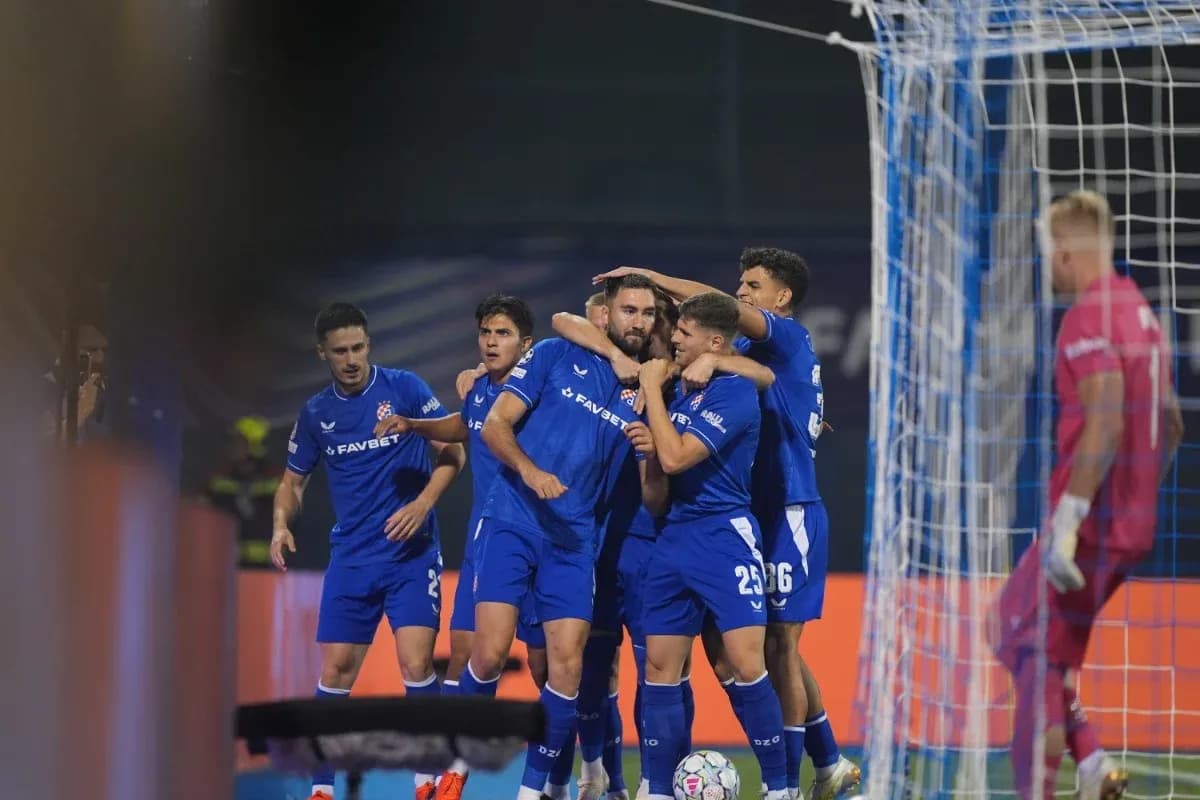
The early 2-0 lead came from exploiting Viking’s high defensive line and imperfect spacing between centre-backs and full-backs. At 6', D. Beljo peeled into the channel to receive from the left and finish a move initiated by M. Perez Vinlof, then at 10' the roles flipped, with Lisica arriving from midfield to score after Beljo’s involvement. Both goals highlighted Dinamo’s capacity to overload the half-spaces around Viking’s No. 6 zone and attack the box with late runs from midfield.
Defensively, however, Dinamo’s rest defence was fragile whenever possession turned over. With both full-backs advanced and Misic sometimes drawn toward the ball, S. Dominguez and S. McKenna were often exposed 2v3 against Viking’s front line. Viking’s 4-3-3, with P. Christiansen central and Z. Tripic and E. Austbo wide, was built to spring quickly into those gaps. Bell and K. Askildsen offered vertical passes into the forwards, while T. Moi drifted into pockets to link play.
The 2-1 goal at 26' for Christiansen came from exactly this pattern: Viking broke Dinamo’s first line, Moi found space to receive and then released Christiansen into the channels behind the advanced full-backs. The equaliser at 39' from Tripic again followed a transition, Moi once more the provider. Viking’s three central midfielders stayed narrow out of possession, ceding width but compressing the central lane, inviting Dinamo into wide areas and trusting their centre-backs to clear crosses.
Second Half Adjustments
After the interval, Dinamo adjusted more than Viking. Kovacevic’s substitutions on the hour and 68' were clearly aimed at refreshing the press and adding creativity between the lines. At 60', L. Kacavenda (IN) came on for M. Zajc (OUT), adding more vertical dribbling and risk between the lines. At 68', R. Mudrazija (IN) replaced L. Stojkovic (OUT), and A. Hoxha (IN) came on for Lisica (OUT), shifting Dinamo toward a more attacking 4-2-3-1/4-4-2 hybrid with extra runners around Beljo. Later, at 84', N. Galesic (IN) replaced Valincic (OUT) and S. Prevljak (IN) came on for Orsic (OUT), further increasing aerial presence and central occupation as Dinamo chased a late winner.
Viking’s substitutions were largely reactive and defensive. At 58', S. Kvia-Egeskog (IN) came on for Moi (OUT), removing Viking’s most creative connector but adding fresh legs for defensive work on the flank. At 72', S. Bjorshol (IN) replaced H. Heggheim (OUT) and H. J. Haugen (IN) came on for K. Haugen (OUT), effectively refreshing both full-back positions to cope with Dinamo’s relentless wing pressure. Finally, at 87', J. Hansen (IN) replaced Tripic (OUT) and R. Postema (IN) came on for Christiansen (OUT), signalling a priority on work rate and defensive coverage over counter-attacking threat in the closing stages.
Goalkeeping and Discipline
In goal, I. Nevistic (Dinamo Zagreb) was rarely called upon, making 1 save across the 90 minutes, underlining how little sustained threat Viking produced outside their two first-half strikes. At the other end, A. Ostbo (Viking) made 2 saves, but the low save count belies the volume of pressure he and his back line faced. Dinamo’s 4 shots on goal from 23 total attempts point to issues with shot selection and execution rather than chance creation.
Discipline was controlled but telling in terms of game state. Viking’s Joe Bell received a yellow card for “Foul” at 65', a reflection of the increasing need to break up Dinamo’s momentum in midfield. Later, Dinamo’s Moris Valincic was booked for “Foul” at 83', a sign that even Dinamo’s full-backs were forced into riskier defensive interventions as they tried to sustain attacks and then recover in transition.
Statistical Overview
Statistically, Dinamo’s dominance is clear: 60% possession, 544 passes at 81% accuracy, and a 23–6 shot count with 17 efforts inside the box. They also led 9–3 in corners and committed only slightly more fouls (12 to Viking’s 10), suggesting their aggression was mostly with the ball rather than without it. Viking’s 40% possession and 371 passes (272 accurate, 73%) underline a game plan based on compactness and selectivity rather than control.
The 2-2 scoreline at half-time remained unchanged to full-time, illustrating a second half in which Dinamo steadily increased territorial control but struggled to turn it into clear, on-target chances, while Viking gradually abandoned offensive ambition to preserve the draw. From a tactical perspective, Dinamo Zagreb showed a coherent positional framework and strong chance volume, but their vulnerability in defensive transition and lack of clinical edge prevented them from translating superiority into a first-leg advantage. Viking, by contrast, maximised their attacking moments in the first half and then executed a disciplined, low-possession defensive block to escape Stadion Maksimir with a valuable away draw.