England's Tactical Comeback Against Congo DR: A 2-1 Victory
England’s 2-1 comeback win over Congo DR at Mercedes-Benz Stadium was defined by structural control against a compact, transitional 4-3-3. Thomas Tuchel’s 4-2-3-1 dominated territory and the ball (60% possession, 517 passes at 91%), but it took second-half adjustments and the introduction of Anthony Gordon and Bukayo Saka to finally convert pressure into goals. Congo DR, under Sebastien Desabre, built their threat around early vertical attacks and a disciplined mid-block, but with only 7 total shots and 0.8 xG, their attacking presence faded as England’s positional play tightened.
Congo DR struck first, exploiting England’s early instability in rest defence. With England’s full-backs high in the 4-2-3-1, Congo DR’s 4-3-3 used Nathanaël Mbuku and Brian Cipenga to attack the spaces outside the centre-backs. The 7th-minute opener from Brian Cipenga, assisted by Chancel Mbemba, came from that pattern: quick progression, early delivery, and England’s back line temporarily disorganised. From there, Congo DR largely dropped into a compact 4-5-1 without the ball, with Yoane Wissa the first presser and the wingers recovering deep.
England’s double pivot of Declan Rice and Elliot Anderson was central to regaining control after the goal. Rice anchored circulation and provided cover against counters, while Anderson pushed slightly higher to connect with Jude Bellingham between the lines. The front four of Noni Madueke, Bellingham, Marcus Rashford and Harry Kane created a box of occupation across the final third, forcing Congo DR’s midfield three to defend large horizontal distances. England’s 13 shots inside the box (out of 16 total) underline how their positional play consistently reached high-value zones, even if the final action was initially lacking.
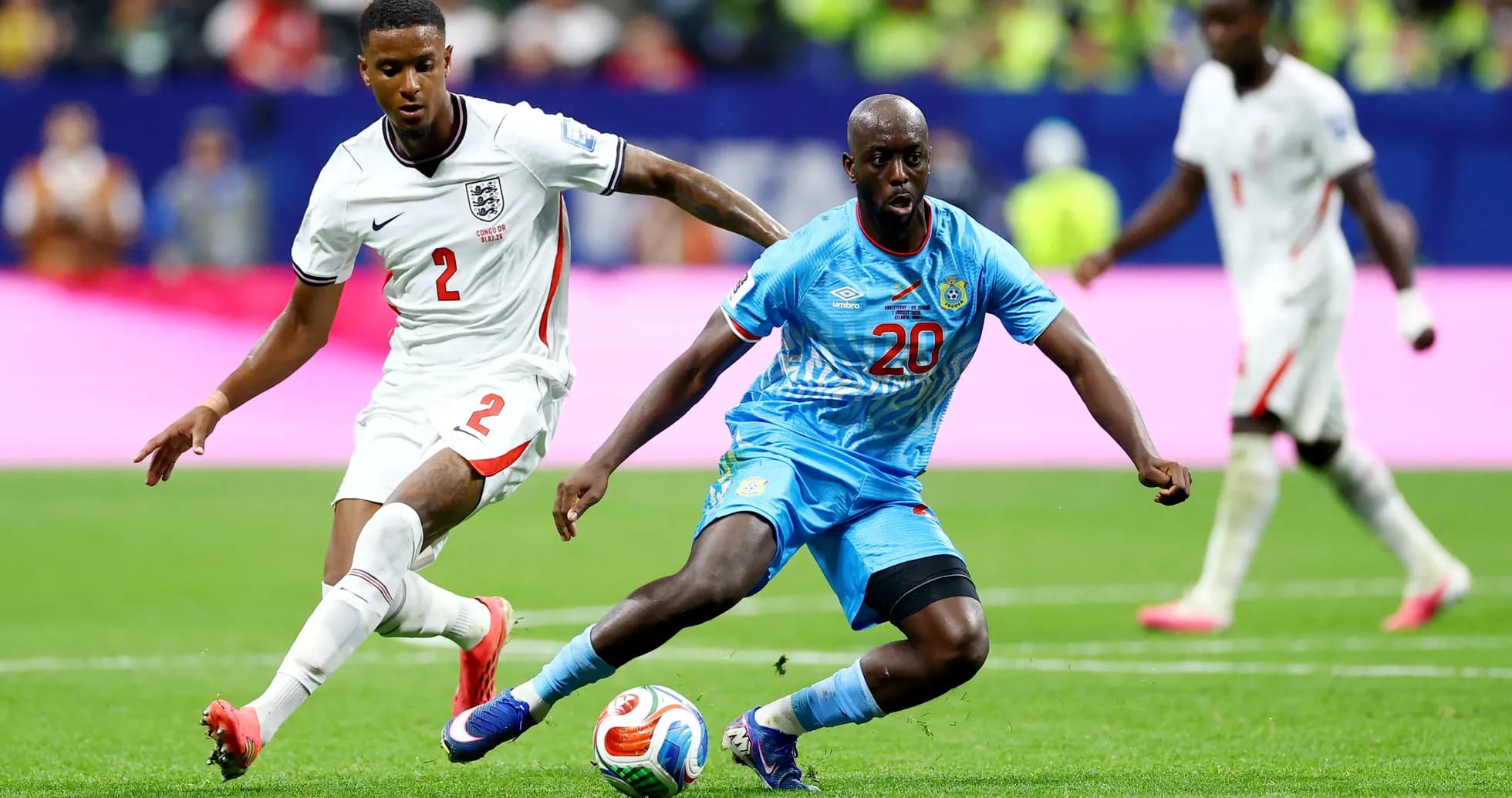
The first half showed England’s structural dominance but also their difficulty in breaking a well-organised block. With 60% possession and 5 corner kicks overall, they pinned Congo DR back but were often too slow in switching play, allowing Aaron Wan-Bissaka and Arthur Masuaku to stay compact with their centre-backs. The cancelled penalty by VAR for Harry Kane at 44' was a key moment: it reflected England’s increasing presence in the box but also Congo DR’s last-ditch defending on the edge of legality.
Tuchel’s decisive shift came on 60'. The substitutions followed the mandated vector: Bukayo Saka (IN) came on for Noni Madueke (OUT), and Anthony Gordon (IN) came on for Marcus Rashford (OUT). Functionally, this changed the profile of England’s wide play. Saka provided more reliable ball retention and underlapping runs from the right, while Gordon attacked the left half-space with aggressive diagonal movements towards Kane. This immediately sharpened England’s combinations around the box and improved the quality of cut-backs and second-phase balls.
Congo DR’s own changes at 64' and 76' — Meschak Elia (IN) for Nathanaël Mbuku (OUT), Théo Bongonda (IN) for Brian Cipenga (OUT), and Edo Kayembe (IN) for Ngal'ayel Mukau (OUT) — aimed to refresh the front line and midfield legs for transition. However, as England increased their tempo and circulation speed, Congo DR were pushed deeper, and their front three became increasingly isolated. Their 365 passes at 82% accuracy show competence in possession, but they had neither volume nor field position to sustain attacks in the second half.
The equaliser at 75' was a direct product of Tuchel’s wing changes and England’s insistence on occupying the box with numbers. Harry Kane’s first goal, assisted by Anthony Gordon, reflected a classic 4-2-3-1 pattern: wide overload, cut-back or cross into a crowded central lane, and Kane attacking the optimal finishing zone. By then, England’s xG had climbed towards their final 2.04, with Congo DR struggling to get out. Djed Spence (OUT) was later replaced by Eberechi Eze (IN) at 71', a move that added another creative presence and further tilted the game towards sustained pressure rather than defensive caution.
Kane’s second goal at 86', again assisted by Anthony Gordon, underlined how Congo DR’s block had finally been stretched beyond its limits. As legs tired and the distances between their lines grew, England were able to find Kane between centre-backs more frequently. Gordon’s double-assist impact was tactical as much as technical: his constant movement inside from the left forced Congo DR’s right-back and right-sided midfielder into difficult decisions, freeing central spaces for Kane and Bellingham.
Defensively, England were rarely threatened after the opening phase. They allowed only 2 shots on target and 7 total shots, with most of Congo DR’s efforts coming from outside the box (5 shots outside vs 2 inside). Jordan Pickford (England) made 1 save, a reflection of how well England controlled the central corridor once their rest defence settled. Ezri Konsa and Marc Guéhi held a high line, supported by Rice’s screening, which limited Congo DR’s ability to find Wissa’s runs in behind.
For Congo DR, Lionel Mpasi Nzau (Congo DR) was central to keeping them in the contest. He made 5 saves against 7 shots on target and faced sustained pressure as England’s attacks became more frequent and better structured. The goals prevented metric of -0.04 for both sides suggests that neither goalkeeper dramatically overperformed or underperformed relative to shot quality; the difference lay in volume and territorial dominance, which favoured England heavily.
Discipline also played a subtle tactical role. Jude Bellingham’s yellow card for “Foul” at 19' did not materially change England’s pressing, but it may have slightly tempered his aggression in duels. Noah Sadiki’s yellow card for “Foul” at 27' came as Congo DR’s midfield tried to disrupt England’s rhythm, underlining how much defending they were forced to do without the ball. With fouls at 10 for England and 12 for Congo DR, the game was competitive but not chaotic, allowing England’s structured possession to gradually impose itself.
Statistically, the match followed the underlying numbers. England’s 2.04 xG aligned closely with their 2 goals, and Congo DR’s 0.8 xG was consistent with a single, early strike followed by limited threat. England’s passing superiority — 517 passes, 468 accurate (91%) — reflects a high technical level and control, while Congo DR’s 365 passes, 299 accurate (82%) show a more direct, lower-volume approach. With 13 of England’s 16 shots coming inside the box and a 60–40 possession split, the tactical verdict is clear: Congo DR’s early punch and compact 4-3-3 posed problems, but Tuchel’s in-game adjustments, enhanced wing profiles, and sustained positional play ultimately turned dominance into a deserved Round of 32 comeback victory.