Luis Diaz's Goal Drought: A Break for Recovery
The gingerbread heart in Harry Kane’s hand said it all. “I got my 100th goal,” he smiled, drifting out of the Allianz Arena just after midnight, the last Bayern player to leave after a 7-0 demolition of Union Berlin. Inside the dressing room there had been speeches, jokes, a bit of ceremony. Michael Olise had his first hat-trick for the club. Ismael Saibari had his first Bayern goal. Serge Gnabry was back from injury. Records, milestones, comebacks – the room was full of them.
Olise’s speech? “The shortest,” Kane grinned.
One man slipped away without a word.
Luis Diaz walked through the same mixed zone with none of the trimmings, none of the noise. No complaints either, no visible sulk. Just a striker stuck in a run he cannot shake, the one subdued figure in a team currently feasting on goals.
The drought behind the fireworks
You have to go back to the Bundesliga opener to find Diaz’s last goal for Bayern. He struck for 5-1 against VfB Stuttgart, a routine finish in a routine thrashing, and it looked like the first step in another big year. Since then? Nothing. Five games, no goals, no assists, and a highlight reel full of almosts and nearlys.
Against Schalke, Osnabrück in the cup and Bodø/Glimt in the Champions League, he saw chance after chance go begging. The low point came in Elversberg. Olise slipped him through beautifully in the box, the sort of pass that usually ends with the net bulging. Diaz, though, tried to decorate it. One trick, then another, and in the end only a tame backheel that infuriated Josip Stanisic.
Union was supposed to be the night it all clicked again. Bayern were rampant, the front line flowing. Diaz finally finished off what had been their best move of the match – sharp run, clean strike, the kind of action that normally restores a forward’s pulse. The flag went up. Offside. Again, the numbers stayed at zero.
He had promised, on Sky/RTL, that the next one would go in. “I think that goal will come in the next game,” he said before Union. “You also have to stay calm mentally so it does not weigh on you. The important thing is to keep working on it, to improve. I know that it is only the chance conversion. It is only the finish that is missing – and then it will be fine.”
The finish is still missing.
A forced pause for a worn-out star
Now Diaz has to wait. International football takes over until 10 October, when Bayern travel to FC Augsburg. Colombia will be playing without their star winger. National coach Nestor Lorenzo, after speaking with Diaz, chose not to call him up. Bayern and player agreed: he needs a break.
No wonder. Last season he played 51 competitive games for Bayern alone, racking up 26 goals and 23 assists. On top of that came 16 more matches for Colombia – seven goals, three assists – and a World Cup run to the last 16. Even there, the same pattern appeared: he got into positions, but the finishing radar flickered.
Back in Munich, the problem has grown. In the first few weeks of this season he has slipped from wasteful to almost invisible in front of goal. Against Union he barely reached the key areas before being substituted for Saibari in the 63rd minute.
The data underlines the frustration. According to Sofascore, Diaz has already missed six “big chances” in the Bundesliga. After four league matchdays, his expected-goals total stood at 3.1. On paper, that should mean three or four goals. In reality, he has one – from opening day.
The contrast with his team-mates is stark. Kane has three goals from an xG of 2.17. Olise, in electric early-season form, has four Bundesliga goals from an xG of 2.65 and already eight goals and three assists across all competitions. Saibari, the man who replaced Diaz against Union, has one goal and three assists from just 178 Bundesliga minutes.
“Some would be glad if they had a dip like his”
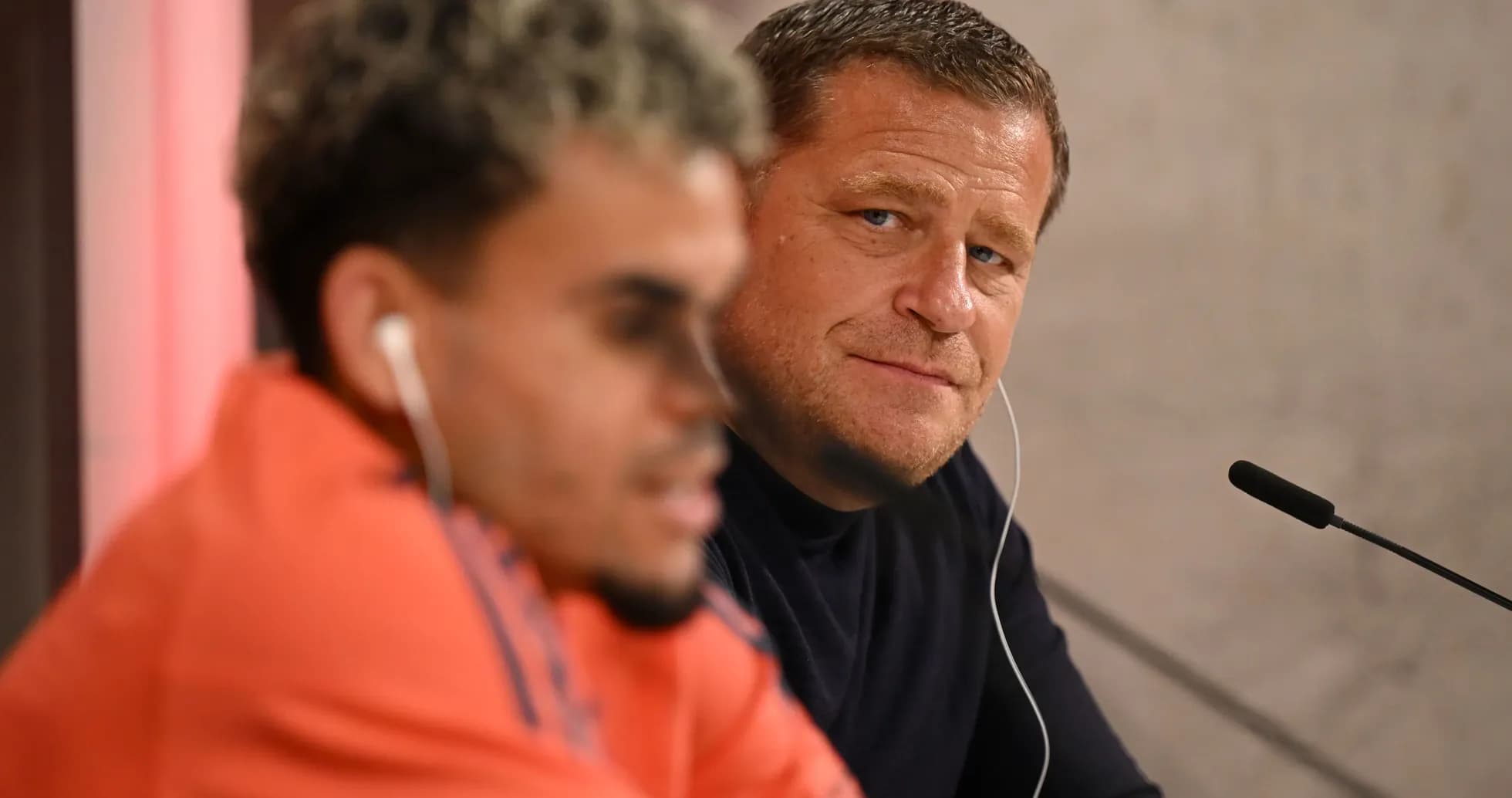
Inside the club, there is no sense of panic. Quite the opposite. “Some would be glad if they had a dip like his,” Bayern’s board member for sport, Max Eberl, said on Friday, before laying out the reasoning behind Diaz’s time off.
“In South America, the international matches are not absolutely necessary now and it is simply good for the player. He has just had a lot of games. So in that respect it is nice.” The plan is clear: a short holiday, then a controlled restart. “He will have his programme. There is no need to worry that he will not come back fit,” Eberl insisted.
Curiously, Diaz himself had hinted that something like this might be needed. In that same Sky/RTL interview, he admitted he would have welcomed a genuine back-up in his position.
“Of course I always want to play. But if someone is there who can help in my position: welcome. That helps a lot when things are not going well. Then the team-mate is there to help you – and that way you alternate. That is very important. I would have liked it. But fine, it did not happen. We are still good as we are.”
Bayern had actually planned to go into the season with exactly that kind of cover. Then, late in the window, they loaned Arijon Ibrahimovic to FC Augsburg. The decision surprised the 20-year-old – and left Diaz as the only natural starter on the left.
Asked on Friday whether the club might rethink that stance in the winter, Eberl responded with a question of his own: “Where did Isi score his goal from today?” The answer was obvious. Saibari’s first Bundesliga strike came from the left side of the penalty area.
The Moroccan is not a classic winger – he lacks the raw pace – but his intelligence, vision and technique allow him to float into any attacking role. Gnabry can also step across to the left. On paper, there are options.
On the pitch, though, Diaz still feels like the first choice. Vincent Kompany is rotating heavily to keep his squad fresh, and the coming weeks bring a run of midweek fixtures that will demand exactly that. Diaz’s place is not under immediate threat. His form is.
A familiar reset button
This is not the first time Bayern have pressed pause on Diaz’s season. In December 2025, suspended in the Champions League after a red card and banned in the Bundesliga due to a fifth yellow, he hit a natural break. Kompany used it.
The coach sent him away “for a few days,” explaining that it was “simply sensible now that he is away for a few days and then comes back mentally and physically at one hundred per cent.”
The response back then was emphatic. Diaz returned sharper, hungrier, and produced an excellent second half of the campaign.
Now the reset comes much earlier, without suspensions, in the middle of a Bayern goal rush. The team is flying. The dressing room is full of speeches and gingerbread and landmark nights.
The question is simple: when Diaz walks back through that door after his break, will the next speech be his?