Mexico Dominates South Africa in World Cup Opener
Under the thin Mexico City air and the towering stands of Estadio Azteca, Mexico opened their 2026 World Cup with the kind of controlled, purposeful performance that announces a campaign, not just a match. The 2-0 victory over South Africa in Group A was more than a routine home win; it was a statement about structure, roles and a squad built to grow into the tournament.
I. The Big Picture – Structure, Scoreline, Stakes
Following this result, Mexico sit 1st in Group A with 3 points and a goal difference of 2, having scored 2 and conceded 0 in total this campaign. Their overall record is clean: 1 win from 1, no draws, no defeats, and a total average of 2.0 goals for and 0.0 against. South Africa, by contrast, occupy 4th place with 0 points and a goal difference of -2, having failed to score and conceding 2 in their only match so far.
The tactical contrast was stark. Javier Aguirre’s Mexico lined up in a 4-1-4-1 that behaved like a modern, fluid 4-3-3 in possession, with Érik Lira as the single pivot behind a line of four creative and industrious midfielders. Hugo Broos responded with a conservative 5-3-2, hoping to absorb pressure and break through Lyle Foster and Iqraam Rayners. The plan held in shape, but not in control.
II. Tactical Voids and Discipline – Where the Game Tilted
There were no listed absentees for either side, so this was close to full-strength against full-strength. The difference came in how each coach used his resources and how their players managed the emotional spikes of a World Cup opener.
Mexico’s disciplinary profile heading into this game already hinted at volatility: their season card data shows a single yellow card in the 16-30 minute window (100.00% of their yellows so far) and a red card in the 91-105 window (100.00% of their reds). That late-game dismissal in the broader campaign context underlines a potential risk when defending leads. Yet against South Africa, the hosts kept their composure. Brian Gutiérrez, who carries 1 yellow in total this tournament, walked the line intelligently in midfield, pressing aggressively without tipping into recklessness.
South Africa’s issues were more severe. Their yellow-card distribution is split: 50.00% of their yellows in 16-30 minutes, 50.00% in 61-75, pointing to emotional spikes early and around the hour mark. More damning is the red-card profile: 1 red in the 46-60 range and another in 76-90, each accounting for 50.00% of their total reds. Themba Zwane and Sphephelo Sithole both feature as red-card offenders in the competition, and that indiscipline is not an abstract number; it is a structural problem. When your midfield enforcer (Sithole) and creative veteran (Zwane) both lose control, your 5-3-2 collapses from the inside.
III. Key Matchups – Hunter vs Shield, Engine Room vs Enforcer
Hunter vs Shield: Raúl Jiménez vs South Africa’s Back Five
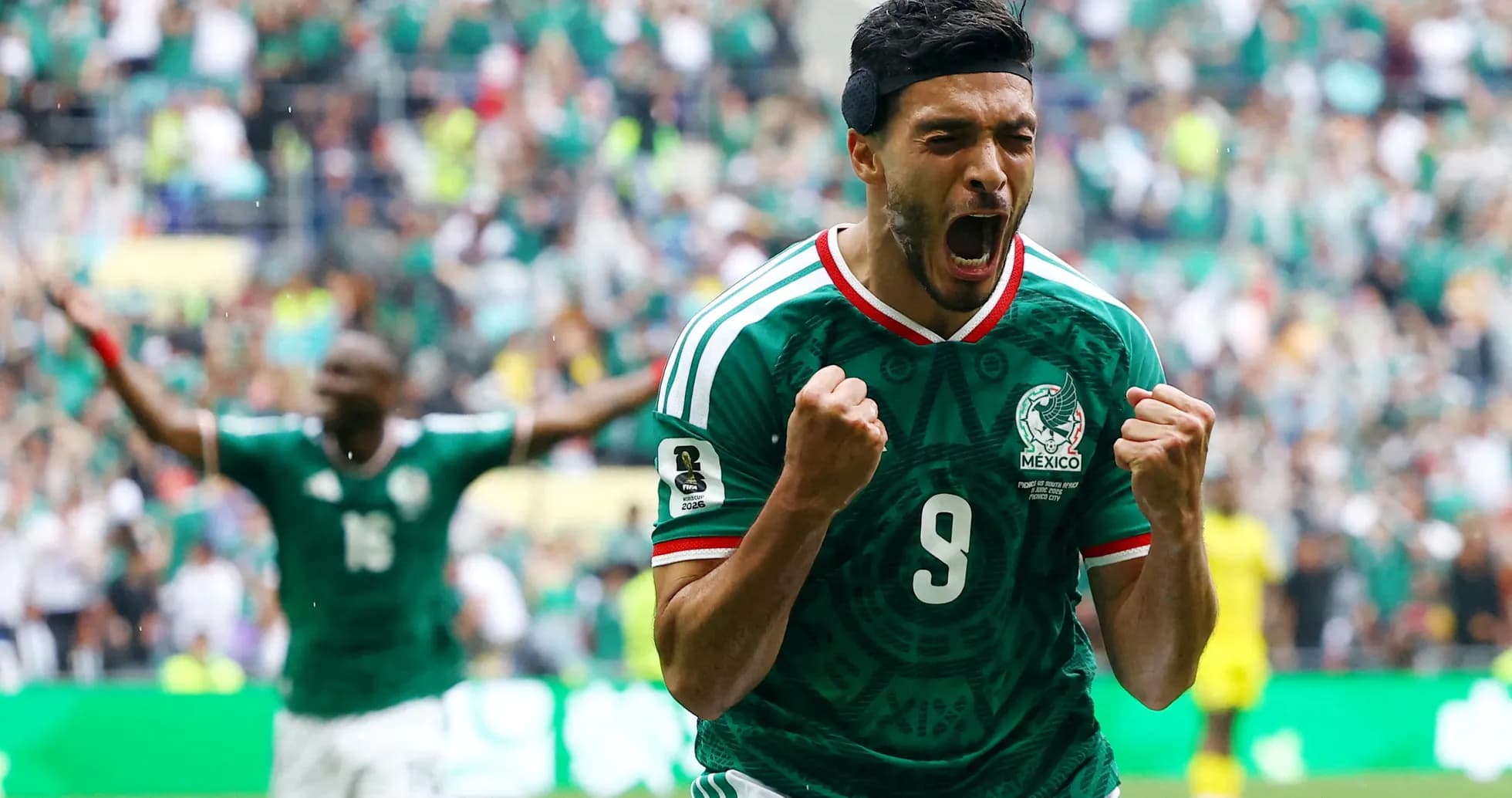
As a top scorer for Mexico so far, Raúl Jiménez embodies the “Hunter” role. In this match he produced 1 goal from 3 shots (2 on target), winning 6 of 10 duels and linking play with 19 passes at 78% accuracy. He is not just a finisher; his 2 key passes underline his role as a reference point around which the second line rotates.
The “Shield” was supposed to be the trio at the heart of South Africa’s five-man defence, led by Nkosinathi Sibisi. Sibisi completed 50 passes at 82% accuracy and added 1 interception, but he also took a yellow card, one of South Africa’s 2 yellows in total this campaign. The defensive unit is conceding an overall average of 2.0 goals per away match, and that is exactly what Mexico extracted here.
What made Jiménez so difficult to contain was the support cast. Julián Quiñones, operating nominally as a midfielder but playing with a forward’s aggression, scored 1 goal from 4 shots, with 2 on target, and won 7 of 10 duels. His 6 dribble attempts with 5 successful turned South Africa’s defensive line, dragging Sibisi and his partners into uncomfortable lateral spaces. When the “Shield” is forced to defend wide and backwards, Jiménez thrives in the resulting pockets.
Engine Room: Érik Lira vs Teboho Mokoena
In the heart of midfield, the duel between Lira and Teboho Mokoena defined the game’s rhythm. Lira, already among the top assist providers, delivered 1 assist and completed 45 passes at 93% accuracy, adding 1 key pass, 1 tackle and 1 interception. He won all 4 of his duels, a perfect platform for Mexico’s structure.
Mokoena, South Africa’s main organiser, was tidy but reactive. He completed 42 passes at 92% accuracy, with 1 key pass and 2 interceptions, winning 4 of 7 duels. Those numbers are solid in isolation, but the context matters: he was pinned deeper, often screening rather than launching. With Sithole struggling (8 duels, only 1 won, 3 fouls committed and a red card in the broader tournament data), Mokoena was forced to firefight rather than dictate.
On the flanks, Roberto Alvarado turned the match into a two-way clinic. Across 90 minutes he produced 35 passes at 91% accuracy, 2 key passes, 2 successful dribbles from 2 attempts and 4 tackles in the top-scorer dataset, rising to 5 tackles in the top-assists record. His 8 of 13 duels won (or 9 of 14 in the assists dataset) show a wide midfielder dominating both with and without the ball.
IV. Statistical Prognosis – What This Win Says About Mexico
Following this result, Mexico’s overall numbers are pristine: 2 goals for, 0 against, 1 clean sheet in total and no failures to score. Their home goals-for average stands at 2.0, with a home goals-against average of 0.0. South Africa’s total picture is the mirror opposite: 0 goals for, 2 against, no clean sheets and 1 match in which they failed to score, with an away goals-against average of 2.0.
Without explicit xG data, we infer from shot volumes, pass accuracy and territorial control that Mexico’s expected goals would have comfortably outstripped South Africa’s. Jiménez and Quiñones alone combined for 7 shots, while the visitors offered little sustained threat, relying on late cameos from Evidence Makgopa and Oswin Appollis, who together produced 11 passes at modest accuracy and a handful of duels won.
The prognosis is clear. Mexico’s 4-1-4-1 is not just functional; it is layered. Lira anchors, Gutiérrez connects, Alvarado and Quiñones break lines, and Jiménez finishes and creates. The bench—Luis Chávez, Gilberto Mora, Alexis Vega, Edson Álvarez and Armando González—added secure passing (all at or near 100% accuracy for several) and fresh legs without disrupting structure.
South Africa, meanwhile, must solve two intertwined problems: a defensive block that concedes an away average of 2.0 goals, and a disciplinary record where 2 reds in key midfield roles fracture any chance of sustained resistance. Unless Mokoena is given more progressive support and the wing-backs like Khuliso Mudau and Aubrey Modiba can push higher without exposing the back line, their 5-3-2 risks becoming a static 5-4-0 under pressure.
In Mexico City, Mexico looked every inch a side “advancing to the Round of 32” in both status and style. If they can keep the late-game red-card tendency from reappearing and maintain this balance between control and incision, the Azteca opener may be remembered as the night their World Cup campaign truly took shape.