Morocco's Tactical Mastery in 3-0 Victory Over Canada
Canada’s 4-4-2 against Morocco’s 4-2-3-1 at NRG Stadium produced a match where structure and control favoured Morocco, even if the raw shot volume leaned slightly toward Canada. Morocco’s 3-0 win in this World Cup 1/8 final was built on superior spacing, cleaner progression through midfield, and ruthless exploitation of Canadian defensive imbalances after the break.
Canada’s initial 4-4-2 block, with Jonathan David and Tani Oluwaseyi leading the line, aimed to compress the centre and funnel Morocco wide. The double pivot of Stephen Eustaquio and Niko Sigur sat narrow, while Tajon Buchanan and Ali Ahmed held relatively conservative starting positions on the flanks. This produced some territorial pressure and 11 total shots, but the quality of those efforts was modest: 0.86 xG from 7 shots inside the box and 4 from distance. The front two rarely received possession between lines; instead, Canada were often forced to work via early balls into the channels or crosses after recycling wide, which Morocco’s centre-backs and full-backs defended with composure.
Morocco’s 4-2-3-1, on the other hand, was built to dominate the ball and control tempo. With 55% possession and 472 total passes (389 accurate, 82%), Mohamed Ouahbi’s side consistently found their double pivot—Ayyoub Bouaddi and Neil El Aynaoui—as the first release under pressure. From there, they used the technical profiles of Azzedine Ounahi, Bilal El Khannouss and Brahim Díaz to overload half-spaces. Even with only 5 total shots and an xG of 0.78, Morocco’s attacks were well-structured and deliberately targeted the seams between Canada’s full-backs and centre-backs.
First Half
The first half was tactically cagey. Canada generated more set-piece pressure—11 corner kicks to Morocco’s 1—reflecting their emphasis on crossing and second balls. Yet those corners rarely turned into clear chances, as Morocco defended the box with tight zonal marking and strong first contacts from Issa Diop and Redouane Halhal. Canada’s 24 fouls and 4 yellow cards, including cautions for Richie Laryea, Jonathan David, Luc De Fougerolles and substitute Cyle Larin, underlined how often they arrived late into duels after being pulled out of shape by Morocco’s circulation.
Key to the turning of the match was Morocco’s increased verticality after half-time. The first goal on 50 minutes encapsulated their tactical idea: Achraf Hakimi, operating high and aggressively from right-back, provided the assist for Ounahi’s opener. Hakimi’s advanced positioning was a deliberate ploy to pin Canada’s left side, drawing out defenders and opening central pockets for Ounahi to arrive from deeper midfield. Once Morocco went ahead, their structure became even more secure: the double pivot sat slightly deeper, the back four compacted, and transitions were managed with intelligent rest defence.
Canada’s response was to inject more direct attacking threat from the bench. Cyle Larin (IN) came on for Tani Oluwaseyi (OUT) at 63', then later Jacob Shaffelburg (IN) for Richie Laryea (OUT) and Promise David (IN) for Ali Ahmed (OUT) at 78'. These moves effectively shifted Canada towards a more aggressive, winger-driven shape, with extra pace and dribbling on the flanks. However, the structural issues remained: build-up was still rushed, and central connections into David and Larin were limited. Despite 357 total passes and 76% accuracy, too many of Canada’s possessions ended in hopeful deliveries rather than carefully constructed final-third combinations.
Second Half
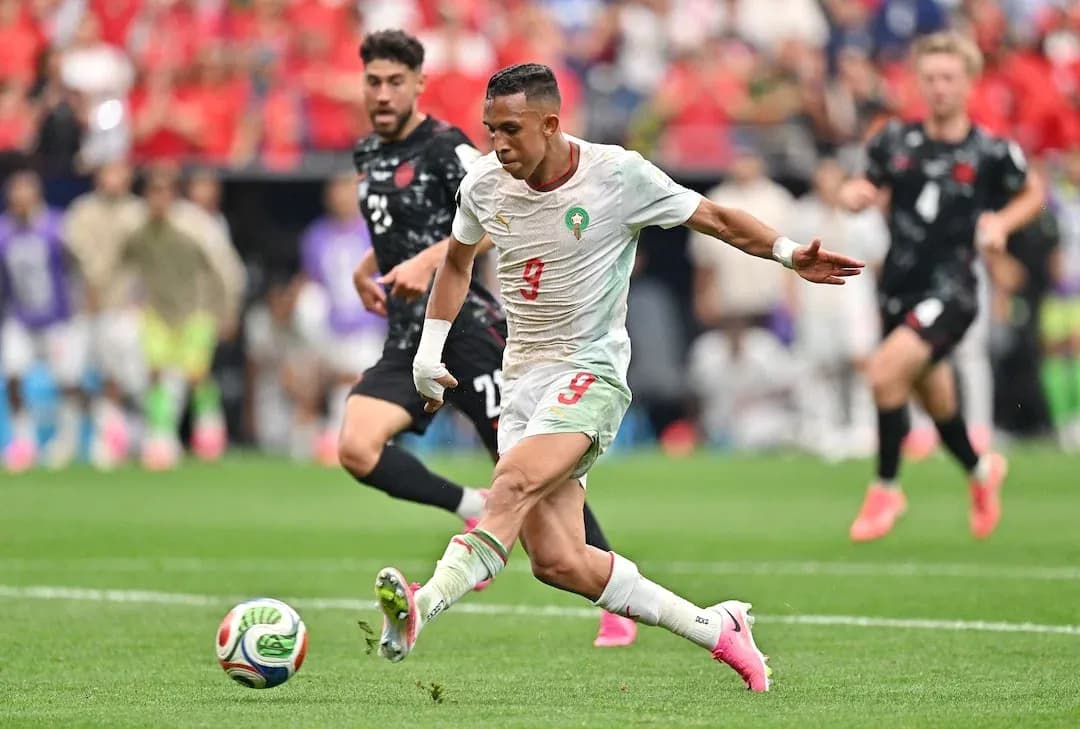
Morocco’s second and third goals highlighted their superiority in exploiting space as Canada opened up. Ounahi’s second strike on 82', assisted by Brahim Díaz, came from another well-timed central run, punishing Canada’s stretched midfield line. By this stage, Díaz was finding more freedom between the lines, drifting into pockets where Canada’s double pivot could not track him tightly without leaving gaps behind. The third goal at 90+8', finished by Soufiane Rahimi from another Díaz assist, was the product of transition control: with Canada committing numbers forward, Morocco’s substitutes attacked the exposed channels with precision and composure.
Defensively, Morocco were notably disciplined in their box management. They conceded 11 shots but allowed Canada very little truly clean looks, reflected in Canada’s relatively low xG despite the volume. Morocco blocked no shots (0 blocked), which actually underlines how effectively they forced Canada into less threatening angles and rushed finishes rather than last-ditch interventions. Their foul count of 14 and 4 yellow cards (Halhal, Hakimi, El Khannouss, Ounahi) was the product of selective, often tactical interventions to break Canadian rhythm, rather than sustained defensive panic.
In goal, Maxime Crépeau (Canada) had a difficult statistical night: 1 save against 4 shots on target, with 0.66 goals prevented. The numbers suggest that Morocco’s finishing, particularly from Ounahi and Rahimi, was clinical and that the chances they did create were of a quality that left little margin for the goalkeeper. At the other end, Yassine Bounou (Morocco) made 3 saves, matching Canada’s 3 shots on target and posting 0.66 goals prevented. His interventions, while not spectacular, were technically clean and reinforced Morocco’s sense of control whenever Canada did manage to break through.
The passing statistics crystallise the tactical story. Morocco’s 472 passes at 82% accuracy allowed them to dictate where the game was played, consistently progressing through midfield and into advanced zones with structure. Canada, with 357 passes at 76%, were more vertical and rushed, often bypassing midfield under pressure and relying on individual duels and set pieces. Despite generating more corners and total shots, Canada’s attacks lacked the layered, repeatable patterns that Morocco demonstrated.
Ultimately, this 3-0 result was less about raw chance creation and more about tactical maturity. Morocco’s 4-2-3-1 provided stable rest defence, clear roles in possession, and multiple routes to access their creative players, while Canada’s 4-4-2 never fully solved the problem of connecting their midfield to their forwards. As the match stretched, Morocco’s structure and bench usage amplified their advantage, turning a relatively balanced xG battle into a comfortable, tactically coherent knockout win.