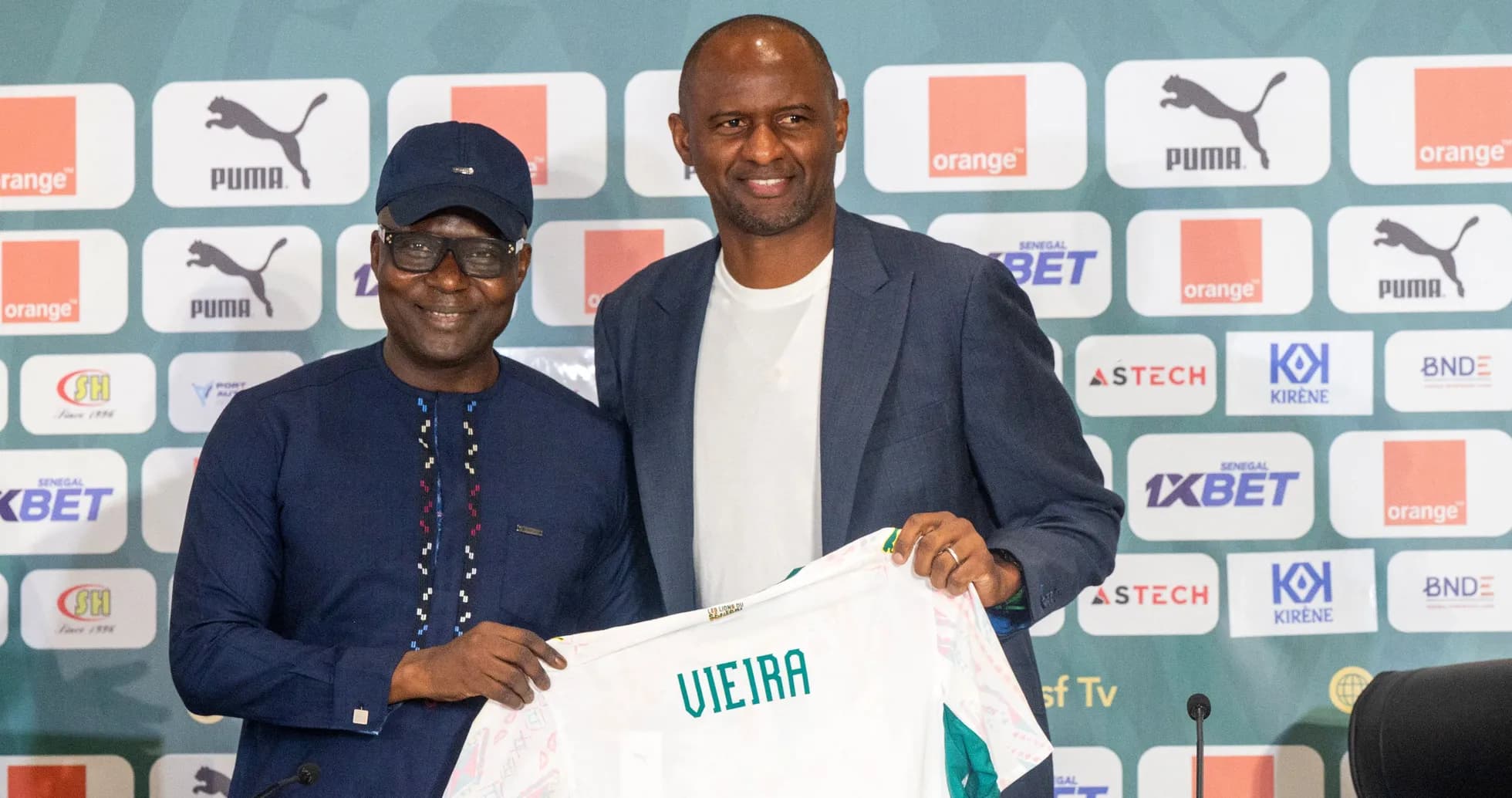
Patrick Vieira's Homecoming: Senegal's New Coach Unveils First Squad
Patrick Vieira walked back into Dakar not as a guest, not as a legend passing through, but as the man now charged with steering Senegal’s future. The new head coach of the Lions of Teranga was officially unveiled in the capital, kicking off a four-year project aimed at keeping Senegal among the game’s elite and pushing towards 2030.
For the Senegalese Football Federation, this was not a luxury hire. It was, in the words of president Abdoulaye Fall, “an absolute necessity” for the national team.
For Vieira, it was something deeper.
Born in Dakar and raised in France from the age of eight, the 50-year-old framed the job not as a career step but as a return to his roots. He spoke of family, of history, of streets and stories that shaped him long before the World Cup medals and Premier League titles.
“This is a homecoming,” he said. Not a new chapter. A return.
A big call: Mane left out of first squad
Then came his first major decision. And it was seismic.
Vieira’s opening 29-man squad landed with one headline: no Sadio Mane.
The Al-Nassr forward, the symbol of Senegal’s golden era, will not feature in this month’s camp. In a country where Mane’s name carries the weight of a generation, the omission cut through the noise of everything else.
Vieira moved quickly to cool any sense of controversy. He explained that Mane is dealing with a minor physical issue and that the decision followed a direct phone call between the pair. No drama, no rupture, just a precaution.
“Regarding Sadio’s absence, whom I spoke to on the phone, he has a physical issue and that is why he will not be with us for this camp,” Vieira said. “But he surely will be for the next one.”
Even so, the new coach’s first squad list arrives with a clear message: no one is bigger than the plan, and the plan has already started.
Not a revolution, but a reset
Vieira did not come to tear the house down.
“The important thing is not to start from scratch,” he stressed. “I’m not going to tear everything down or throw everything out the window, but to preserve what has been achieved and begin a four-year cycle.”
That idea runs through his 29-player group. The core remains, but the edges are sharper, younger, more experimental.
With Edouard Mendy stepping away from international duty, the goalkeeping department has been widened. Four keepers are in, including first-time call-ups for Monza’s Ngagne Demba Thiam and AS Saint-Etienne’s Mamour Ndiaye. It’s a clear attempt to fast-track the next generation into a position that has been a pillar of Senegal’s recent success.
Across the pitch, seven debutants have been handed a chance to stake their claim. Monaco centre-back Sadibou Sane joins the defensive pool, Auxerre full-back Lamine Sy adds energy on the flanks, and FC Metz forward Pape Moussa Fall offers a fresh option in attack.
This is not a clean break with the past. It is a controlled reshaping, a coach respecting what came before while quietly moving pieces into place for what comes next.
Trial by fire: AFCON qualifiers on the horizon
There is no gentle introduction waiting for Vieira.
Senegal’s new era begins under real pressure, with a demanding international window that will test his ideas immediately — and without Mane on the pitch.
The Lions of Teranga open their 2027 AFCON qualification campaign away to Mozambique in Maputo on 25 September. Four days later, they head to face Ethiopia on 29 September, another tricky trip in a compressed schedule. The window closes with a friendly against Comoros in Marseille on 4 October, a match that may feel like a breather but will be scrutinised just as closely.
Three games. Three different contexts. One new coach trying to imprint his tactical principles on a squad still learning his voice.
Vieira has spoken about emotion, about belonging, about responsibility to a nation that watched him grow from afar. Now comes the hard part: turning that homecoming into results, performances, and a team that can carry Senegal to the next decade.
The romance of the return is over. The work starts with Mozambique.