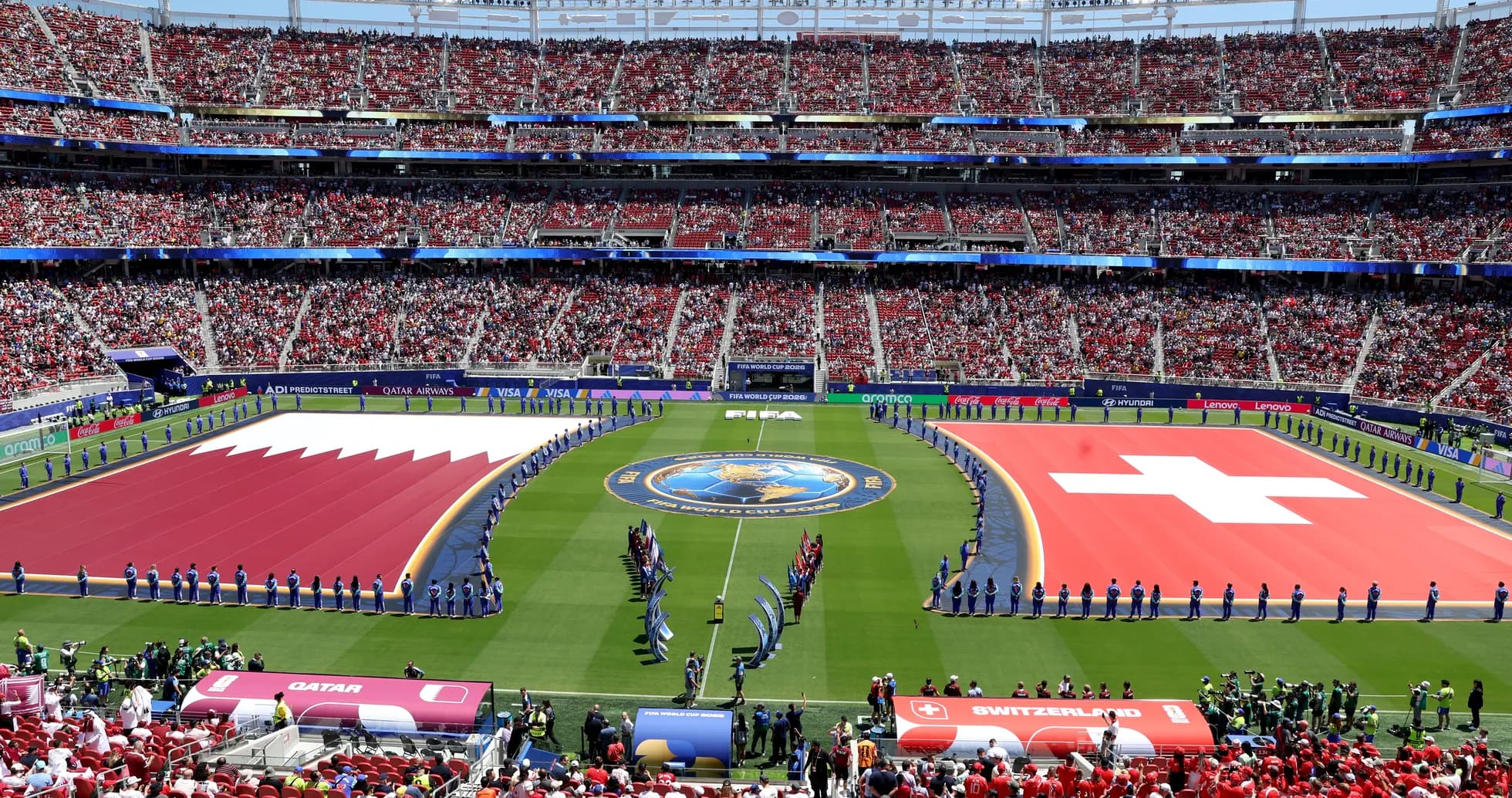
Qatar Holds Switzerland to 1-1 Draw in Tactical Battle
Qatar’s 1-1 draw with Switzerland at Levi's Stadium was a classic case of defensive resilience and opportunistic attacking against a structurally dominant opponent. Switzerland, in a 4-3-3 under Murat Yakin, controlled the rhythm and territory almost throughout, while Julen Lopetegui’s Qatar, also in a 4-3-3, accepted a low-possession game and tried to compress the central lane and counter from wide starting positions.
From the outset, Switzerland’s 68% possession and 575 passes (522 accurate, 91%) reflected a clear plan: build patiently through Manuel Akanji and Nico Elvedi, use Granit Xhaka and Remo Freuler as dual conductors, and pin Qatar’s full-backs with Rubén Vargas and Dan Ndoye. Michel Aebischer’s positioning as the right-sided midfielder, often stepping into the half-space, created a 2-3-5 in settled attack, with Ricardo Rodríguez advancing on the left to provide width and allow Vargas to drift inside.
Qatar’s 4-3-3 was far more conservative in practice. The back four of Homam Al-Amin, Boualem Khoukhi, Pedro Miguel and Ayoub Al Oui stayed narrow, with the midfield trio of Jassem Gaber Abdulsallam, Assim Madibo and Issa Laye collapsing close to their own box. Their 32% possession and 275 passes (196 accurate, 71%) underline a reactive approach: defend deep, deny central combinations, and then release Akram Afif and Yusuf Abdurisag quickly into space.
The early pattern was Switzerland circulating the ball side to side, looking for gaps between Qatar’s full-back and centre-back. The 16' sequence encapsulated the dynamic: sustained Swiss pressure forced Qatar into emergency defending, culminating in a penalty incident confirmed by VAR involving Remo Freuler. Breel Embolo converted at 17', rewarding Switzerland’s territorial control and their aggressive occupation of the box. At that stage, with Switzerland already generating shots inside the box (they would finish with 18), Qatar’s block was under continuous strain.
Defensively, Qatar’s plan revolved around vertical compactness and protecting the central lane. The front three often dropped into a 4-5-1 without the ball, with Afif and Edmilson Junior tracking full-backs and wide midfielders. Fouls were used as a pressure-release mechanism: 12 fouls, and an early yellow card for Mahmud Abunad for Time wasting at 16' signalled a desire to slow the tempo and disrupt Swiss momentum. The second Qatar booking, for Jassem Gaber Abdulsallam (Foul) at 23', came from another attempt to break up a Swiss attack in midfield.
Switzerland, by contrast, were more controlled in their defensive transitions. Their 11 fouls and a single yellow card for Denis Zakaria (Foul) at 42' reflected a high, but generally clean, press. Zakaria’s role as a nominal right-back but de facto hybrid defender-midfielder allowed Switzerland to counterpress aggressively when possession was lost on their right side, with Xhaka anchoring and Freuler shuttling to close gaps.
The shot profile underlines the tactical imbalance. Switzerland produced 26 total shots to Qatar’s 7, with 7 on goal versus Qatar’s 4. The 9 blocked Swiss efforts show how often Qatar defended in numbers in and around their box, turning their own penalty area into a low block with multiple bodies in the shooting lanes. Switzerland’s xG of 3.24 versus Qatar’s 0.76 is a stark indicator: Yakin’s side consistently created high-quality chances, particularly through cut-backs and crosses into congested central zones, but their finishing and decision-making in the final third were wasteful.
In goal, Mahmud Abunad (Qatar) was central to the result. He made 5 saves and, combined with a goals prevented figure of 0.43, was a key factor in bending, but not breaking, under Swiss pressure. His shot-stopping, especially against efforts from inside the box, compensated for Qatar’s inability to limit volume: Switzerland’s 18 shots inside the box would normally yield more than one goal. At the other end, Gregor Kobel (Switzerland) had a relatively quiet night in terms of volume, with 3 saves, but was generally well-protected by a back line that allowed only 7 total shots and 5 inside the box.
Lopetegui’s in-game adjustments were decisive in changing the game’s momentum late on. The triple substitution at 60' was a structural refresh: Ahmed Alaaeldin (IN) came on for Yusuf Abdurisag (OUT), Karim Boudiaf (IN) came on for Jassem Gaber Abdulsallam (OUT), and Ahmed Fathi (IN) came on for Ayoub Al Oui (OUT). These changes injected fresh legs in midfield and on the flank, slightly raising Qatar’s defensive line and giving them more capacity to hold the ball when they did recover it. Later, at 79', Mohamed Naceur Almanai (IN) came on for Assim Madibo (OUT), adding further energy and vertical running from midfield, and at 88' Hassan Al Haydos (IN) came on for Edmilson Junior (OUT), providing experience and composure in the final third.
Yakin responded with his own rotation, but more in the context of managing a lead than chasing a game. At 65', Johan Manzambi (IN) came on for Dan Ndoye (OUT) and Fabian Rieder (IN) came on for Michel Aebischer (OUT), maintaining the 4-3-3 shape but altering the profiles in the wide and midfield roles. Later, at 79', Zeki Amdouni (IN) came on for Rubén Vargas (OUT), and at 89' Miro Muheim (IN) came on for Ricardo Rodríguez (OUT) while Ardon Jashari (IN) came on for Remo Freuler (OUT). These changes subtly shifted Switzerland towards a more conservative stance, with fresher legs but slightly less control and cohesion in midfield.
That slight drop in Swiss control, combined with Qatar’s increased risk-taking, set the stage for the late equaliser. Qatar had produced little in terms of sustained attacking patterns, but their willingness to push Homam Al-Amin higher from left-back in the closing stages finally created a breakthrough. In the 90+4' minute, Boualem Khoukhi finished from a situation created by Homam Al-Amin’s assist, a rare instance where Qatar committed numbers forward and attacked the Swiss box with conviction. It was a low-volume, high-impact moment that aligned with their modest xG but punished Switzerland for not converting their earlier dominance into a decisive second or third goal.
The disciplinary balance—Qatar 2 yellow cards, Switzerland 1—also mirrors the tactical story. Qatar’s bookings, for Time wasting and Foul, were directly linked to game-state management and emergency defending. Switzerland’s single yellow for Zakaria came from their proactive, front-foot defending but did not materially change their approach.
Statistically, the verdict is clear: Switzerland’s superior xG (3.24 to 0.76), shot volume, and passing accuracy point to a performance that, on most days, should yield victory. Their 10 corner kicks to Qatar’s 3 further highlight their territorial dominance. Yet Qatar’s defensive organisation, the work of their back four and screening midfield, and the interventions of Mahmud Abunad (Qatar) allowed them to survive long periods without the ball. In tactical terms, Qatar executed a low-block, counter-punch plan well enough to stay in the game, and their late structural tweaks gave them just enough attacking presence to snatch a point that, on underlying numbers, they scarcely deserved but strategically engineered.