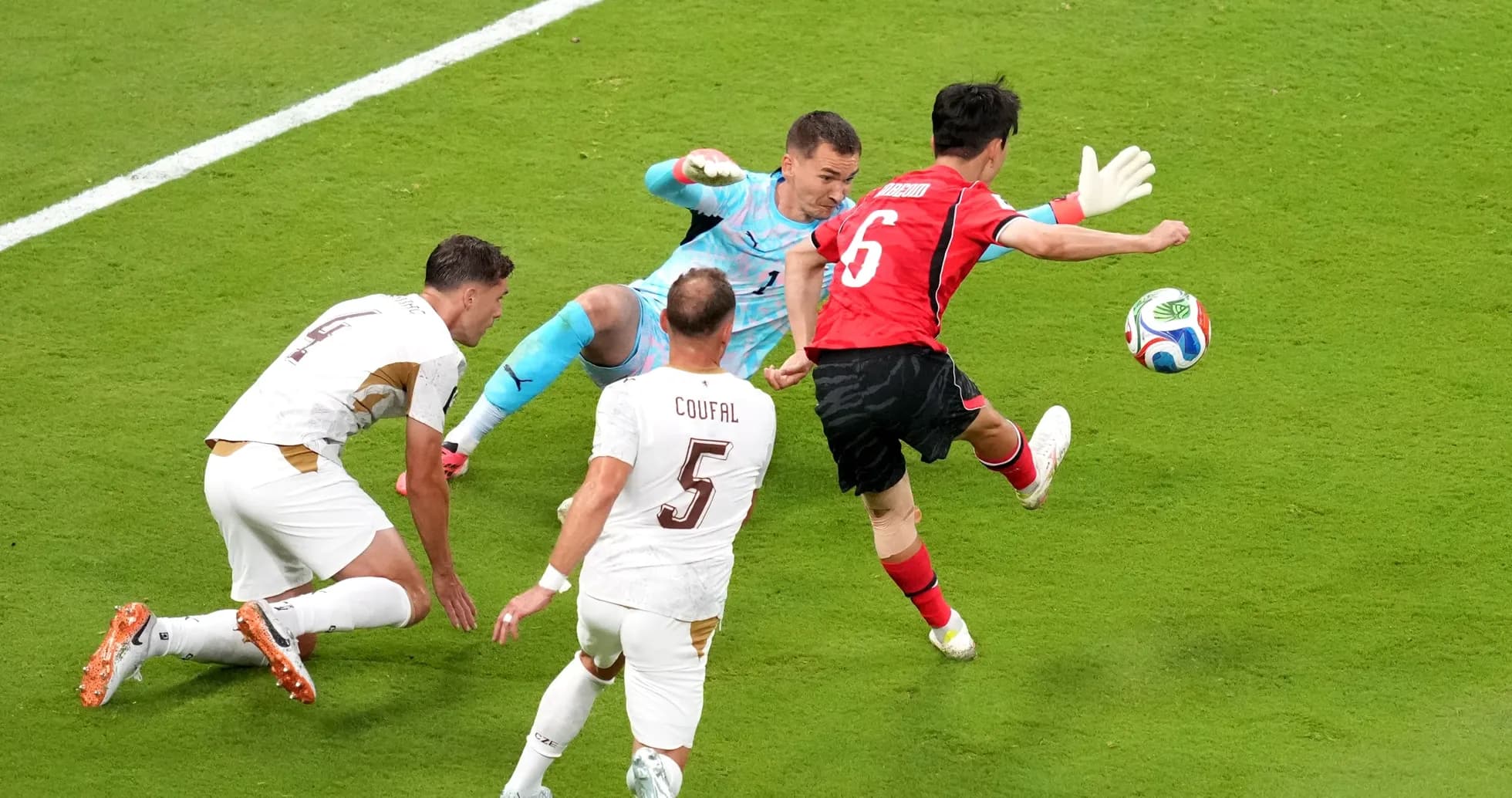
South Korea’s Tactical Victory Over Czechia in World Cup Opener
Under the lights of Estadio Akron, South Korea’s 2–1 victory over Czechia felt less like a routine group opener and more like a tactical statement. In a World Cup Group Stage - 1 clash that finished in regular time, two mirror-image 3-4-2-1 systems collided, but only one emerged with the clarity and control to justify its design.
I. The Big Picture: Structures, Scoreline, Stakes
Following this result, South Korea sit 2nd in Group A with 3 points, a goal difference of +1 and a perfect early record: 1 win from 1, with 2 goals for and 1 against overall. Czechia, by contrast, are 3rd with 0 points, a goal difference of -1 and a form line that reads simply: L.
Both coaches leaned into a back three. Myung-Bo Hong’s 3-4-2-1 for South Korea was built on Kim Min-jae as the central pillar, flanked by Han-Beom Lee and Gi-Hyuk Lee. Wing-backs Young-woo Seol and Lee Tae-seok stretched the pitch, while the double pivot of Hwang In-beom and Seung Ho Paik provided the metronome. Ahead of them, Kang-in Lee and Jae-sung Lee floated behind Son Heung-min, the lone but dangerous spear.
Miroslav Koubek mirrored the shape: Matěj Kovář behind a defensive trio of Štěpán Chaloupek, Robin Hranáč and Ladislav Krejčí. Vladimír Coufal and Jaroslav Zelený offered width from midfield, with Tomáš Souček and Alexandr Sojka inside. Lukáš Provod and Pavel Šulc operated off Patrik Schick, the reference point up front.
The symmetry on paper disguised asymmetry in execution. South Korea, already showing an overall attacking average of 2.0 goals per game, played with a clarity of roles that Czechia’s more rigid structure struggled to match.
II. Tactical Voids: Discipline, Risk and the Cost of Control
In a match without listed injuries or suspensions, the absences were tactical rather than physical. For South Korea, the major “loss” was numerical: Gi-Hyuk Lee’s disciplinary profile loomed over the back line. He emerged from this fixture as a statistical lightning rod, carrying both a yellow and red card in the season’s early data. The card distribution for South Korea is telling: 100.00% of their yellow-card volume so far has arrived in the 91–105 minute range. This suggests a team that plays on the edge late, when fatigue and game management collide.
That late-game volatility is a double-edged sword. On one hand, it reflects a side willing to suffer and scrap to protect a lead, as they did here. On the other, it hints at a potential structural void: when the tempo drops and the game fragments, South Korea can become reactive, inviting pressure and exposing their back three to duels they would rather avoid.
Czechia’s disciplinary record is clean so far: no yellow or red cards across any time range. But that numerical tidiness masks a competitive softness. With no card spikes in any minute band, there is a sense of a team that can be too accommodating between the lines, especially when the opposition’s creative players – like Kang-in Lee and Hwang In-beom – are allowed to dictate.
III. Key Matchups: Hunter vs Shield, Engine Room vs Enforcer
The “Hunter vs Shield” narrative in this match is best captured not by Son Heung-min or Patrik Schick, but by the emerging scoring core in midfield and defense.
For South Korea, Hwang In-beom has become the unlikely hunter. In total this campaign, he has 1 goal and 1 assist, with 3 shots (2 on target) and a stellar 8.9 rating. His 81 passes at 90% accuracy underline his dual role: creator and controller. His presence in the half-spaces, just ahead of Seung Ho Paik, repeatedly forced Czechia’s back three to step out and break their line.
Opposite him stood Ladislav Krejčí, the shield with teeth. In total this campaign, he has 1 goal from 1 shot on target, 43 passes at 72% accuracy, and 3 tackles. As the left-sided centre-back, he was asked to both contain Son’s movements into the channel and step into midfield when Hwang drifted between the lines. That dual responsibility is unsustainable without support; too often, Krejčí was dragged into zones that left space behind him.
The “Engine Room” duel was defined by Hwang In-beom versus Tomáš Souček. Hwang’s line-breaking passing and 2 interceptions gave South Korea verticality and counter-pressing bite. Souček, more accustomed to dominating aerially and screening, found himself in a game of chase rather than control. With Alexandr Sojka alongside him but still bedding into this level, Czechia’s midfield two were outmanoeuvred, their passing lanes to Provod and Šulc repeatedly shut down.
On the flanks, Young-woo Seol and Lee Tae-seok versus Coufal and Zelený was a battle of timing. Kang-in Lee’s data – 37 passes at 100% accuracy, 3 key passes, 6 dribbles attempted with 5 successful – reveals how often he isolated Coufal, turning the right side into a Korean launchpad. Coufal, though credited with 1 assist and 1 key pass in total this campaign, spent long spells pinned back, unable to step forward without leaving Krejčí exposed.
IV. Statistical Prognosis: Trajectories and xG Logic
Even without explicit xG numbers, the patterns are clear. South Korea’s overall record of 2 goals for and 1 against from 1 match, with no failures to score and no clean sheets, paints a profile of a proactive, front-foot side that will always give you chances but almost always create more.
Czechia’s overall numbers – 1 goal for, 2 against from 1 away match – sketch a team that can threaten sporadically but concedes too much for their own good. Their away average of 1.0 goal scored versus 2.0 conceded hints at an xG balance that is likely negative: they are chasing games rather than dictating them.
Following this result, the prognosis is stark. South Korea’s 3-4-2-1, anchored by Kim Min-jae at the back, orchestrated by Hwang In-beom and illuminated by Kang-in Lee, looks sustainably dangerous. With Oh Hyeon-gyu already contributing 1 goal in 28 minutes off the bench, Myung-Bo Hong has a decisive late-game weapon to complement Son’s gravity.
Czechia, by contrast, lean heavily on individuals. Krejčí’s goal threat from the back, Coufal’s crossing, and Schick’s presence are real assets, but they sit atop a structure that currently concedes territory and control in midfield. Without a sharper press or a braver line from Souček and Sojka, they will continue to invite the kind of pressure that South Korea converted into a 2–1 platform and, perhaps, into a deeper run in this World Cup.