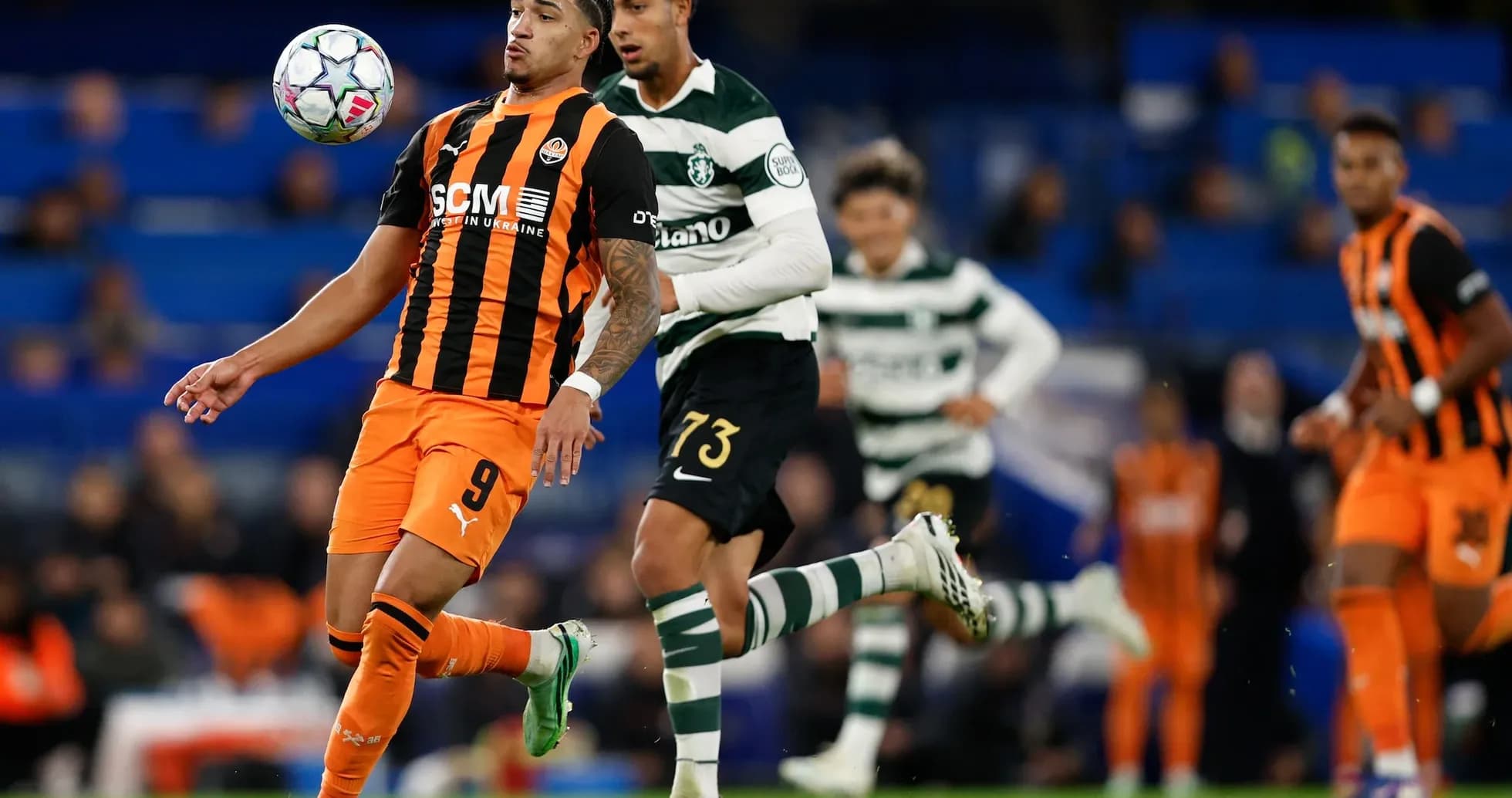
Sporting CP Edges Shakhtar Donetsk 1–0 in Tactical Clash
Under the Stamford Bridge floodlights, this “home” tie for Shakhtar Donetsk unfolded like a tactical chess match that ultimately tilted Sporting CP’s way, 1–0, after 90 minutes that were as much about structure and discipline as they were about flair.
I. The Big Picture – Two Paths Through the League Stage
Heading into this game, the league table told a clear story. Shakhtar arrived ranked 21st in the UEFA Champions League standings with 4 points from 4 matches. Their overall record of 1 win, 1 draw and 2 defeats came with 4 goals scored and 4 conceded, a goal difference of 0 that perfectly captured their fragile balance between promise and vulnerability. At home they had been more assertive: 2 matches, 1 win and 1 loss, with 3 goals for and 2 against.
Sporting CP, by contrast, travelled in with the swagger of a side already shaping the competition. Ranked 10th with 9 points from 4 games, they had won 3 and lost just 1, scoring 8 and conceding 4 overall for a goal difference of +4. On their travels they had been flawless: 2 away matches, 2 wins, 3 goals scored and none conceded. Their season averages underlined the contrast: Shakhtar’s attack produced 1.5 goals per game at home but only 0.5 away, for an overall 1.0, while Sporting’s attack was humming at 2.5 at home and 1.5 on their travels, for 2.0 overall. Defensively, Shakhtar conceded 1.0 goal per match both home and away, while Sporting’s away defence had been perfect with an average of 0.0 goals conceded.
Into that statistical context stepped two very different shapes. A. Turan doubled down on Shakhtar’s season-long identity, rolling out the familiar 4-1-4-1 that has been his most-used setup in Europe. Rui Borges responded with a 3-4-1-2, a nod to Sporting’s tactical flexibility after using three different formations across the campaign.
II. Tactical Voids – Absences and the Edges of the Squad
The absentees list quietly reshaped both squads. For Shakhtar, the loss of Eguinaldo to a shoulder injury removed a direct, vertical option in the final third, while the absence of Marlon through a muscle problem further thinned their defensive depth and ball progression from the back. V. Korniyenko, T. Puzankov, M. Shved and D. Tvardovskyi were all off the roster, narrowing Turan’s rotation options and putting more responsibility on those present.
Most intriguingly, the data listed Pedrinho as missing with a muscle injury, yet a Pedrinho started at left-back. The explanation is likely administrative duplication around different registrations, but in practical terms Shakhtar did have a Pedrinho on the pitch – an aggressive full-back asked to provide width and crossing from the left.
Sporting’s absences were more concentrated but still significant. S. Alexandropoulos was off the roster, while Z. Debast and N. Santos missed out through injury and a knee injury respectively. For a side leaning into a back three, Debast’s absence especially put more weight on Eduardo Quaresma, Eduardo Felicíssimo and Gonçalo Inácio to handle both buildup and Shakhtar’s transitions without their usual depth.
Disciplinary trends added another layer. Shakhtar’s yellow-card profile showed a tendency to pick up cautions in the 31–45 and 46–75 minute windows, with 20.00% of their yellows between 31–45 minutes and a combined 60.00% between 46–75. That hinted at a side that grows increasingly desperate or stretched as halves wear on. Sporting’s bookings were clustered even more sharply: 20.00% between 16–30 minutes and 31–45, but a striking 60.00% in the 61–75 window, suggesting that their intensity spike after the break often skirts the disciplinary edge.
III. Key Matchups – Hunter vs Shield, Engine Room vs Enforcer
The marquee duel was always going to be Sporting’s “hunter” against Shakhtar’s “shield.” Luis Suárez, already one of the competition’s standout forwards, came into the night with 4 goals in 4 appearances. His shot profile – 15 attempts, 7 on target – and a rating of 7.56 reflected a striker who not only finishes but constantly tests goalkeepers. Add 2 penalties scored from 2 taken and you have a high-pressure specialist with no misses from the spot so far.
Opposite him stood D. Riznyk and a Shakhtar back four that had been solid but not impregnable. Overall, Shakhtar had conceded 4 goals in 4 matches, 1.0 per game both at home and away, and had yet to keep a clean sheet in the competition. The 4-1-4-1 placed V. Bondar and M. Matvienko at the heart of the defence, with Vinícius Tobias and Pedrinho as full-backs. The single pivot, E. Nazaryna, was tasked with screening Suárez’s movements between the lines and cutting supply from Sporting’s wing-backs and attacking midfielders.
Behind Suárez, Rui Borges constructed a layered supply chain. Geny Catamo and M. Araújo provided width and running in the line of four, with S. Andersen and Sergi Altimira stabilising central circulation. I. Doumbia, operating closer to the forwards, acted as the bridge – a roaming midfielder who could either overload the half-spaces or press Shakhtar’s first pass out from the back. Alongside Suárez, F. Ioannidis offered a more physical reference point, occupying centre-backs and creating the channels Suárez loves to attack.
In midfield, the “engine room” clash was finely poised. For Shakhtar, Alisson Santana, O. Ocheretko, Marlon Gomes and G. Mendoza formed a four-man band ahead of Nazaryna. Their task was double: compress Sporting’s passing lanes through the centre while still offering enough support to lone forward Kauã Elias. Without a natural second striker or a classic No.10 behind him, Kauã Elias needed those midfielders to arrive from deep, otherwise he risked isolation against Sporting’s back three.
IV. Statistical Prognosis and Tactical Verdict
From a statistical standpoint, Sporting’s away profile always hinted they could edge a tight encounter. On their travels they had scored 1.5 goals per game and conceded 0.0, with 2 clean sheets from 2 away matches. Shakhtar, meanwhile, had failed to score in 2 of their 4 Champions League fixtures overall, and their clean sheet count stood at 0. Their penalty record – 1 taken, 1 scored, no misses – showed composure from the spot, but they rarely generated enough pressure to live there.
The formations reinforced those numbers. Shakhtar’s 4-1-4-1 is designed to be compact and reactive, particularly useful against stronger opposition, but it relies heavily on quick, precise transitions and wide overloads. With key attacking depth missing and Sporting’s back three protected by a hard-working midfield line, the Ukrainian side often found themselves funneled into crowded central zones where Sporting’s athleticism took over.
Sporting’s 3-4-1-2, by contrast, maximised their strengths: dual forwards to pin the Shakhtar centre-backs, wing-backs to stretch the pitch, and a flexible midfield box to outnumber Shakhtar centrally when pressing. Their season-long ability to score in bursts – and to lock games down once ahead – aligned perfectly with Shakhtar’s tendency to collect cards and lose control in the middle third of each half.
In the end, the 1–0 scoreline reflected more than a single decisive moment. It was the logical intersection of Sporting’s superior attacking averages, their flawless away defensive record, and the structural issues in Shakhtar’s lone-striker system under injury pressure. Following this result, Sporting’s campaign continues to look like that of a dark horse with serious knockout ambitions, while Shakhtar are left to ponder how a carefully constructed shape can still be undone when the margins – in personnel, in discipline, in penalty-box quality – all lean the other way.