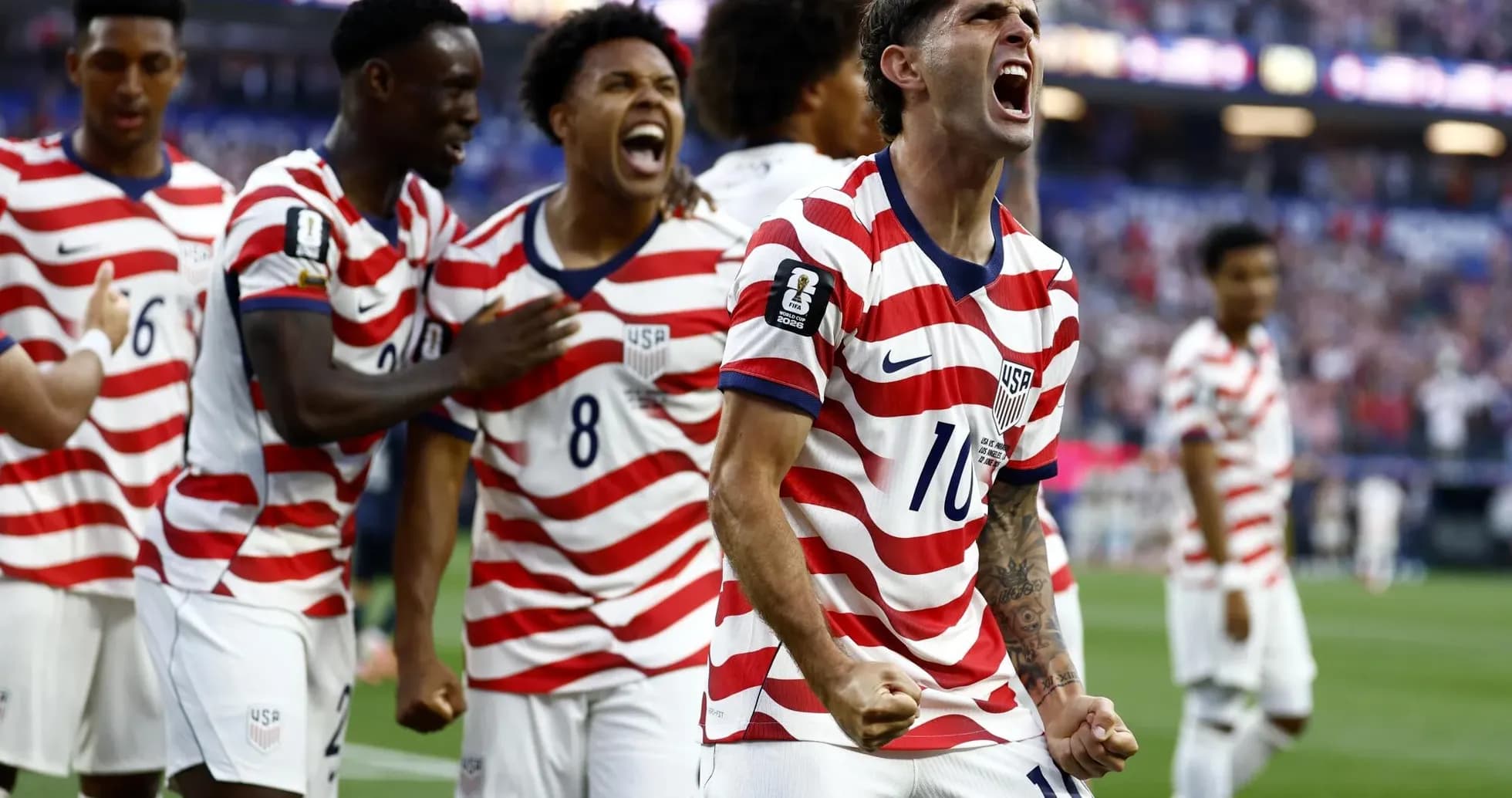
USA Dominates Paraguay 4-1 at SoFi Stadium
USA’s 4-1 win over Paraguay at SoFi Stadium was built on a clear structural superiority and a well-drilled pressing and possession plan. Mauricio Pochettino’s side used a 4-2-3-1 that behaved like a high-possession, high-territory machine, pinning Gustavo Alfaro’s 4-4-2 deep for long stretches. With 65% of the ball, 16 total shots (13 inside the box) and a 3-0 half-time lead, USA converted territorial control into scoreboard dominance, while Paraguay’s late adjustments only produced a single consolation goal.
I. STRUCTURE AND PRESSING
USA’s 4-2-3-1 was defined by a double pivot of Tyler Adams and Malik Tillman, with Weston McKennie and Christian Pulišić stepping high from the line of three behind Folarin Balogun. Out of possession, this often resembled a 4-4-2 press: Balogun and McKennie led the first line, Pulišić dropped to the left and Sergiño Dest to the right, with Adams and Tillman screening central lanes.
The early own goal at 7' from Damián Bobadilla underlined the pressure Paraguay faced trying to play out. USA’s front four consistently locked the ball to one side, forcing rushed clearances or risky central passes. Paraguay’s 320 passes at 72% accuracy, compared to USA’s 596 at 85%, show how often Alfaro’s team were forced into lower-quality circulation.
Paraguay’s 4-4-2 block was initially narrow, with Diego Gómez and Andrés Cubas trying to protect the central corridor ahead of Gustavo Gómez and Omar Alderete. But USA’s fullbacks, Antonee Robinson and Alexander Freeman, pushed high and wide, stretching Paraguay’s wide midfielders Miguel Almirón and Bobadilla. This created constant dilemmas: step out to the fullback and leave the half-space, or stay narrow and concede easy progression down the flanks.
II. BALL PROGRESSION AND CHANCE CREATION
USA’s shot profile is the clearest tactical fingerprint: 16 total shots, 13 inside the box, from an xG of 1.27. The volume and locations suggest sustained occupation of the penalty area, even if the underlying chance quality per shot was moderate.
Progression was built in three main ways:
- Left-side overloads: Pulišić, Robinson, and Tillman repeatedly formed triangles on the left. Pulišić’s assist for Balogun at 31' came from this pattern: USA drew Paraguay’s midfield across, then exploited the channel between fullback and centre-back. The disallowed Balogun goal at 28'—overruled by VAR for offside—came from a similar dynamic, showing how consistently USA were able to find their striker running behind.
- Central third-man runs: With Adams holding and Tillman given more license, McKennie could arrive late into the box. Even when not directly on the scoresheet, his positioning helped pin Paraguay’s back line, creating space for Balogun to receive between the centre-backs. The second Balogun goal at 45+5', assisted by Tillman, encapsulated this: central overload, lay-off, and a decisive finish from inside the area.
- Right-side width and late surges: Dest started high as a nominal right midfielder, but his substitution for Tim Weah at 72' shifted the threat profile. Weah’s direct running widened Paraguay’s tiring block, opening central pockets that Giovanni Reyna later exploited. Reyna’s 90+8' goal, set up by a forward surge and cross from Freeman, was the culmination of USA’s fullback involvement and fresh attacking legs against a stretched defensive unit.
Despite scoring four, USA’s xG of 1.27 indicates a degree of clinical finishing and help from the early own goal rather than relentless creation of top-tier chances. The pattern was more about sustained pressure and box occupation than a flurry of clear one-on-ones.
III. PARAGUAY’S PLAN AND ADJUSTMENTS
Paraguay’s initial 4-4-2 aimed to combine compactness with counter-attacking through Almirón and Julio Enciso. However, with only 9 total shots and just 4 inside the box, they struggled to turn transitions into genuine penalty-area presence. Their xG of 0.51 and a lone shot on goal underline how rarely they broke USA’s structure.
The first-half plan relied heavily on Almirón carrying the ball out of pressure, but USA’s counter-press, led by Adams and McKennie, frequently trapped him near the touchline. Almirón’s yellow card for “Diving” at 53' reflected both his frustration and how isolated he became when attempting to draw fouls to relieve pressure.
Alfaro’s substitutions were a clear tactical pivot. Mauricio replacing Bobadilla at 46' brought more vertical running from midfield, and later changes—Alex Arce for Antonio Sanabria at 62', Ramón Sosa for Almirón at 79', Gustavo Velázquez for Juan Cáceres at 79', and Alejandro Romero for Diego Gómez at 80'—tilted Paraguay toward a more aggressive, risk-taking shape. Mauricio’s goal at 73', assisted by Enciso, came from this more adventurous posture: quicker vertical passing and more numbers committed forward.
However, the cost was structural. As Paraguay pushed, their foul count climbed to 17 and they collected five yellow cards—Cáceres (“Tripping”), Almirón (“Diving”), Diego Gómez (“Holding”), Arce (“Roughing”), and Junior Alonso (“Holding”). The late bookings for Arce at 88' and Alonso at 90+3' captured a side increasingly stretched and forced into reactive defending against USA’s fresh attackers.
IV. DEFENSIVE ORGANISATION AND GOALKEEPERS
Defensively, USA’s key was rest defence: even in sustained attacks, Adams and the centre-backs, Chris Richards and Tim Ream, maintained strong central coverage. Paraguay managed only 1 shot on goal, and while USA committed 13 fouls and picked up a single yellow card (Adams for “Roughing” at 59'), their challenges were mostly in controlled zones, preventing dangerous counters.
In goal, Matthew Freese (USA) faced little direct threat, registering 1 save. The low number of shots on target against him reflects how effectively the outfield structure limited Paraguay to speculative efforts or blocked attempts (Paraguay had 5 blocked shots).
At the other end, Orlando Gill (Paraguay) made 3 saves but conceded four times, with a goals prevented figure of -1.16. That negative mark, combined with USA’s 6 shots on goal, suggests that USA’s finishing and Paraguay’s goalkeeping performance both tilted the scoreline beyond what the xG numbers alone might predict.
V. STATISTICAL VERDICT
The statistical picture reinforces the tactical story:
- Possession: USA 65% – 35% Paraguay
- Shots: USA 16 (6 on goal, 4 blocked) – Paraguay 9 (1 on goal, 5 blocked)
- Passes: USA 596 passes, 508 accurate (85%) – Paraguay 320 passes, 230 accurate (72%)
- Fouls: USA 13 – 17 Paraguay
- Cards: USA 1 yellow – Paraguay 5 yellows
USA’s superior pass volume and accuracy reflect a side comfortable circulating under minimal pressure, using the ball to control tempo and territory. Paraguay’s higher foul and card counts reveal the strain of defending for long stretches and chasing the game after falling behind early.
With USA outperforming their 1.27 xG to score four and Paraguay matching their 0.51 xG with a single goal, the match outcome combined structural dominance, effective pressing, and a decisive edge in both finishing and defensive control.