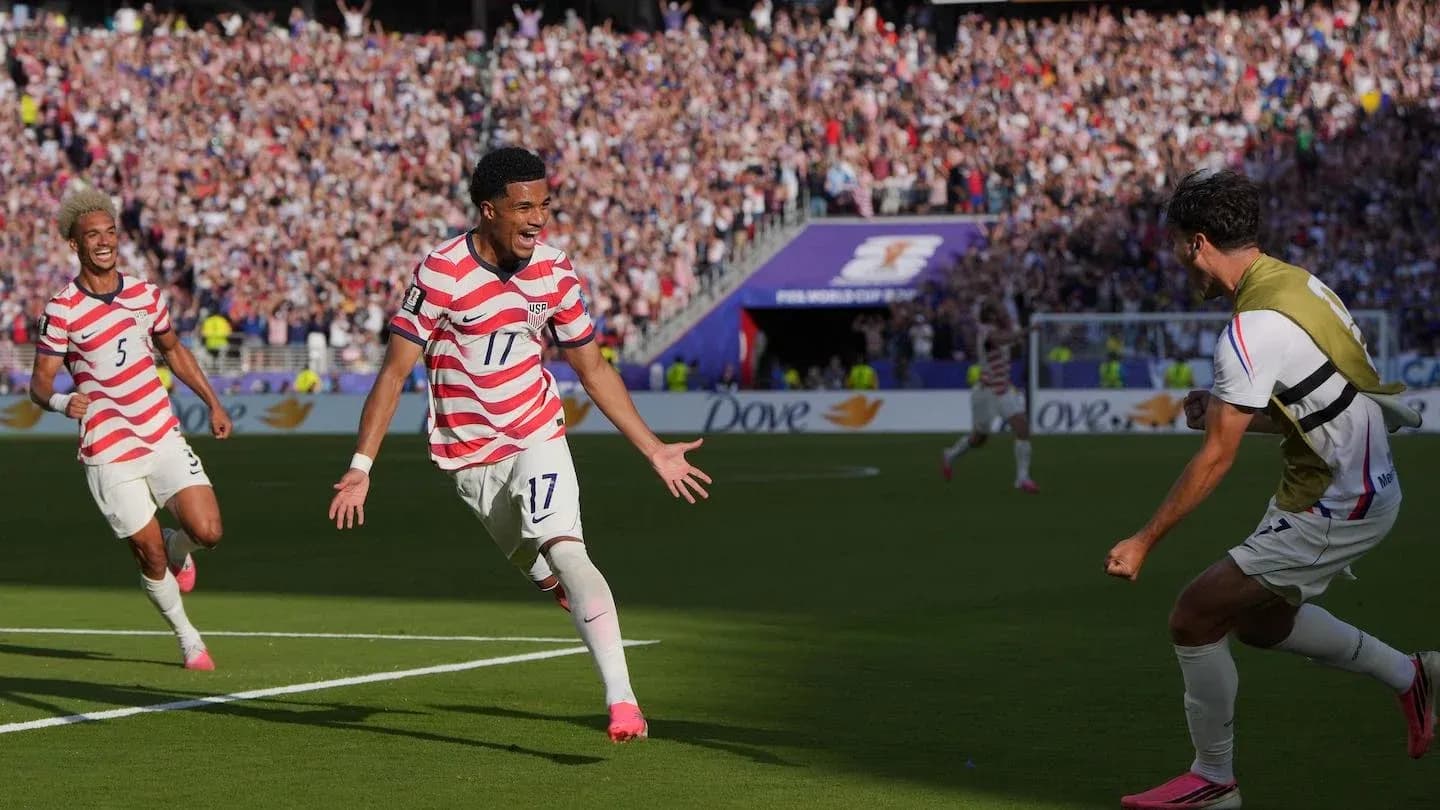
USA Secures 2-0 Victory Over Bosnia & Herzegovina in World Cup Clash
USA’s 2-0 win over Bosnia & Herzegovina at Levi's Stadium in this World Cup Round of 32 tie was defined by structural clarity and superior box efficiency rather than sheer territorial dominance. With USA in a 4-3-3 under Mauricio Pochettino and Bosnia & Herzegovina in Sergej Barbarez’s conservative 5-3-2, the game became a contrast between a proactive, lane-occupying front line and a deeper, more reactive block that never translated its marginal possession edge into genuine threat.
USA’s 4-3-3 was built on a clear positional framework. Matthew Freese (USA) anchored behind a back four of Alexander Freeman, Chris Richards, Tim Ream and Antonee Robinson, with Tyler Adams holding as the single pivot. Weston McKennie and Malik Tillman operated as advanced interiors, frequently staggering their positions to create vertical connections with the front three of Sergiño Dest, Folarin Balogun and Christian Pulišić. This structure aimed to pin Bosnia’s back five and drag their midfield three into lateral shifts.
Bosnia & Herzegovina’s 5-3-2, with Nikola Vasilj in goal behind a line of Amar Dedić, Nikola Katić, Tarik Muharemović, Stjepan Radeljić and Sead Kolašinac, was set up first to deny central progression. In midfield, Armin Gigović, Ivan Šunjić and Kerim Alajbegović formed a compact triangle behind the front pair of Edin Džeko and Ermedin Demirović. The plan was to compress the central corridor and then spring Džeko and Demirović into the channels once possession was won.
First Half
The first half reflected USA’s cleaner attacking mechanisms. Despite having slightly less of the ball (48% to Bosnia’s 52%), USA generated 8 total shots to Bosnia’s 10 but were more purposeful around the box: 6 of USA’s efforts came from inside the area compared to Bosnia’s 5. The breakthrough on 45 minutes, when Folarin Balogun finished for 1-0, was the logical outcome of repeated occupation of the half-spaces and quick combinations that finally unbalanced the Bosnian back five.
Defensively, USA’s back four managed the space behind their full-backs with good horizontal shifting. Richards and Ream were rarely isolated, and Adams’ screening in front of them limited clean entries into zone 14. Bosnia’s 0.25 xG underlines how effectively USA controlled the quality of chances, even if Bosnia managed 10 shots and 3 on target. When called upon, Matthew Freese (USA) made 3 saves, matching Bosnia’s shots on goal total and reinforcing the sense of a well-protected penalty area rather than a keeper under siege.
Bosnia’s 5-3-2 struggled in possession to create overloads in advanced zones. With wing-backs pinned deep by Dest and Pulišić, their first line often became a flat five, leaving the midfield three outnumbered by USA’s trio plus the dropping movements of Balogun and Tillman. The result was sterile control: more passes (446 to USA’s 415) but with a lower attacking yield and a much smaller xG. Their 3 blocked shots point to attempts under pressure rather than crafted, high-quality looks.
Second Half
The second half’s key tactical inflection came at 51 minutes with a triple substitution for Bosnia & Herzegovina. Armin Gigović (OUT) made way for Esmir Bajraktarević (IN), Ivan Šunjić (OUT) for Benjamin Tahirović (IN), and Edin Džeko (OUT) for Ermin Mahmić (IN). These moves signaled a desire for more dynamism and ball-carrying from midfield and fresher legs up front, but the structural issues persisted: USA’s midfield continued to control central spaces, and Bosnia’s possession remained largely in front of the block.
The red card to Folarin Balogun at 64 minutes for a “Serious foul” radically altered the game state. Reduced to ten men and already 1-0 up, USA had to compress their shape. Pochettino’s side responded by tightening distances between the lines, with the wingers working deeper and Adams’ role becoming almost a double-screen with McKennie. Despite the numerical disadvantage, Bosnia could not convert their extra man into penalty-box pressure, a reflection of their limited attacking patterns and USA’s disciplined 4-4-1 out-of-possession adaptation.
Bosnia’s defensive substitutions at 75 minutes — Sead Kolašinac (OUT) for Haris Tabaković (IN) and Nikola Katić (OUT) for Amar Memić (IN) — further reconfigured their back line, but also hinted at a late attempt to add aerial threat and direct presence. Yet the defensive line’s cohesion suffered; as they pushed higher, gaps appeared between the lines. USA exploited this on 82 minutes when Malik Tillman struck for 2-0, a goal that encapsulated USA’s superior efficiency: fewer total shots, but better use of transitional moments and space between Bosnia’s stretched units.
Discipline and duels tilted in USA’s favor in terms of control, even if the card count suggested friction. Bosnia & Herzegovina committed 13 fouls to USA’s 7 and collected a yellow card for Stjepan Radeljić at 80 minutes for “Holding”, along with another yellow shown to coach Sergej Barbarez. The higher foul count was consistent with Bosnia chasing the game and arriving late into challenges as USA managed tempo and transitions.
From a passing perspective, both sides were technically secure — USA completed 346 of 415 passes (83%), Bosnia 364 of 446 (82%). The marginal edge in volume and possession for Bosnia did not translate into penetration because USA’s block was well-organized and their pressing triggers were clear: they engaged most aggressively when the ball moved into the full-back lanes or when Bosnia attempted to play into feet between the lines.
In goal, Nikola Vasilj (Bosnia & Herzegovina) was not credited with any saves, a stark statistical confirmation of USA’s clinical finishing: 2 shots on goal, both converted. The goals prevented metrics underline the story of chance quality and execution: USA produced 0.92 xG and still scored twice, while Bosnia’s meager 0.25 xG reflected speculative efforts more than sustained pressure.
Overall, this was a tactically mature performance from USA: a clear 4-3-3 possession structure, efficient use of half-spaces, and a compact, adaptable defensive block after going down to ten men. Bosnia & Herzegovina’s 5-3-2 never solved the problem of progressing through USA’s midfield, and their numerical advantage after the red card remained largely theoretical, never destabilizing the American defensive architecture.