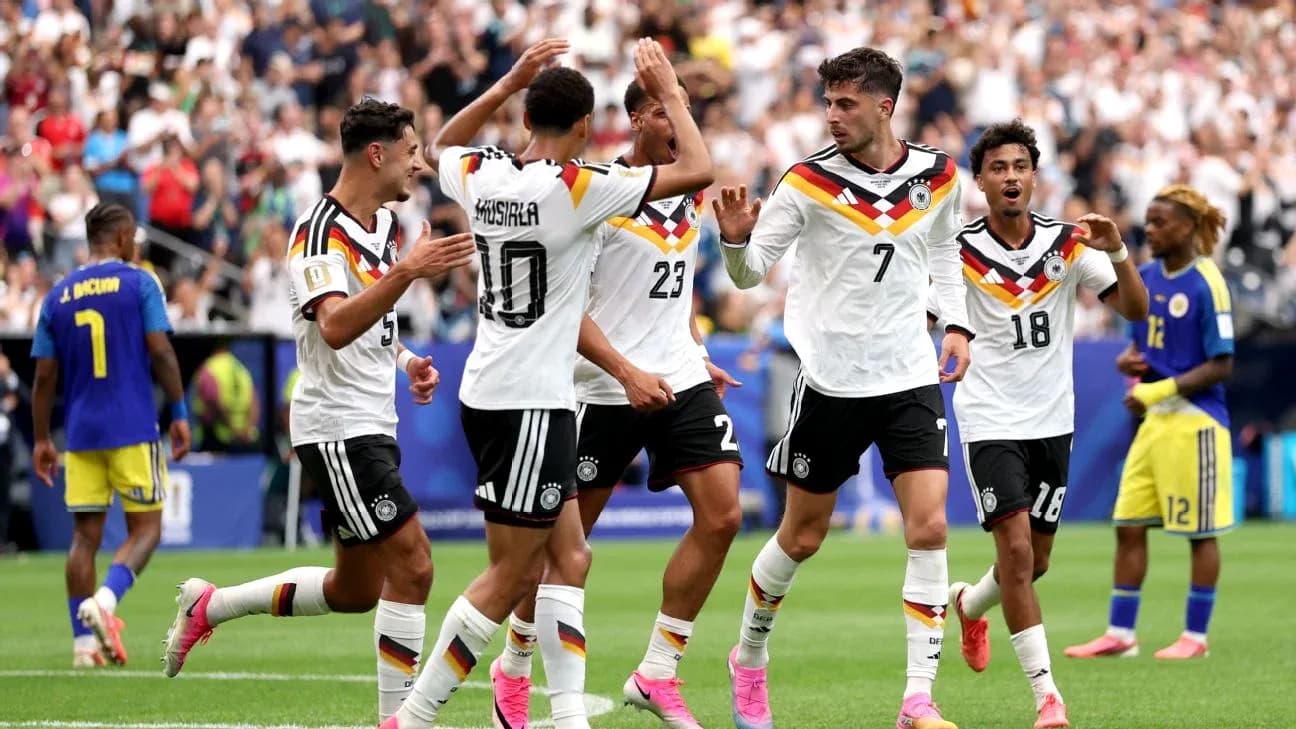
Germany's Tactical Superiority in 7-1 Victory Over Curaçao
Germany’s 7-1 dismantling of Curaçao at NRG Stadium was a tactical rout built on structural superiority, intelligent occupation of the half-spaces, and a relentless high-possession game. Julian Nagelsmann’s 4-2-3-1 functioned as an aggressive, ball-dominant system that pinned Dick Advocaat’s 4-3-1-2 deep and repeatedly exposed its defensive width and cover in transition. With 65% possession, 27 total shots (22 inside the box) and an xG of 3.91, Germany not only controlled the ball but consistently converted territorial dominance into high-quality chances.
Out of possession, Curaçao’s 4-3-1-2 was designed to congest central lanes, with Juninho Bacuna and Leandro Bacuna flanking Livano Comenencia in midfield and Tahith Chong operating ahead of them. In practice, the narrow front two of Jürgen Locadia and Sontje Hansen struggled to screen Germany’s first line of build-up. Joshua Kimmich, nominally the right-back in the back four, repeatedly stepped into midfield to create a 3-2 base in possession alongside Aleksandar Pavlović and Felix Nmecha. This allowed Germany to progress cleanly through the first phase, as Curaçao’s front press lacked the horizontal coverage to close passing lanes into the double pivot and the half-spaces.
Attacking Play
Germany’s positional play in the attacking third was the decisive factor. The 4-2-3-1 morphed into a 2-3-5 when settled: Kimmich advanced high and wide on the right, Nathaniel Brown pushed from left-back to provide width on the opposite side, while Leroy Sané, Jamal Musiala and Florian Wirtz rotated between the lines behind Kai Havertz. The opening goal on 6 minutes from Felix Nmecha, assisted by Wirtz, encapsulated this: Germany found a free man between Curaçao’s midfield and defensive lines, then attacked the box with multiple runners. Curaçao’s narrow midfield three could not track all the late arrivals, and their back four was dragged out of shape by the overloads.
Even Curaçao’s equaliser on 21 minutes through Comenencia did little to alter the tactical pattern. Germany continued to compress the pitch, using counter-pressing after losses to sustain pressure. With 633 total passes and 550 accurate (87%), their circulation was both high-volume and efficient. Curaçao, by contrast, completed 276 of 336 passes (82%) but were largely confined to deeper zones, rarely able to link midfield to attack in sustained fashion; their xG of 0.4 and just 8 total shots (4 inside the box) reflect how rarely they reached dangerous positions.
Set-Pieces
Set-pieces and second phases added another layer of German control. Nico Schlotterbeck’s goal in the 38th minute, assisted by Brown, underlined Germany’s aerial and structural superiority on dead balls. Curaçao’s zonal and hybrid marking lacked aggression on the delivery point and the second ball, and Germany exploited this with well-timed runs from the defensive line. The penalty converted by Havertz at 45+5’ effectively killed the contest before half-time, rewarding Germany’s constant pressure and box occupation.
Second Half Management
The second half showcased Nagelsmann’s in-game management and squad depth. Jamal Musiala’s goal at 47’, assisted by Kimmich, came from a familiar pattern: Kimmich advancing high on the right to deliver from the half-space and Musiala attacking the inside channel against a retreating back line. As legs tired in the Curaçao block, the structural weaknesses became more pronounced. The substitution vector shifted the dynamic further: Deniz Undav (IN) came on for Jamal Musiala (OUT) at 64’, Jeremy Antonisse (IN) came on for Sontje Hansen (OUT) at 46’, Jearl Margaritha (IN) came on for Jürgen Locadia (OUT) at 64’, David Raum (IN) came on for Nathaniel Brown (OUT) at 73’, Antonio Rüdiger (IN) came on for Jonathan Tah (OUT) at 73’, Leon Goretzka (IN) came on for Felix Nmecha (OUT) at 73’, Waldemar Anton (IN) came on for Joshua Kimmich (OUT) at 83’, and Gervane Kastaneer (IN) came on for Tahith Chong (OUT) at 83’.
Undav’s introduction was particularly influential. First, he assisted Brown’s goal in the 68th minute with a combination that again exploited Curaçao’s weak coverage of the wide channels. Then, he scored himself in the 78th minute, again supplied by Kimmich, attacking the space between centre-back and full-back as Germany flooded the final third. By the time Havertz added his second in the 88th minute from an Undav assist, Curaçao’s defensive structure was completely stretched, with the back line forced to defend large spaces and the midfield unable to provide screening.
Overall Analysis
Individually, Germany’s attacking midfielders and full-backs were decisive, but the platform came from their control of tempo and territory. The double pivot of Pavlović and Nmecha balanced progression and protection, allowing the front four to take aggressive positions without leaving Manuel Neuer exposed. Curaçao did create two shots on target, but overall their attacking plan relied on isolated moments rather than sustained patterns, and their front players were often disconnected from the rest of the team.
From a defensive perspective, Germany’s 18 fouls reflect an aggressive counter-press and a willingness to stop transitions early rather than a lack of control. Curaçao committed 11 fouls, often as emergency interventions once Germany had already broken their lines. With 8 corner kicks to Curaçao’s 1, Germany also dominated territorial set-piece situations, constantly resetting pressure in the attacking third.
The statistical verdict underlines the tactical story. Germany’s 65% possession, 27 total shots, 12 shots on goal and 22 attempts inside the box show a side that not only monopolised the ball but repeatedly penetrated into prime scoring areas. Their xG of 3.91 aligns with the volume and quality of chances created, while the final 7 goals illustrate ruthless finishing against a defence that structurally could not cope. Curaçao’s 35% possession, 8 shots and 0.4 xG capture their role as a reactive side, largely pinned back and reliant on sporadic breaks.
Passing profiles further highlight the gap: Germany’s 633 passes, 550 accurate (87%) against Curaçao’s 336 passes, 276 accurate (82%) show how often Nagelsmann’s team could reset and probe, whereas Advocaat’s side were forced into quicker, riskier distributions. The absence of offsides for Germany (0 to Curaçao’s 1) also hints at the precision of their timing and positioning in behind. Overall, the numbers and patterns combine to depict a comprehensive tactical superiority from Germany in every phase of play.